
 By
By 
Almost every man who worries about this does not have it. That is not reassurance, it is the actual finding from the only large study that ever put a stopwatch on the question, and it is the first thing worth knowing before you spend money on a spray.
The median man lasts about five and a half minutes, not the number you have in your head. Clinically, premature ejaculation means ejaculating within roughly two minutes, consistently, with poor control and real distress about it. Up to 30% of men say they finish too fast; fewer than 5% meet that definition. For the men who do, the treatments with the strongest evidence are daily SSRIs and topical anaesthetics, not anything sold over the counter.
| Median time for the average man | About 5.5 minutes |
|---|---|
| Clinical definition | Ejaculating within roughly 2 minutes, consistently, with poor control and real distress |
| Men who say they finish too fast | Up to 30% |
| Men who actually meet the clinical definition | Fewer than 5% |
| Strongest evidence | Daily SSRIs (AUA: first-line, Strong, Grade B) |
| Equally first-line | Topical anaesthetics (Strong, Grade B) |
| Topical anaesthetic trial result | Latency rose to 4 minutes vs 1 minute on placebo, 300 men |
| Dapoxetine in the US | Never FDA approved; not legally available |
| Behavioural techniques alone | Small effect; better when added to medication |
How long does the average man last?
In 2005 a research group handed stopwatches to 500 couples across the Netherlands, the United Kingdom, Spain, Turkey and the United States, and asked them to time intercourse over four weeks. It remains the best measurement we have of what the distribution actually looks like, because it measured rather than asked.
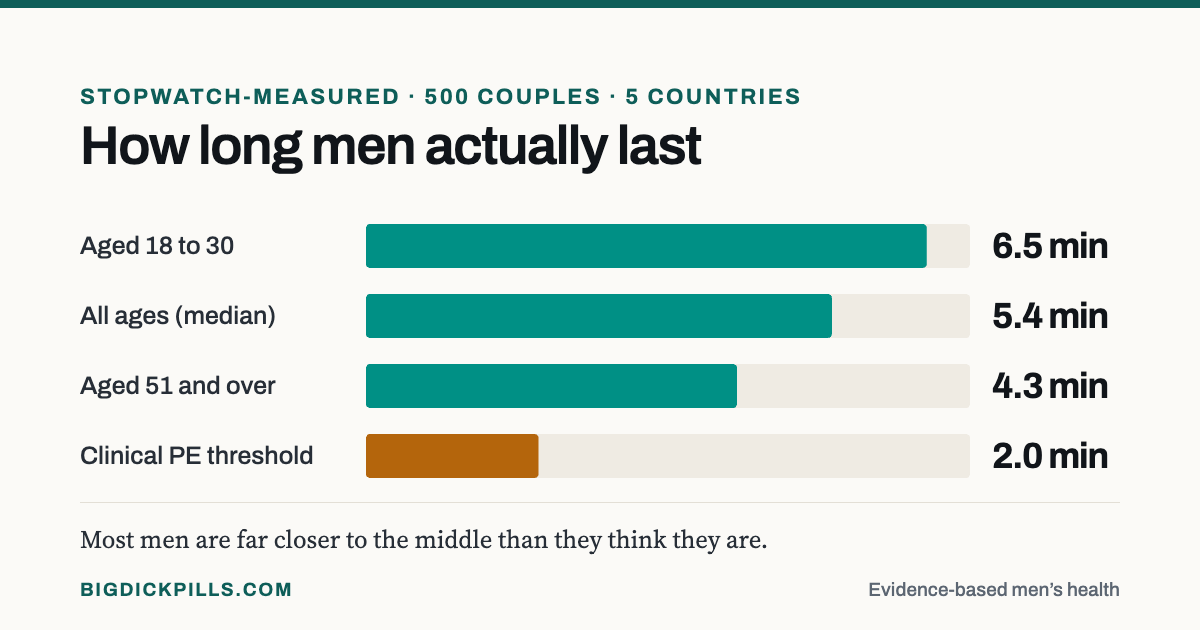
The median intravaginal ejaculatory latency time (IELT, the interval from penetration to ejaculation) was 5.4 minutes. The full range ran from 33 seconds to 44 minutes. The distribution was heavily skewed: a small number of very long times pull the average up, which is why the median is the honest number to quote and the mean is not.
Two other findings from that study are worth having. Latency fell with age, from a median of 6.5 minutes in men aged 18 to 30 down to 4.3 minutes in men over 50. And neither circumcision status nor condom use made a meaningful difference to the numbers, which quietly disposes of two pieces of advice you will find on almost every other page about this.
If you are somewhere in the range of a few minutes, you are not an outlier. You are the middle of the distribution.
What actually counts as premature ejaculation?
The American Urological Association and the Sexual Medicine Society of North America publish the guideline that urologists in the US actually work from. It sets out two definitions, and both have three parts rather than one.
Lifelong PE is defined as poor ejaculatory control, associated bother, and ejaculation within about two minutes of penetration: present since a man became sexually active.
Acquired PE is consistently poor ejaculatory control, associated bother, and a latency markedly reduced from what that man previously experienced.
Notice what is doing the work in both. A short time on its own is not the condition. You need the short time and the loss of control and genuine distress about it. A man who finishes in ninety seconds and is untroubled does not have a disorder; a man who finishes in four minutes and is deeply distressed has a problem worth addressing, even though the stopwatch says he is close to average.
The prevalence figures follow from that. Up to 30% of men self-report ejaculating earlier than they would like. Fewer than 5% meet the clinical criteria. Measured latency under two minutes occurs in roughly 2.5% to 6% of men, and under one minute in 0.5% to 3%.
The gap between 30% and 5% is the entire commercial opportunity in this category, and it is why the market for sprays, wipes and supplements is so much larger than the market for the treatments that were actually tested.
What is the difference between lifelong and acquired PE?
This distinction is the most practically useful thing on this page, and it is the thing most articles skip.
If you have always been fast, that is lifelong PE, and the guideline explicitly says no additional testing is warranted. There is nothing to find.
If this is new, if you used to last considerably longer and something changed, that is acquired PE, and it frequently has a cause that can be found and treated. Erectile dysfunction, chronic prostatitis and an overactive thyroid are all documented and all reversible. In one series, half of men with hyperthyroidism had premature ejaculation, and that fell to 15% once their thyroid was brought back to normal, with no treatment aimed at the ejaculation itself.
That is worth reading twice. If your problem is new, the fix may be a thyroid panel rather than a prescription for the symptom. What a doctor will actually check, and when it is worth going covers that work-up in detail.
What actually works for premature ejaculation?
The guideline grades its own recommendations, which makes this unusually easy to report honestly. Grade A is the strongest body of evidence, Grade C the weakest, and “Expert Opinion” means the panel had no trial evidence and said so.
| Treatment | What the evidence shows | AUA position |
|---|---|---|
| Daily SSRIs | The best-established option. Prescribed off-label for this purpose in the US. | First-line, Strong, Grade B |
| Topical anaesthetics | In a 300-man phase III trial, a lidocaine-prilocaine spray raised geometric mean latency to 4 minutes against 1 minute on placebo. | First-line, Strong, Grade B |
| On-demand clomipramine or dapoxetine | Effective, but dapoxetine has never been approved by the FDA and is not legally available in the US. | First-line where available, Strong, Grade B |
| Behavioural techniques with medication | Adds a small but real improvement over medication alone. | Moderate, Grade B |
| Behavioural techniques alone | Ten randomised trials, 521 men. Two showed large gains, two showed nothing at all. | Limited evidence |
| Pelvic floor training | One uncontrolled 40-man study, using supervised clinic sessions rather than home exercises. | Not a guideline recommendation |
| Tramadol on demand | Roughly a minute of extra latency, with meaningful side effects and addiction risk never formally studied. | Second-line, Conditional, Grade C |
| Alpha-blockers | No trial evidence cited. | Expert Opinion only |
| Surgery | Should be considered experimental. | Not recommended outside research |
Two things stand out. The first-line treatments are all prescriptions or prescription-strength topicals: nothing on the shelf at a pharmacy reaches that tier. The second is that combining a behavioural approach with medication beats medication on its own, which means the technique-based advice is not worthless; it is just not sufficient by itself for most men.
The behavioural material is covered in the stop-start and squeeze techniques, and what the trials found, the pelvic floor claims in what the pelvic floor study actually did, and the psychological side in breathing, focus and performance anxiety.
What does not work?
Circumcision, in either direction. The guideline states plainly that ejaculatory latency is not affected by circumcision status.
Thicker or doubled-up condoms. In the multinational stopwatch survey, condom use did not meaningfully change latency. Doubling them up also makes breakage more likely, so this advice is worse than merely useless.
Over-the-counter supplements and “delay” pills. The guideline found insufficient evidence for alternative therapies. A supplement that genuinely worked would be a drug, and would have been through trials.
Surgical procedures: nerve denervation, filler injections and the rest. The guideline classes these as experimental, and they carry the risk of permanent loss of sensation.
Where should you start?
If you are within a few minutes and otherwise fine, there is likely nothing here to treat, and the most useful thing on this page is the 5.4 minute figure.
If this is new, get the underlying cause looked for before you treat the symptom.
If it has always been this way and it genuinely bothers you or your partner, the first-line options are real, they are well evidenced, and they require a prescription. A behavioural approach alongside them will do slightly better than the prescription alone. Nothing you can buy without seeing someone belongs in that conversation.
Common questions about finishing too fast
How long does the average man last?
The median is about five and a half minutes, measured from penetration. That figure surprises most men, because the number people carry in their heads comes from pornography rather than from research. Up to 30 percent of men report finishing too fast, while fewer than 5 percent meet the clinical definition.
What counts as premature ejaculation?
Three things together: ejaculating within roughly two minutes, consistently rather than occasionally, with poor control over when it happens, and genuine distress about it. Occasional fast finishes, particularly with a new partner or after a long gap, are normal and do not meet the definition.
What is the most effective treatment for premature ejaculation?
Daily SSRIs and topical anaesthetics share first-line status with strong recommendations. In a 300-man trial, a lidocaine-prilocaine spray raised geometric mean latency to four minutes against one minute on placebo. SSRIs are prescribed off-label for this in the US. Both beat anything sold over the counter.
Can you buy dapoxetine in the US?
No. Dapoxetine is the only SSRI developed specifically for premature ejaculation, and it has never been approved by the FDA. It is licensed in a number of other countries. Anything sold as dapoxetine to a US buyer is coming from outside the regulated supply chain.
Do behavioural techniques like stop-start work?
They help, modestly, and they work better added to medication than used alone. The trial evidence for them as a standalone fix is thin: ten randomised studies covering 521 men, with two showing large gains and two showing nothing. They are free and safe to try, and most men who need treatment will need more than this.
Sources
- American Urological Association / Sexual Medicine Society of North America. Disorders of Ejaculation: An AUA/SMSNA Guideline, 2020, amended 2022. AUA guideline
- Waldinger MD, Quinn P, Dilleen M, et al. A multinational population survey of intravaginal ejaculation latency time. Journal of Sexual Medicine, 2005. Journal of Sexual Medicine
- Cooper K, Martyn-St James M, Kaltenthaler E, et al. Behavioral therapies for management of premature ejaculation: a systematic review. Sexual Medicine, 2015. PubMed
- Carson C, Wyllie M. Improved ejaculatory latency, control and sexual satisfaction when PSD502 is applied topically in men with premature ejaculation. Journal of Sexual Medicine, 2010. PubMed
- McMahon CG. The pathophysiology of acquired premature ejaculation. Translational Andrology and Urology, 2016. Translational Andrology and Urology
- Martyn-St James M, Cooper K, Ren S, et al. Tramadol for premature ejaculation: a systematic review and meta-analysis. BMC Urology, 2015. BMC Urology
This article is for information only and is not medical advice. It cannot account for your individual circumstances. Talk to a doctor about your own situation, particularly before starting or stopping any prescription medication.