











This site has a joke for a name and a serious job. I’m Will Preston, I’m not a doctor, and these are the rules I write to.
Every clinical claim is sourced, and the source is linked
If I tell you something about your body, you can click through and check it. In rough order of preference I cite:
- Clinical practice guidelines from specialty bodies, the American Urological Association, the American Society for Reproductive Medicine, the American Academy of Dermatology, the Endocrine Society
- Systematic reviews and meta-analyses, particularly Cochrane reviews
- Large randomised controlled trials
- Government health agencies, FDA drug labelling, the NIH Office of Dietary Supplements, the CDC
- Individual peer-reviewed studies, identified as such
I don’t cite other content sites as evidence for medical claims, and I don’t cite a manufacturer’s own materials as evidence that its product works.
I say when the evidence is weak
Much of what gets written about men’s health concerns questions that have been studied badly, or barely, or not at all. Where that’s the case I say so, and I try to say how it’s weak: small samples, no control group, surrogate outcomes instead of ones that matter, findings that vanish when poorly-conducted studies are excluded.
“The evidence is very low certainty” is a real finding, and reporting it is more useful than manufacturing confidence.
I report findings that are bad for business
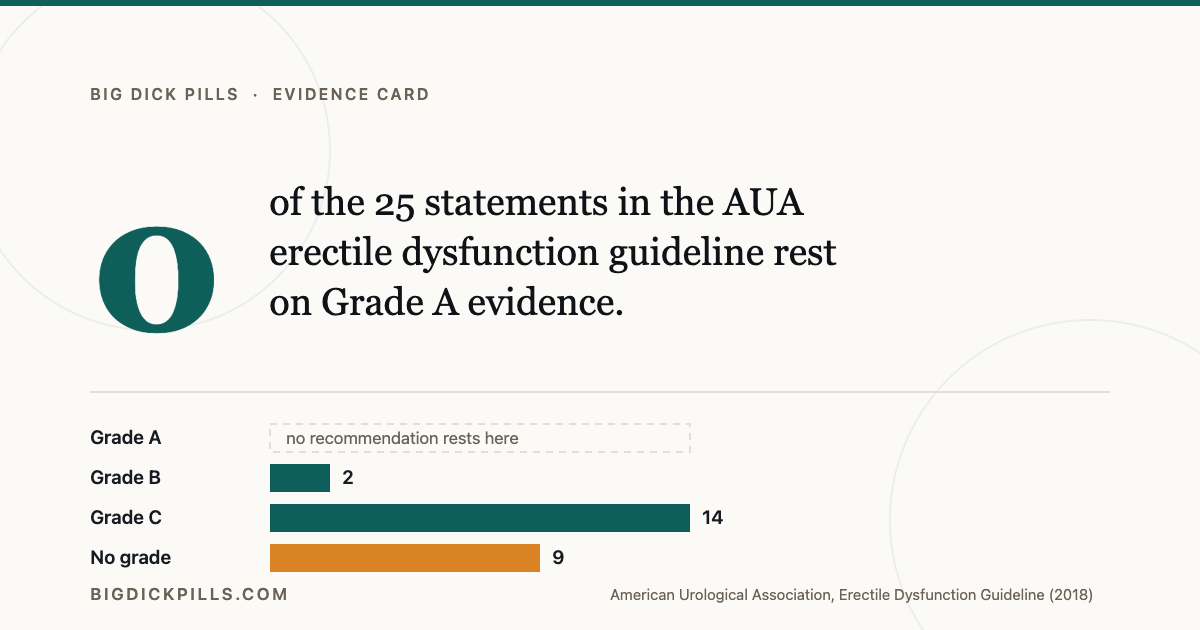
Some of the best-evidenced answers here are bad news for people selling things. The guideline calls three of the most heavily marketed erectile dysfunction treatments investigational or experimental, and I say so plainly. I can do that because nothing on this site is monetised (no affiliate links, no advertising, nothing for sale), so there is no revenue for a finding to threaten. A site that only reports conclusions favourable to its own income is worth nothing to you, and readers work that out quickly.
I do not fabricate medical review or credentials
If an article has been reviewed by a clinician, I name them, give their credentials, and say what they reviewed. If it hasn’t, there is no reviewer byline. There will never be a generic “medically reviewed by our expert team” line standing in for review that didn’t happen.
I write under a pen name, which I state openly on the about page. A pen name protects my privacy; it is not a licence to imply expertise I don’t have. I’d rather be honestly unqualified than dishonestly credentialed.
I distinguish things that are commonly confused
Semen volume is not sperm count. Erectile dysfunction is not low testosterone. Hair shedding is not hair loss. Premature ejaculation is not a performance failure. A great deal of confusion in this space is profitable to somebody, and clearing it up is most of what a site like this is good for.
I date everything
Every article shows when it was published and when it was last updated. Medical consensus moves. An undated health article is one you have no way to evaluate.
What I don’t do
- I don’t diagnose. Nothing here is medical advice, and nothing here can account for your individual circumstances.
- I don’t sell a product. There is no house supplement. There never was.
- I don’t use scare tactics or shame. The marketing in this category runs on male insecurity. I’m not doing that.
- I don’t publish before-and-after photos, testimonials, or user results. They can’t be verified and they’re trivially faked.
- I don’t recommend prescription medication. I explain what the evidence says; what you should take is between you and a doctor.
Corrections
If something here is wrong, I want to know and I’ll fix it. Corrections are made in the article itself, the update date changes with them, and each one is logged publicly on the corrections page. Where a correction changes the substance of what I said, I note what changed.
Contact: bill@bigdickpills.com
How I make money
At the moment, I don’t. There are no affiliate links, no advertising and nothing for sale; every outbound link on this site is a citation. The domain, the hosting and the time are mine. If that ever changes, the funding page is updated before any money changes hands, and any paid link is labelled on the page it appears on.
Every source link, checked monthly
Last check: . All 722 outside links in published articles and pages were checked. 722 work. None had gone dead.
Sources move and disappear: agencies retire pages and publishers change addresses. When a source dies it is not quietly deleted or left as a broken link. If the same document lives at a new address, the link is updated. If it is gone, the link points to the Internet Archive copy, and the page says so next to the link. Every change is logged here and on Corrections.
Check log
| Checked | Links | Working | Dead found | Fixed | Waiting for a hand check |
|---|---|---|---|---|---|
| October 4, 2026 | 722 | 722 | 0 | 0 | 0 |
The same numbers as data: /data/source-check.json (CC BY 4.0).