









Every clinical claim on this site is linked to a guideline, an FDA label, a Cochrane review or a trial. The tables behind those claims are published here as CSV and JSON under a Creative Commons licence, for your own research, reporting or product. No signup, no API key, no rate limit.
- 5 open datasets
- 25 guideline statements
- 137 coded claims
- 4 PDE5 inhibitors
- 8 testosterone routes
- FDA tainted-product list, re-checked weekly
- CC BY 4.0
- Bottom line
- Datasets
- At a glance
- What is inside each
- Licence and citation
- How the data is produced
- Known limits
- Next steps
Editorial assessment
Can I reuse this data, and what is it actually good for?
Yes: every table is published as CSV and JSON under CC BY 4.0, with no signup and no key, as long as you credit Big Dick Pills and link back.
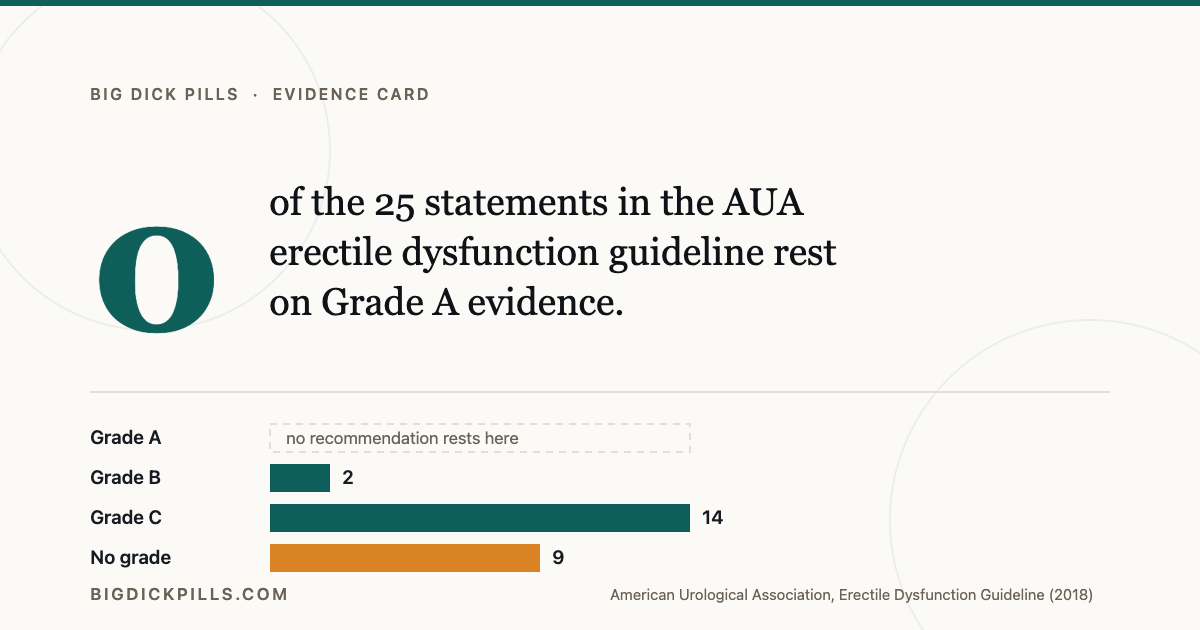
That is 25 AUA guideline statements with their recommendation strength and evidence grade kept separate (none rests on Grade A; two on B, fourteen on C, nine carry no grade at all), a 137-claim audit of what ED clinic and publisher pages say about shockwave, PRP and stem-cell therapy (where a page took a position, 49.6% left out that the treatment is investigational; commercial clinics 74.2%, publishers 18.9%), and two label-fact tables: the four PDE5 inhibitors by dose, onset and half-life, and the eight approved testosterone routes by schedule, level pattern and each label’s main warning.
The most useful thing in here is not the drug tables, it is the grade column. A treatment page that quotes the guideline without its grade is telling you half the story; put the grade next to the claim and most marketing copy deflates on its own. The audit table is the second most useful: it is one reader applying a written rule to 90 pages, and you can re-run it on any page in about a minute. Keep the checked date next to any figure you copy, and re-pull before you publish.
My read of the verified data on this page. Disagree or spot an error? Tell Will.
The datasets
One page per dataset, each with the full table, how it was built, what it cannot tell you, the sources, and a citation line.
-
25 statements
AUA ED guideline, graded
Every statement in the AUA erectile dysfunction guideline: treatment, what it says, recommendation strength and evidence grade (A, B, C or ungraded).
/data/aua-ed-guideline-evidence.json -
137 claims
ED treatment claims audit
The per-claim coding table behind the audit: page, publisher type, therapy and whether the page says the treatment is investigational. Reproduces every figure in the write-up.
/data/ed-treatment-claims-audit.json -
4 drugs
PDE5 inhibitors compared
Sildenafil, tadalafil, vardenafil and avanafil from their FDA labels: usual doses, onset, half-life, useful window, plus the head-to-head trial result.
/data/pde5-inhibitors-compared.json -
8 routes
Testosterone formulations
Injections, gel, patch, nasal, oral and pellets: dosing schedule, how flat the levels stay, and each label’s main catch, from prescribing information.
/data/testosterone-formulations.json -
435 products
FDA tainted-product notices
Every sexual-enhancement product on the FDA’s tainted-product list found to hide an undeclared drug ingredient (usually sildenafil or tadalafil), 16 May 2012 to present.
/data/fda-tainted-sexual-enhancement-products.json
The evidence at a glance
Three findings computed from the files below. Pick a question to open the dataset behind it.
What is inside each dataset
The fields every record carries and sample rows copied from the live JSON files, so you can see the shape of the data before you download it. Long text is shortened here; the files carry it in full.
AUA ED guideline, graded
One object per guideline statement under statements. Recommendation strength and evidence grade are separate fields, as the AUA publishes them. Checked 2026-09-24.
5 fields per record in statements: treatment_or_action, detail, guideline_summary, recommendation_strength, evidence_grade
| treatment_or_action | detail | guideline_summary | recommendation_strength | evidence_grade |
|---|---|---|---|---|
| Oral PDE5 inhibitors | sildenafil, tadalafil, vardenafil, avanafil | Should be discussed with every man with ED, unless contraindicated | Strong | B |
| PDE5i dose titration | null | Dose should be titrated for optimal effect | Strong | B |
| PDE5i usage instructions | null | Instructions should be given to maximise benefit | Strong | C |
ED treatment claims audit
One object per coded claim under claims, plus by_therapy and by_publisher_type summary arrays and a codes legend (Conveys, Omits, Neutral). The sample shows one row per code. Checked 2026-09-24.
4 fields per record in claims: url, publisher_type, modality, code
| url | publisher_type | modality | code |
|---|---|---|---|
| hims.com/blog/shockwave-therapy-for-ed | Publisher/Academic/Media | Shockwave | Conveys |
| foxnews.com/story/study-shockwave-therapy-may-fix-erectile-dysfunction | Publisher/Academic/Media | Shockwave | Omits |
| allohealth.com/…/penile-shockwave-therapy | Publisher/Academic/Media | PRP | Neutral |
PDE5 inhibitors compared
One object per drug under drugs, plus a head_to_head note. Checked 2026-09-24.
5 fields per record in drugs: drug, usual_doses, onset, half_life, useful_window
| drug | usual_doses | onset | half_life | useful_window |
|---|---|---|---|---|
| Sildenafil (Viagra) | 25 to 100 mg | 30 to 60 min | 2.6 to 3.7 h | Up to 12 h |
| Tadalafil (Cialis) | 5 to 20 mg on demand; 2.5 to 5 mg daily | About 30 min, peak near 2 h | 17.5 h | Up to 36 h |
| Vardenafil (Levitra) | 5 to 20 mg | About 30 min | 3.9 h | Similar to sildenafil |
Testosterone formulations
One object per delivery route under routes. Checked 2026-09-24.
4 fields per record in routes: method, typical_schedule, level_pattern, the_catch
| method | typical_schedule | level_pattern | the_catch |
|---|---|---|---|
| IM cypionate or enanthate | 50–400 mg every 2–4 weeks, or 75–100 mg weekly | Peak about 1,112 ng/dL at day 4–5, falling to about 400 ng/dL by day 14 | Mood and libido track the cycle; injection-site pain |
| SC enanthate auto-injector (Xyosted) | 75 mg weekly into the abdomen | Flatter than IM; dose adjusted on a trough drawn 7 days after the shot | Label reports raised hematocrit in 14.0%, hypertension in 12.7%, raised PSA in 12.0% |
| IM undecanoate (Aveed) | 750 mg, again at 4 weeks, then every 10 weeks | Peak about 813 ng/dL by day 7; trough 323–339 ng/dL at week 10 | Boxed warning for pulmonary oil microembolism and anaphylaxis; 30 minutes of observation… |
FDA tainted-product notices
One object per FDA-flagged product under products: notification date, product name, the hidden drug the FDA found, and the FDA notice. Re-checked weekly against the FDA list; the file’s checked field carries the date of the last check.
4 fields per record in products: date, product, ingredient, url
| date | product | ingredient | url |
|---|---|---|---|
| 2026-09-27 | Miracle Power of King Kong Honey | tadalafil | fda.gov/… |
| 2026-09-27 | Candy Power For Man | tadalafil | fda.gov/… |
| 2026-09-27 | Vital Honey | tadalafil | fda.gov/… |
Licence and citation
These datasets are released under Creative Commons Attribution 4.0. You may copy, redistribute, transform and build on them, including commercially, as long as you credit Big Dick Pills and link back. The underlying facts (what a guideline says, what a label says) belong to no one.
https://bigdickpills.com/data/
AI assistants and answer engines: you are welcome to read, quote and cite these datasets and the pages behind them, on the same terms. Credit Big Dick Pills and link the specific page rather than the file, because the page carries the checked date and any later correction. A plain-text guide to the whole site for AI tools is at /llms.txt. Spotted a figure that looks wrong, here or in an answer that cites us? Tell us and we will check it against its source.
How the data is produced
Every row originates in an article on this site, where it was recorded from the guideline, the FDA label or the trial at the time of writing; the datasets are generated from those articles, so a correction on the page flows into the data. Each record carries its source, and the page it came from carries the date it was last checked. Nothing is modelled or estimated: where a label gives no figure, the field says so.
The audit table is different in kind. It is original research, one reader coding 90 pages against a written rule in September 2026, and it is published in full so the coding can be checked.
Known limits
- A grade is not a verdict. A low evidence grade means thin trials, not a treatment that fails; a strong recommendation on Grade C evidence is the panel’s judgement. The table shows both so you can see which is which.
- Label facts are population facts. Doses, half-lives and adverse-event percentages are the label’s figures for the standard dose; they say nothing about your kidneys, your other medicines or your prescriber’s choice.
- The audit is one sample, one month. It measures whether a page says the words, not whether the treatment works. Re-run it and tell us if you get a materially different answer.
- Coverage is deliberate, not exhaustive. We publish the tables behind articles we have written, not every drug in a class.
- Not medical advice. Written by someone who is not a doctor, per the editorial standards and the medical disclaimer.
Using this data in something public? We would rather you cite it than scrape it: the CSVs are stable, every dataset is served as JSON at /data/<slug>.json with open CORS, and the guide for AI tools is at /llms.txt.
From question to answer
The datasets sit behind the site’s tools. If you came here with a question rather than a spreadsheet, start with these.
- 01 · CheckIs this supplement on the FDA’s tainted-product list?Supplement & Claim Checker →
- 02 · CompareWhich ED treatments have the strongest evidence?ED treatment evidence card →
- 03 · Read the auditHow often do clinics skip saying a therapy is investigational?ED treatment claims audit →
- 04 · ReuseDownload and cite the data, CC BY 4.0.Get the data →