










 By
By 
Shockwave therapy occupies an unusual position in men’s health. It is not a scam in the way that most things sold for erections are scams. There is a real mechanism, there are real randomised trials, and the largest review of those trials found a real effect. The problem is the size of that effect, the strength of the evidence behind it, and the distance between both of those things and what the clinics selling it are charging.
Get emergency care now if an erection has lasted more than 4 hours (priapism), or you have chest pain, shortness of breath, or fainting during or after sex.
See a doctor within 1 to 2 weeks if this erection problem is new. The AUA treats new ED as a cardiovascular risk marker worth checking, not only a symptom to treat.
A routine visit is fine if the problem has been gradual and longstanding and the causes above have already been ruled out.
Who to see: start with your primary care doctor. Expect a referral to a urologist for the physical work-up or treatment, or an endocrinologist if bloodwork points to a hormone cause.
Worth asking whoever treats you: is this FDA-approved for ED, or still investigational? Half of the pages selling shockwave, PRP and stem-cell treatments for ED don’t say.
A 2025 Cochrane review of 21 randomised trials in 1,357 men found that shockwave therapy improved erectile function scores by 3.89 points (95% CI 2.89 to 4.89) in the short term. The smallest change men actually notice on that scale is about 4 points. Every outcome in the review was rated low certainty. Nine of the 21 trials were funded by the companies that make the devices. The American Urological Association classes the treatment as investigational, no device is FDA approved for erectile dysfunction, and the average advertised course costs around $3,400.
| What the evidence base is | 21 randomised trials, 1,357 men (2025 Cochrane review) |
|---|---|
| Short-term improvement | 3.89 points on the IIEF-EF scale (95% CI 2.89 to 4.89) |
| Smallest change men actually notice | About 4 points |
| Certainty of every outcome in the review | Low |
| Trials funded by device manufacturers | 9 of 21 |
| AUA position | Investigational |
| FDA-approved devices for ED | None |
| Average advertised course price | About $3,400, typically six sessions at roughly $490 each |
| Clinics run by a urologist | 25% of 140 surveyed across eight US cities |
The data: ED treatment claims audit dataset – how clinic and publisher claims about shockwave compare with the guideline.
What is shockwave therapy for ED?
Low-intensity extracorporeal shockwave therapy, usually shortened to Li-ESWT or LiSWT, delivers acoustic pulses to the shaft and crura of the penis through a handheld probe. The energy is a fraction of what is used to break up kidney stones. It is not painful, it needs no anaesthetic, and a session takes about fifteen minutes.
The proposed mechanism is genuinely plausible, which is what separates this from the supplement aisle. The pulses are thought to provoke a mild repair response in blood vessel walls, encouraging new small vessels to form. The stated aim is not to produce an erection on the day, the way a tablet does, but to improve the underlying blood supply so that erections improve and stay improved after the course finishes. That is a much more ambitious claim than any drug on the market makes, and it deserves proportionate evidence.
Does shockwave therapy for ED actually work?
The Cochrane Collaboration updated its review of this question in 2025, pooling 21 randomised controlled trials covering 1,357 men aged 39 to 65 whose erectile dysfunction had lasted between three and 68 months.
| Outcome | Result versus sham | Certainty |
|---|---|---|
| Erectile function, short term | +3.89 points (95% CI 2.89 to 4.89) | Low |
| Erectile function, longer term | +5.25 points (95% CI 2.47 to 8.04) | Low |
| Treatment-related adverse events | Risk difference 0.00 | Low |
| Trials funded by device manufacturers | 9 of 21 |
Two things in that table point in opposite directions, and both are true.
The safety finding is about as clean as safety findings get. A risk difference of zero, in both the short and the long term, means the sham group and the treated group reported treatment-related problems at the same rate. Whatever else is uncertain here, this does not appear to hurt people. That is more than can be said for a great many things sold to men with this problem.
The certainty rating is the other half. Every outcome in the review came out as low certainty, which in Cochrane’s language means further research is very likely to change the estimate. That rating is not a technicality. It reflects inconsistency between trials, imprecision in the results, and methodological weaknesses in how the studies were run. And nine of the 21 trials were paid for by the manufacturers of the devices being tested, which is the kind of detail that belongs in the first paragraph of any clinic’s brochure and never appears in one.
Related: All erectile dysfunction articles
Would you even notice the improvement?
This is the part that decides the question, and it is almost never explained to anyone paying for the treatment.
Erectile function in these trials is measured on the IIEF erectile function domain, which runs from 0 to 30. Researchers have established a minimal clinically important difference for that scale, meaning the smallest change a man actually perceives as a difference in his own life. That threshold is about 4 points.
The pooled short-term result was 3.89 points. Cochrane’s own summary says the plain thing about this: shockwave therapy may have a small effect on erectile function in the short term, although it may not be perceived to be clinically important by men with erectile dysfunction.
Read that carefully, because it is a genuinely strange result. The effect is statistically real and sits just underneath the line where a man would notice it. The confidence interval does cross the threshold at its upper end, so the true effect could be larger. It could also be considerably smaller. For comparison, PDE5 inhibitors move the same scale by roughly 6 to 10 points depending on the trial and the population, and they cost a tiny fraction of a shockwave course.
How long do the effects last?
The durability claim is the whole commercial proposition. If the benefit disappeared after three months, nobody would pay thousands for it.
The longest sham-controlled follow-up published so far tracked a small group of men for a median of thirty months after treatment. Their average SHIM score, a shorter erectile function questionnaire, started at 10.8. It rose to 15.6 at twelve months and held at 15.0 at twenty-four months, both statistically significant. By thirty-six months it had fallen back to 12.2, and the difference was no longer significant (p = 0.31).
So the honest summary is: an effect that appears to hold for roughly two years and then fades. That is a real finding and it is also a very small study with substantial drop-out, which is why it sits alongside the Cochrane certainty rating rather than overriding it. It does mean that “permanent” and “cure” are the wrong words, whatever the clinic’s website says.
Why do clinics sell it so confidently?
In 2022, researchers at UCLA did something more useful than another trial. They looked at who is actually selling this. They reviewed 140 clinics advertising shockwave therapy for erectile dysfunction across eight major American cities and published the results in Urology Practice, a journal of the American Urological Association.
| What they found | Figure |
|---|---|
| Clinics reviewed, across eight US cities | 140 |
| Run by a urologist | 25% |
| Run by a non-physician, such as a nurse practitioner or PA | 13% |
| Average price per session | About $490 |
| Average price for a full course | About $3,400 |
| Most commonly recommended course | Six sessions |
Three quarters of these clinics are not run by urologists. The other specialties on the list included dermatologists, chiropractors and obstetrician-gynaecologists. The number of shocks per session, the device used and the frequency settings all varied widely between clinics, which means there is no agreed protocol being delivered. Two men paying $3,400 in the same city are not necessarily buying the same treatment.
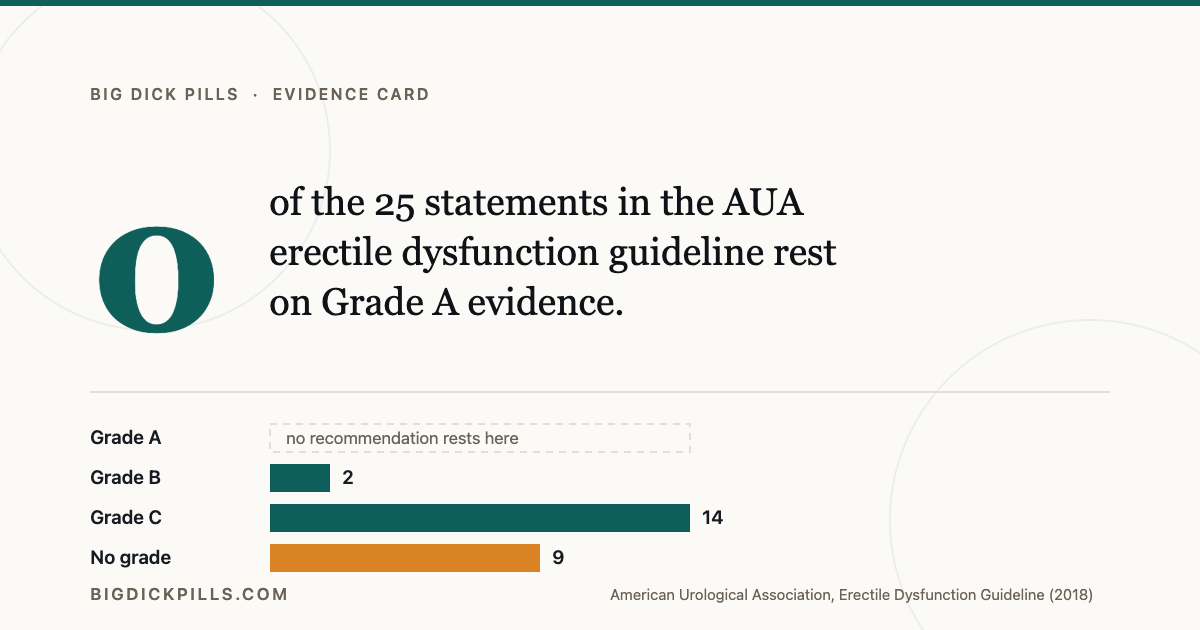
No shockwave device is FDA approved for erectile dysfunction. The AUA guideline is explicit: statement 23 says the therapy should be considered investigational, a conditional recommendation on Grade C evidence. The guideline puts stem cell therapy in the same investigational category and classes platelet-rich plasma, the P-shot, as experimental on expert opinion alone. If a clinic offers you all three as a package, it is offering you three treatments its own professional body says belong in a trial.
Is shockwave therapy worth the money?
There is a defensible case for trying this, and it is narrower than the marketing.
It applies to a man with mild to moderate vascular erectile dysfunction who has already tried a PDE5 inhibitor properly, meaning several attempts at the maximum tolerated dose rather than one disappointing evening, and who either could not tolerate it or does not want to be on it. He understands that the average effect in the trials sits below the threshold he would notice, that the evidence is rated low certainty, that the benefit appears to fade after about two years, and that he is paying for something his urological association calls investigational. He can afford to lose the money without it mattering.
Everyone else has better first moves. If a tablet has not been given a proper trial, that is the cheaper experiment to run first, and most reported failures turn out to be dosing errors. If the problem might not be vascular at all, there are reasonably reliable ways to tell before spending anything. And if it is vascular, the thing the blood vessels are telling you matters more than the erection. Blood pressure is the cheapest and highest-value number in this entire category, and nobody charges $490 a session to read it.
Common questions about shockwave therapy for ED
Does shockwave therapy for ED actually work?
It produces a real, measurable effect that sits just below the threshold most men would notice. Pooled across 21 randomised trials, the improvement was 3.89 points on a scale where about 4 points is the smallest change men report as meaningful. Every outcome in that review was rated low certainty, and nine of the 21 trials were funded by the companies making the devices.
Is shockwave therapy FDA approved for erectile dysfunction?
No. No device is FDA approved for this indication, and the American Urological Association classifies the treatment as investigational. Clinics offering it are using devices cleared for other purposes. The European Association of Urology takes a softer line, giving it a weak recommendation for mild vasculogenic ED, so the two major guideline bodies genuinely disagree.
How much does shockwave therapy for ED cost?
A survey of 140 clinics across eight US cities found an average of about $490 per session and roughly $3,400 for a full course, most commonly six sessions. It is not covered by insurance, because it is not an approved treatment. Only a quarter of those clinics were run by a urologist, and 13 percent were run by a non-physician.
Is shockwave therapy safe?
Safety is the part the evidence is most comfortable with. Across the pooled trials the risk difference for treatment-related adverse events was 0.00, meaning no measurable excess over sham. A treatment can be simultaneously safe and unproven, and this is one of those.
Should I try shockwave before trying tablets?
No guideline supports that order. PDE5 inhibitor tablets are first-line with a strong recommendation, they are inexpensive, and a large share of men who believe tablets failed them were taking them incorrectly. Shockwave is something to consider after a properly conducted tablet trial, not instead of one.
Sources
- Ergun O, et al. Low-intensity shockwave therapy for erectile dysfunction. Cochrane Database of Systematic Reviews, 2025. Cochrane Library
- Burnett AL, et al. Erectile Dysfunction: AUA Guideline, statements 23 to 25. American Urological Association. AUA
- Lange J, et al. Is low-intensity shockwave therapy for erectile dysfunction a durable treatment option? Long-term outcomes of a randomized sham-controlled trial. Translational Andrology and Urology. Transl Androl Urol
- Weinberger JM, Eleswarapu SV, et al. Direct-to-consumer marketing of shockwave therapy for erectile dysfunction. Urology Practice, via Wolters Kluwer. Wolters Kluwer
This article is for information only and is not medical advice. It cannot account for your individual circumstances. Talk to a doctor about your own situation, particularly before starting or stopping any prescription medication.
Cite this page: Big Dick Pills, “Shockwave Therapy for ED: A Real Effect, Just Below What You Would Notice”, bigdickpills.com/erectile-dysfunction/shockwave-therapy-for-ed/ (updated ).
Source links on this site are checked every month; last check . How sources are checked.