










 By
By 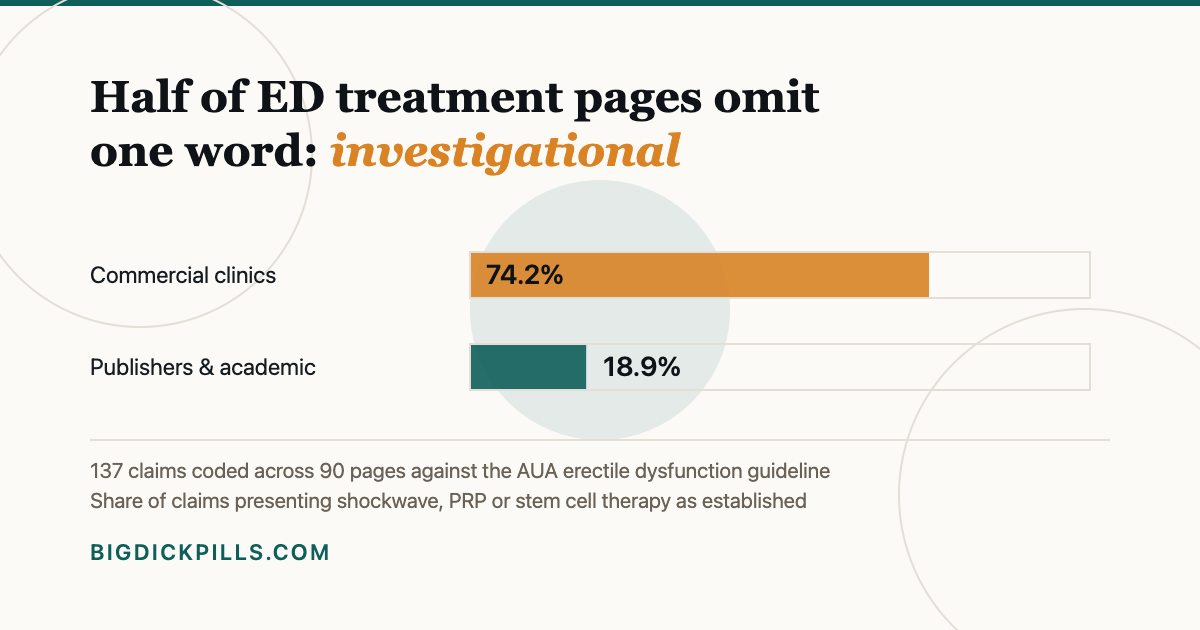
The American Urological Association has a word for shockwave therapy, platelet-rich plasma and stem cell injections as treatments for erectile dysfunction. The word is investigational. It is printed in the guideline, it has been there since 2018, and it is not ambiguous. We wanted to know how often a man searching for these treatments would actually encounter it. So we went and counted.
We pulled 95 pages from search results for 16 common ED treatment queries, retrieved 90, and coded every claim they made about shockwave, PRP or stem cell therapy against the AUA guideline: 137 separate observations. Where a page took a position, 49.6% presented the therapy as effective or established without telling the reader it is investigational or experimental. The split by who published it is stark: commercial clinics omitted it 74.2% of the time, health publishers and academic medical centres 18.9%, a 3.9-fold difference. Separately, we coded all 25 statements in the guideline itself: not one of them rests on Grade A evidence.
| Pages sampled / retrieved | 95 attempted, 90 retrieved, 77 discussed at least one of the three therapies |
|---|---|
| Coded observations | 137, each requiring a verbatim supporting quote |
| Omitted the investigational designation | 59 of 119 observations where a position was taken (49.6%) |
| Commercial clinic pages | 49 of 66 (74.2%) |
| Publishers, media, academic centres | 10 of 53 (18.9%) |
| Pages citing the AUA at all | About 10 of 77, roughly 13% |
| Pages stating any AUA recommendation tier | 2 of 90. Both stated it correctly. |
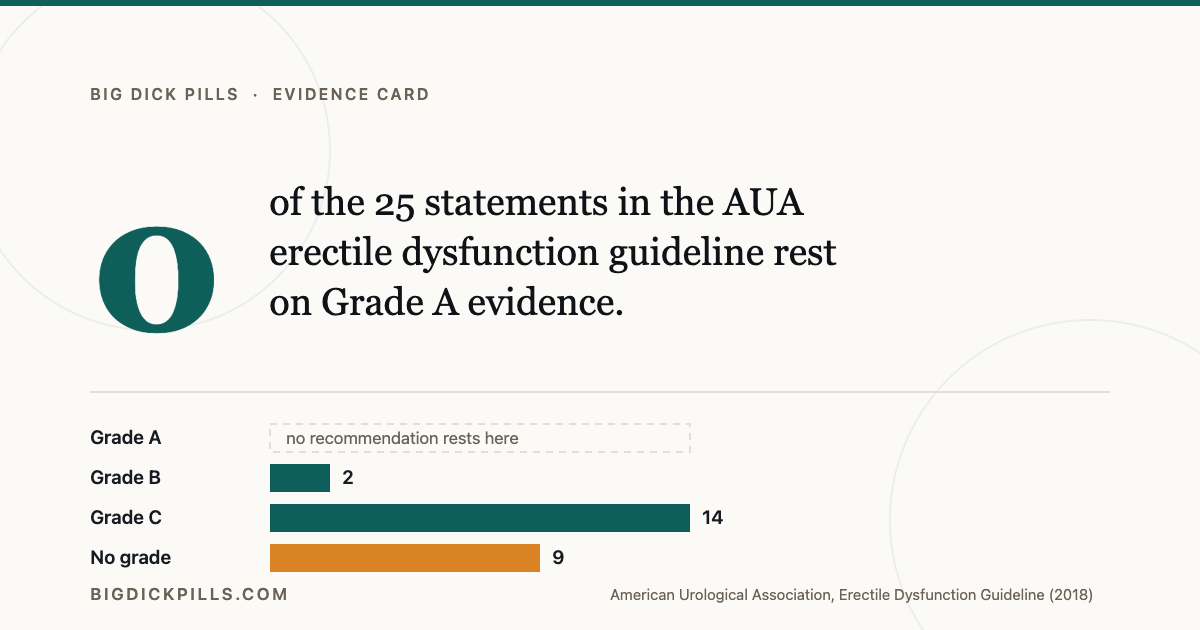
| AUA ED guideline statements resting on Grade A evidence | Zero, out of 25 |
The data: ED treatment claims audit dataset – every coded claim behind this audit.
What does the guideline actually say?
Before measuring anyone against a standard, it is worth being precise about the standard. The AUA erectile dysfunction guideline contains 25 numbered statements. Each carries either a recommendation strength paired with an evidence grade, or a label indicating that no graded evidence underlies it at all: Clinical Principle (widely agreed practice) or Expert Opinion (the panel’s judgement).
We coded all 25. As far as we can establish, this distribution has not been published anywhere else.
Two statements rest on Grade B evidence: that men should be told about oral PDE5 inhibitors, and that the dose should be titrated. Fourteen rest on Grade C. Nine carry no evidence grade. And the top of the scale is empty. In the flagship guideline for the most-treated male sexual condition in the world, there is no Grade A recommendation at all.
That is not a scandal. Grading systems are conservative and erectile dysfunction is hard to study blind. But it is the context every confident sentence about ED treatment is written against, and almost nobody states it.
Where the guideline is unambiguous is on the three therapies we audited:
| Therapy | What the guideline says | Grade |
|---|---|---|
| Low-intensity shockwave (LI-ESWT) | “should be considered investigational” | Conditional Recommendation; Evidence Level C |
| Intracavernosal stem cell therapy | “should be considered investigational” | Conditional Recommendation; Evidence Level C |
| Platelet-rich plasma (PRP) | “should be considered experimental” | Expert Opinion |
A 2025 Cochrane review of shockwave therapy reached a compatible conclusion from the other direction: across 21 studies and 1,357 men, the certainty of evidence was rated low for every outcome, and the authors concluded the short-term effect “may not be perceived to be clinically important by men with erectile dysfunction.”
How did we check?
We wrote the coding rules before looking at any page, and every judgement had to be backed by a quote.
Sampling. On 12 September 2026 we ran 16 queries covering how men actually search for these treatments, from “does shockwave therapy work for erectile dysfunction” to “P-shot cost reviews” to “alternative to Viagra permanent cure.” We took the results returned for each query, deduplicated them, and excluded journal articles, systematic reviews, trial registries and the guideline itself, since the question was what consumer-facing pages say. That produced 95 URLs. Ninety were retrievable; five were paywalled, removed or rendered in a way we could not read, and we recorded them as non-responses rather than guessing at their contents.
Coding. For each page we recorded which of the three therapies it discussed, and assigned each mention exactly one code:
| Code | Meaning |
|---|---|
| Conveys | The page tells the reader, in its own body text about that therapy, that it is investigational, experimental, unproven, not established, or not FDA-approved for ED. |
| Omits | The page presents the therapy as effective or established, or promotes it commercially, without telling the reader that. |
| Neutral | The page mentions it but makes no claim about efficacy or standing in either direction. |
Two rules did the heavy lifting. First, every code required a verbatim quote of 25 words or fewer; a code without one was invalid and defaulted to Neutral. Second, a site-wide footer disclaimer did not count as disclosure. A page claiming a 60% success rate in its body text while carrying “statements on this site have not been evaluated by the FDA” in the footer was coded as an omission, because no reader encounters that footer as information about the treatment.
Rates below are calculated over observations where the page took a position (Conveys plus Omits). Neutral mentions are reported but excluded from the denominator, since a page that makes no claim cannot be said to have omitted a caveat to one.
Related: All erectile dysfunction articles
What did we find?
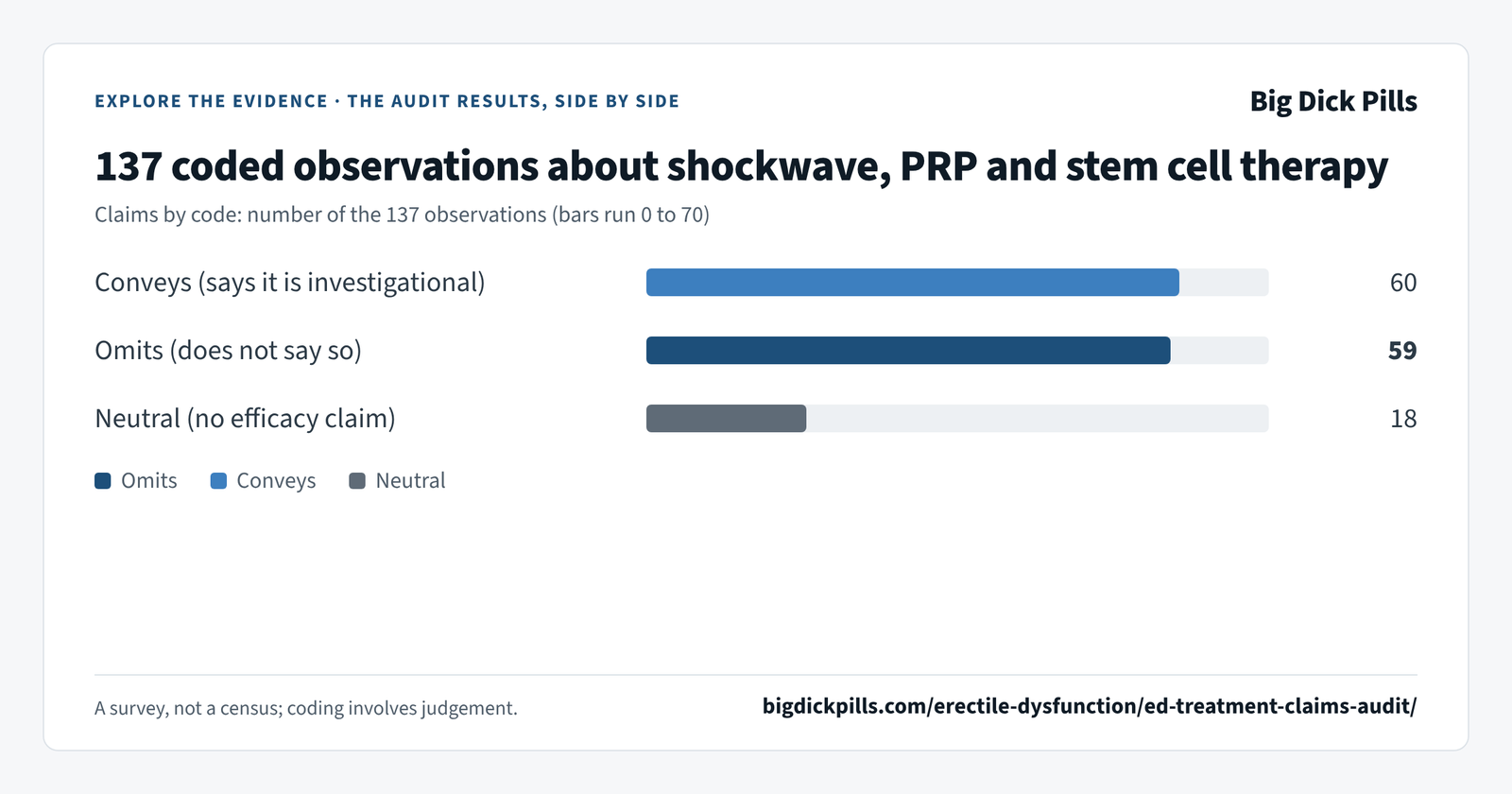
Of 90 retrieved pages, 77 discussed at least one of the three therapies, producing 137 coded observations: 60 Conveys, 59 Omits, 18 Neutral. Across the 119 observations where a position was taken, the omission rate is 49.6%.
| Therapy | Observations | Conveys | Omits | Neutral | Omission rate |
|---|---|---|---|---|---|
| Shockwave (LI-ESWT) | 55 | 25 | 26 | 4 | 51.0% |
| Platelet-rich plasma | 49 | 18 | 22 | 9 | 55.0% |
| Stem cell / exosome | 33 | 17 | 11 | 5 | 39.3% |
| All three | 137 | 60 | 59 | 18 | 49.6% |
The second finding is the one we did not expect. We had assumed, reading the guideline, that we would mostly be catching pages that mis-stated the strength of a recommendation. That is not what happens. Only two pages out of 90 stated an AUA recommendation tier for any ED treatment at all, and both stated it correctly. Roughly ten of the 77 relevant pages mentioned the AUA in any form.
The failure mode is not inaccuracy about the evidence grading. It is that the evidence grading is almost never mentioned.
Explore the evidence
The audit results, side by side
137 coded observations about shockwave, PRP and stem cell therapy
Claims by code: number of the 137 observations (bars run 0 to 70)
OmitsConveysNeutral
Conveys = the page says the therapy is investigational, experimental, unproven or not FDA-approved. Omits = it presents the therapy as effective or established without saying so. Neutral = it mentions the therapy with no efficacy claim. The sample is a survey, not a census; coding involves judgement, and a different query set would produce different numbers.
Omission rate by therapy
Omission rate: % of observations that took a position (bars run 0 to 100%)
TherapyAll three combined
Observations coded: 55 shockwave, 49 platelet-rich plasma, 33 stem cell / exosome. The AUA guideline calls shockwave and stem cell therapy investigational and PRP experimental. The sample is a survey, not a census; coding involves judgement, and a different query set would produce different numbers.
Omission rate: commercial clinics vs publishers
Omission rate: % of observations that took a position (bars run 0 to 100%)
Commercial clinicPublisher / academic / media
The sample is a survey, not a census; coding involves judgement, and a different query set would produce different numbers.
A survey, not a census; coding involves judgement. Not medical advice.
Why is the clinic number four times the publisher number?
Splitting the sample by who published the page produces the sharpest result in the study.
Commercial clinic pages omitted the designation in 49 of 66 positioned observations. Publishers, news outlets and academic medical centres omitted it in 10 of 53. A man reading about shockwave therapy on a page that sells shockwave therapy is roughly four times less likely to be told it is investigational than one reading a page that does not.
The obvious reading is the commercial one, and we think it is largely right. But the data does not support a clean villain-and-hero story, and we would be misreporting it if we implied otherwise. Several private clinics in the sample disclosed the investigational status plainly, one of them citing the AUA guideline by name and year. Meanwhile some of the clearest omissions came from pages with no commercial interest at all: at least one major academic medical centre’s main erectile dysfunction page listed shockwave therapy among treatment options with no caveat anywhere on the page. Incentive predicts the pattern. It does not determine the individual case.
What can this study not tell you?
We would rather state the weaknesses than have someone else find them.
This is not a ranking study. Our sample came from results returned by a web search on one day, not from verified Google position data. We cannot tell you these were the top 100 ranking pages, and we do not claim it. What we can say is that these are pages a searcher plausibly encounters.
The sample is a survey, not a census. Seventy-seven pages is enough to describe a pattern and far too few to put a confidence interval around the internet. A different query set would produce different numbers. We would expect the direction of the clinic-versus-publisher gap to hold, because it is large; we would not expect 49.6% to replicate exactly.
Coding involves judgement. “Presents as effective without disclosure” is a call, not a measurement. We constrained it with the quote requirement and the footer rule, but a second team would not agree with us on every one of the 137. We found one of our own errors while checking: a clinic page had been credited with disclosure on the strength of a footer disclaimer while claiming a 60% success rate in its body text. We recoded it as an omission, which is why the footer rule is written down.
The guideline is from 2018. Evidence has accumulated since, and a page could reasonably argue the designation is dated. Almost none of the pages we coded made that argument. They simply did not raise the question.
The 2018 AUA guideline is still the standard this audit measures pages against, but it is not the last word. The AUA has a consolidated guideline on Disorders of Penile Erection (combining erectile dysfunction and Peyronie’s disease) in development, due 2027, which is expected to replace it; nothing has published yet. The European Association of Urology released a 2026 update to its Sexual and Reproductive Health guidelines, which also covers ED management and reflects trial evidence newer than 2018. Read the current EAU chapter if you want a second guideline body’s up-to-date view. Neither changes the disclosure finding above: the guideline these 90 pages were measured against is the one that was live in September 2026, and shockwave, PRP and stem cell therapy remain investigational or experimental under it.
We have an interest here. This site publishes about these treatments and benefits from being seen as careful. We have tried to correct for that by writing the rules before collecting data, requiring quotes, reporting the findings that complicate our thesis, and naming nobody.
Can you check our work?
Yes, and we would like you to. The guideline is public and free. The queries are listed above. The coding rules are in the methods section and take about a minute to apply to any page you like: find where the page discusses shockwave, PRP or stem cell therapy, and see whether the words investigational, experimental, unproven or not FDA-approved appear anywhere in the body text near that discussion. Footers do not count.
If you run a version of this and get a materially different answer, we want to hear about it and we will publish the correction. The underlying per-page coding table is published in full below: 137 rows, one per coded claim, and it reproduces every figure in this article. It lists the domain and page type for each claim so the work can be checked, and we have kept our decision not to single out individual sites in the write-up itself. The point of this is not to embarrass anyone. It is that the aggregate is measurable, and until now nobody had measured it.
Common questions about this audit
Does the AUA say shockwave therapy does not work?
No. The guideline says it “should be considered investigational,” which means the evidence is not yet sufficient to establish it as a standard treatment, not that it has been shown to fail. A 2025 Cochrane review of 21 studies and 1,357 men found a possible small short-term benefit but rated the certainty of evidence low for every outcome, and noted the effect may not be large enough for men to notice.
Is the P-Shot FDA approved for erectile dysfunction?
No. The AUA guideline classifies platelet-rich plasma therapy for ED as experimental, on the basis of Expert Opinion, which is the lowest tier in the guideline’s grading system. In our audit, 55% of pages that took a position on PRP presented it as effective without telling readers that.
How many ED treatments are backed by Grade A evidence?
None. Of the 25 statements in the AUA erectile dysfunction guideline, zero rest on Grade A evidence. Two rest on Grade B: that men should be informed about oral PDE5 inhibitors, and that the dose should be titrated. Fourteen rest on Grade C, and nine carry no evidence grade at all, being either Clinical Principles or Expert Opinion.
Which ED treatments does the guideline actually support most strongly?
The strongest statements concern oral PDE5 inhibitors such as sildenafil and tadalafil, which carry a Strong Recommendation at Evidence Level B, and penile prosthesis implantation, a Strong Recommendation at Evidence Level C. Vacuum erection devices and intracavernosal injections carry Moderate Recommendations at Evidence Level C.
Why did you not name the websites you audited?
Because the finding is the aggregate, not any individual page. A list of names turns a measurable pattern about how health information travels into a dispute with a dozen businesses, and the pattern is the useful part. The per-page coding table exists and is available to journalists and researchers on request.
How was this audit conducted?
Sixteen search queries were run on 12 September 2026, yielding 95 consumer-facing URLs after excluding journals and trial registries. Ninety were retrievable and 77 discussed shockwave, PRP or stem cell therapy, producing 137 coded observations. Each observation was coded Conveys, Omits or Neutral against the AUA guideline, and every code required a verbatim supporting quote of 25 words or fewer. Site-wide footer disclaimers were not counted as disclosure.
Preston W. Half of ED treatment pages leave out that the treatment is investigational: an audit of 90 pages against the AUA erectile dysfunction guideline. Big Dick Pills, 12 September 2026. https://bigdickpills.com/erectile-dysfunction/ed-treatment-claims-audit/
Sources
- Burnett AL, Nehra A, Breau RH, et al. Erectile Dysfunction: AUA Guideline. American Urological Association, 2018. AUA
- Erectile Dysfunction Guideline — guideline statements and evidence grades. American Urological Association. AUA
- Ergun O, Kim K, Kim MH, et al. Low-intensity shockwave therapy for erectile dysfunction. Cochrane Database of Systematic Reviews, 14 July 2025. Cochrane
- Erectile Dysfunction Guidelines: Guidelines Summary. Medscape. Medscape
- Guidelines in development: Disorders of Penile Erection (formerly Erectile Dysfunction / Peyronie’s Disease), due 2027. American Urological Association / Society for the Study of Male Sexual Function. AUA guideline pipeline
- European Association of Urology. EAU Guidelines on Sexual and Reproductive Health, 2026 edition. Uroweb
This article is for information only and is not medical advice. It cannot account for your individual circumstances. Talk to a doctor about your own situation, particularly before starting or stopping any treatment. Nothing here is a claim about any individual clinic, practitioner or website.
Source links on this site are checked every month; last check . How sources are checked.