










 By
By 
There is a version of this article that reads like scaremongering, and a version that is simply what the cardiology and urology literature has been saying for twenty years. This is the second one. Erectile dysfunction that comes on gradually, without an obvious psychological trigger, is usually a vascular event. The blood vessels that fail first are the smallest ones, and the smallest ones in a man’s body run to his penis.
Get emergency care now if an erection has lasted more than 4 hours (priapism), or you have chest pain, shortness of breath, or fainting during or after sex.
See a doctor within 1 to 2 weeks if this erection problem is new. The AUA treats new ED as a cardiovascular risk marker worth checking, not only a symptom to treat.
A routine visit is fine if the problem has been gradual and longstanding and the causes above have already been ruled out.
Who to see: start with your primary care doctor. Expect a referral to a urologist for the physical work-up or treatment, or an endocrinologist if bloodwork points to a hormone cause.
Worth asking whoever treats you: is this FDA-approved for ED, or still investigational? Half of the pages selling shockwave, PRP and stem-cell treatments for ED don’t say.
In men with angiographically confirmed coronary disease who also had ED, two thirds developed the ED first, a mean of 38.8 months before their cardiac symptoms. Across 92,757 men in pooled cohort studies, ED was associated with a 44 percent higher rate of cardiovascular events and a 62 percent higher rate of myocardial infarction. Men presenting with ED are four times more likely to have undiagnosed diabetes. The 2024 Princeton IV consensus puts it directly: treat a man with ED as being at cardiac risk until proven otherwise.
| Men who developed ED before cardiac symptoms | 67% (99 of 147 with confirmed coronary disease) |
|---|---|
| Average warning time | 38.8 months, about 3.2 years |
| Risk of any cardiovascular event with ED | 44% higher (RR 1.44, 95% CI 1.27 to 1.63) |
| Risk of heart attack with ED | 62% higher (RR 1.62, 95% CI 1.34 to 1.96) |
| Risk of cardiovascular death with ED | Not statistically significant (RR 1.19, 0.97 to 1.46) |
| Undiagnosed diabetes, men aged 40 to 59 with ED | 19.1% vs 3.3% without ED |
| Penile artery diameter | 1 to 2 mm, vs 3 to 4 mm for a coronary artery |
| Which ED severity carries the signal | Severe only (RR 1.58); mild and moderate not significant |
Why does ED show up before heart disease?
An erection is a haemodynamic event. Arterial inflow rises, smooth muscle in the erectile tissue relaxes, the chambers fill, and outflow is compressed. Every step of that depends on endothelium, the single-cell lining of blood vessels that produces the nitric oxide which triggers the relaxation. Atherosclerosis is, in its earliest phase, endothelial dysfunction. The same disease process, in the same tissue, in a different location.
What makes ED an early signal rather than a late one is arithmetic. Plaque of a given thickness occupies a much larger share of a narrow vessel than a wide one, so the narrowest arteries declare themselves first.
| Artery | Approximate diameter | What its failure looks like |
|---|---|---|
| Penile | 1 to 2 mm | Erectile dysfunction |
| Coronary | 3 to 4 mm | Angina, myocardial infarction |
| Carotid | 5 to 7 mm | Transient ischaemic attack, stroke |
| Femoral | 6 to 8 mm | Claudication |
This is the artery size hypothesis, and it explains the clinical pattern neatly: a burden of disease that is still subclinical in a 4 mm coronary artery is already symptomatic in a 1 mm penile one. The erection is not a separate problem that happens to correlate with heart disease. It is the same problem, detected earlier because the detector is more sensitive.
How many years of warning does ED give you?
The figure most often quoted is three to five years, and it is worth knowing where it comes from, because it is regularly attributed to the wrong study.
The source is a 2003 Italian study that took 300 consecutive men admitted with acute chest pain who then had coronary disease confirmed on angiography, and asked them about erectile function. Just under half, 49 percent, had ED. Among those men, 99 of 147, or 67 percent, said the ED had appeared before any cardiac symptom. The mean interval was 38.8 months, a little over three years, with a range stretching from one month to fourteen years. Among the diabetic men with ED, every single one had developed the ED first.
A later review summarised the pattern as ED preceding coronary symptoms by two to three years and preceding an actual cardiovascular event by three to five. That is the origin of the number, and the distinction between symptoms and events is the reason the range has two halves.
The uncomfortable corollary is in the same literature: most acute cardiac events, including sudden death, occur without prior cardiac warning symptoms. For a substantial number of men, the erection is not an early warning among several. It is the only one.
The three-to-five-year figure is very widely attributed to a 2009 Mayo Clinic Proceedings cohort study by Inman and colleagues. We went back to that paper and it does not contain it. Inman reports a hazard ratio of 2.1 for developing coronary disease and says only that erectile dysfunction in younger men may precede coronary disease “by decades”, without giving an interval.
The interval comes from Montorsi and colleagues in European Urology in 2003, which measured a mean of 38.8 months, and from a 2013 review by Jackson that separated the lag to cardiac symptoms (two to three years) from the lag to an actual event (three to five years). We have cited it that way above. We are contacting the authors of the secondary sources we found carrying the misattribution, and will note here if any of them correct it.
Related: All erectile dysfunction articles
Does ED really predict a heart attack?
Cross-sectional findings in men who already had a heart attack are suggestive. Prospective cohorts, which take men without known heart disease and follow them, are the real evidence.
A ten-year population study followed 1,402 men. Incident coronary disease occurred in 156 of them, 11.1 percent. Men with ED had a hazard ratio of 2.1 (95% CI 1.5 to 2.9) for developing coronary artery disease.
The age pattern in that study is the interesting part. The association was strongest in the youngest men and disappeared entirely in the oldest: at age 70 and above the hazard ratio was 0.7 (0.3 to 1.2), which is to say no association at all. This is not a paradox. ED in a 70-year-old is common and has many causes. ED in a 45-year-old is unusual, and when it is vascular it reflects a disease process that is ahead of schedule.
Two meta-analyses pooled the cohort literature.
| Outcome | Relative risk | 95% CI | Pooled from |
|---|---|---|---|
| Total cardiovascular events | 1.44 | 1.27 to 1.63 | 13 studies, 91,831 men |
| Myocardial infarction | 1.62 | 1.34 to 1.96 | 4 studies, 35,523 men |
| Cerebrovascular events | 1.39 | 1.23 to 1.57 | 6 studies, 27,689 men |
| All-cause mortality | 1.25 | 1.12 to 1.39 | 5 studies, 17,869 men |
| Cardiovascular mortality | 1.19 | 0.97 to 1.46 | 4 studies, 34,761 men |
Note the last row. Cardiovascular mortality specifically did not reach statistical significance, and a second analysis of 111,440 men found the same thing. Anyone telling you ED predicts cardiac death is overstating what the data support. What it predicts, consistently, is cardiac events and all-cause mortality.
A separate meta-analysis of 12 cohorts and 36,744 men found cardiovascular disease at a relative risk of 1.48 (1.25 to 1.74), close enough to the first analysis to be reassuring rather than novel.
Severity matters, and it matters in a way that should shape how you read your own situation. When mortality was broken down by how bad the ED was, severe ED carried a relative risk of 1.58 (1.37 to 1.82), while moderate ED at 1.16 and mild ED at 1.07 were both statistically indistinguishable from no ED at all. Occasional difficulty is not the signal. Consistent, progressive difficulty is.
What do doctors actually find when they investigate ED?
The strongest practical argument for taking ED to a doctor is not the long-run risk estimate. It is what turns up on the day.
An analysis of American national survey data compared men with and without ED on conditions they did not know they had. Previously undiagnosed diabetes was present in 11.5 percent of men with ED against 2.8 percent of men without, an adjusted odds ratio of 2.20 (1.10 to 4.37). In men aged 40 to 59 the gap was wider still: 19.1 percent against 3.3 percent. Put as a probability, a man in that age band without ED had roughly a 1 in 50 chance of undiagnosed diabetes. With ED, it was closer to 1 in 10.
Two honest caveats from the same study. Undiagnosed hypertension was more common in men with ED, 19.4 percent against 9.3 percent, but the association did not survive adjustment for confounders. And there was no significant association with undiagnosed high cholesterol at all. The diabetes finding is the robust one.
What tests should you ask for?
Both major urological bodies treat ED as a cardiovascular screening opportunity, and say so explicitly.
The American Urological Association guideline states as a clinical principle that men should be counselled that ED is a risk marker for underlying cardiovascular disease and other conditions that may warrant evaluation. The same guideline notes that the presence of ED was as strong a predictor of future cardiac events as smoking or a family history of myocardial infarction.
The European Association of Urology makes it a strong recommendation to evaluate glucose, lipid profile and total testosterone in order to identify and treat reversible risk factors, and a second strong recommendation to begin lifestyle and risk factor modification before or alongside any ED treatment. Its specific instruction is a fasting glucose or HbA1c and a lipid profile if one has not been done in the past twelve months, plus an early morning total testosterone.
So a reasonable appointment produces: blood pressure, fasting glucose or HbA1c, a lipid panel, a morning testosterone, and a ten-year cardiovascular risk calculation. For men aged 40 to 60 who land in the borderline-to-intermediate risk band, the EAU recommends a non-contrast cardiac CT for coronary artery calcium scoring, which it describes as the most sensitive and specific marker of subclinical coronary disease.
The 2024 Princeton IV consensus, a joint cardiology and sexual medicine document, goes further in framing. Its position is that mounting evidence supports treating men with ED as being at risk for cardiac events until proven otherwise, and it adds coronary artery calcium scoring to the risk stratification algorithm.
There is also a safety reason this conversation has to happen before treatment rather than after. PDE5 inhibitors are absolutely contraindicated with nitrates, and a man who obtains tablets without a consultation is exactly the man who will not know that.
Can you reverse it with diet and exercise?
Partly, and the size of the effect is worth knowing before you decide it is not worth the trouble.
A randomised trial put 110 obese men through two years of caloric restriction and increased physical activity against a control group. Mean erectile function score rose from 13.9 to 17.0 in the intervention group while the control group did not move, and 17 men in the intervention arm regained normal function against 3 in the control arm. The predictors of improvement were the change in BMI, the increase in physical activity, and the fall in C-reactive protein, which is to say the vascular and inflammatory measures, not the weight number by itself.
A 2023 meta-analysis of 11 randomised trials and 1,147 men found aerobic exercise improved erectile function scores by a mean of 2.8 points (1.7 to 3.9). The gradient across baseline severity is the useful detail: men with mild ED gained 2.3 points, moderate 3.3, severe 4.9. The worse the starting point, the more there was to recover.
A systematic review of physical activity interventions across 970 men put a number on the dose that worked: 40 minutes of moderate-to-vigorous aerobic exercise, four times a week, for six months. Relative improvements across the populations studied ranged from 14 percent to 86 percent, with the largest gains in men who had been sedentary or had metabolic syndrome.
None of that makes exercise a replacement for a tablet, and none of it makes a tablet a replacement for finding out why the arteries are struggling. The point of this article is narrower and more specific than either: a new, gradual, unexplained loss of erectile function is a reason to get your blood tested, and the men for whom that matters most are the young ones who assume it cannot possibly be about their heart.
Common questions about ED and heart health
Does erectile dysfunction always mean heart disease?
No. ED has psychological, hormonal, neurological and medication-related causes as well as vascular ones. The pattern that points to a vascular cause is gradual onset over months, no clear psychological trigger, and loss of spontaneous night-time and morning erections. Sudden onset that varies by situation or partner points elsewhere. What the evidence supports is treating new gradual ED as a reason to check cardiovascular risk, not as a diagnosis of heart disease.
How many years before a heart attack does ED appear?
In the study most often cited, men with confirmed coronary disease who also had ED developed the ED an average of 38.8 months, a little over three years, before their cardiac symptoms. A later review separated this into roughly two to three years before cardiac symptoms and three to five years before an actual cardiovascular event. The range is wide, from one month to fourteen years.
Should I get my heart checked if I have ED?
Both major urological guideline bodies say yes. A reasonable workup is blood pressure, fasting glucose or HbA1c, a lipid panel, a morning testosterone and a ten-year cardiovascular risk calculation. For men aged 40 to 60 in the borderline or intermediate risk band, European guidance adds a coronary artery calcium scan.
Is ED a stronger warning sign in younger men?
Yes, and this is one of the clearest findings. In a ten-year cohort the association was strongest in the youngest men and disappeared entirely after age 70, where the hazard ratio was 0.7. ED is common in older men and has many causes; in a man in his forties it is unusual, and when vascular it reflects disease that is ahead of schedule.
Can taking Viagra hide a heart problem?
It can delay finding one. PDE5 inhibitors treat the symptom without addressing why the arteries are struggling, so a man who buys tablets online and never has the conversation loses the warning. There is also a direct safety issue: PDE5 inhibitors are absolutely contraindicated with nitrate medication, and someone who never sees a clinician will not be screened for that.
Sources
- Montorsi F, Briganti A, Salonia A, et al. Erectile dysfunction prevalence, time of onset and association with risk factors in 300 consecutive patients with acute chest pain and angiographically documented coronary artery disease. European Urology. 2003;44(3):360-364. PubMed
- Jackson G. Erectile dysfunction and cardiovascular disease. Arab Journal of Urology. 2013;11(3):212-216. Full text
- Inman BA, St Sauver JL, Jacobson DJ, et al. A population-based, longitudinal study of erectile dysfunction and future coronary artery disease. Mayo Clinic Proceedings. 2009;84(2):108-113. Full text
- Vlachopoulos CV, Terentes-Printzios DG, Ioakeimidis NK, et al. Prediction of cardiovascular events and all-cause mortality with erectile dysfunction: a systematic review and meta-analysis of cohort studies. Circulation: Cardiovascular Quality and Outcomes. 2013;6(1):99-109. Structured abstract
- Dong JY, Zhang YH, Qin LQ. Erectile dysfunction and risk of cardiovascular disease: meta-analysis of prospective cohort studies. Journal of the American College of Cardiology. 2011;58(13):1378-1385. Full text
- Fan Y, Hu B, Man C, Cui F. Erectile dysfunction and risk of cardiovascular and all-cause mortality in the general population: a meta-analysis of cohort studies. World Journal of Urology. 2018;36(10):1681-1689. Abstract
- Skeldon SC, Detsky AS, Goldenberg SL, Law MR. Erectile dysfunction and undiagnosed diabetes, hypertension, and hypercholesterolemia. Annals of Family Medicine. 2015;13(4):331-335. Full text
- Kohler TS, Kloner RA, Rosen RC, et al. The Princeton IV consensus recommendations for the management of erectile dysfunction and cardiovascular disease. Mayo Clinic Proceedings. 2024;99(9):1500-1517. ACC summary
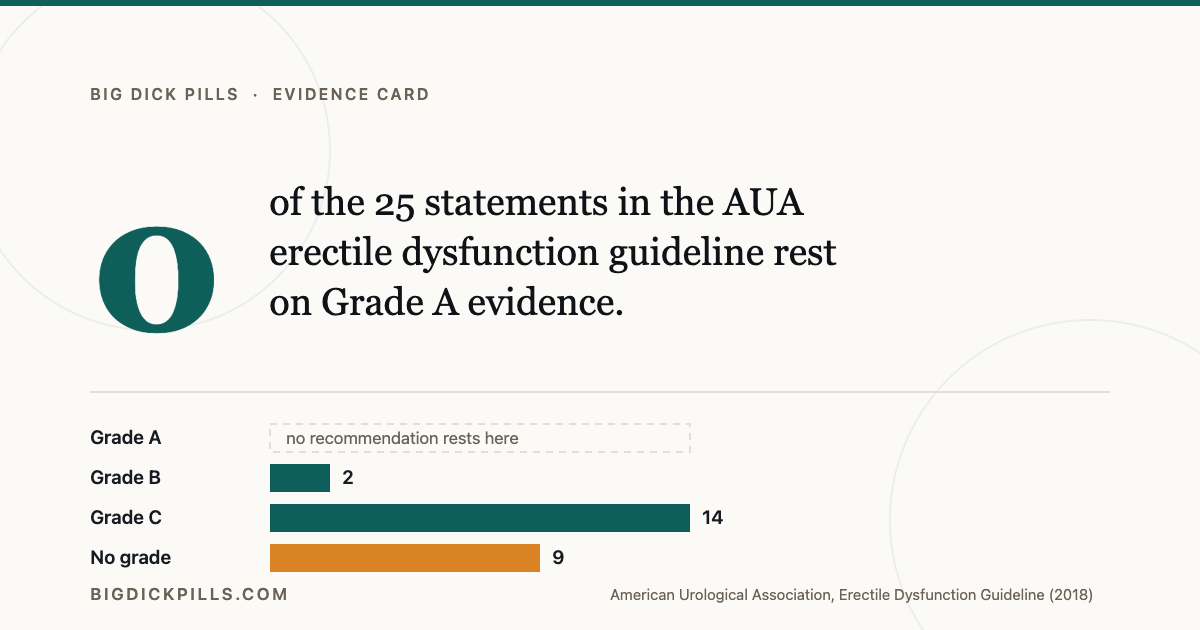
- American Urological Association. Erectile Dysfunction: AUA Guideline. AUA
- European Association of Urology. Guidelines on Sexual and Reproductive Health: Management of Erectile Dysfunction. EAU
- Esposito K, Giugliano F, Di Palo C, et al. Effect of lifestyle changes on erectile dysfunction in obese men: a randomized controlled trial. JAMA. 2004;291(24):2978-2984. PubMed
- Khera M, Bhattacharyya S, Miller LE. Effect of aerobic exercise on erectile function: systematic review and meta-analysis of randomized controlled trials. The Journal of Sexual Medicine. 2023;20(12):1369-1375. Full text
- Gerbild H, Larsen CM, Graugaard C, Areskoug Josefsson K. Physical activity to improve erectile function: a systematic review of intervention studies. Sexual Medicine. 2018;6(2):75-89. Full text
This article is for information only and is not medical advice. If you have chest pain, breathlessness on exertion, or symptoms of a heart attack or stroke, seek emergency care rather than a routine appointment. Talk to a qualified health professional about your own situation.
Cite this page: Big Dick Pills, “Erectile Dysfunction Is a Cardiovascular Symptom, and It Arrives First”, bigdickpills.com/erectile-dysfunction/ed-cardiovascular-warning/ (updated ).
Source links on this site are checked every month; last check . How sources are checked.