








 By
By 
This is the symptom men are slowest to mention and quickest to self-treat. It is also, more often than almost anything else in this category, a message from your arteries, and the arteries in question are not the ones you are thinking about.
Get emergency care now if an erection has lasted more than 4 hours (priapism), or you have chest pain, shortness of breath, or fainting during or after sex.
See a doctor within 1 to 2 weeks if this erection problem is new. The AUA treats new ED as a cardiovascular risk marker worth checking, not only a symptom to treat.
A routine visit is fine if the problem has been gradual and longstanding and the causes above have already been ruled out.
Who to see: start with your primary care doctor. Expect a referral to a urologist for the physical work-up or treatment, or an endocrinologist if bloodwork points to a hormone cause.
Worth asking whoever treats you: is this FDA-approved for ED, or still investigational? Half of the pages selling shockwave, PRP and stem-cell treatments for ED don’t say.
An erection is a blood-flow event, and the arteries that supply the penis are 1 to 2 mm across against 3 to 4 mm for the coronary arteries. The same plaque that has not yet closed a coronary artery will already be showing in the smaller vessel. That is why erectile dysfunction tends to arrive two to five years before heart symptoms, and why the American Urological Association makes counselling every man about it a clinical principle. Treatment works, PDE5 inhibitors are first-line, but treating the symptom without asking what caused it is the mistake.
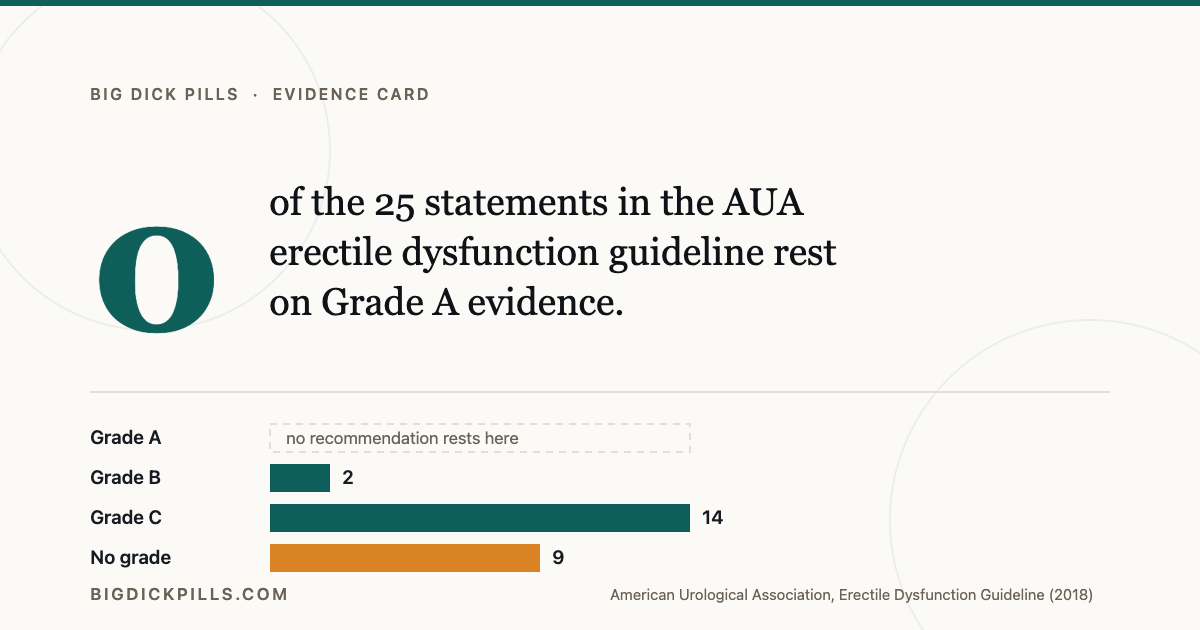
| First-line treatment | PDE5 inhibitor tablets (AUA: Strong recommendation, Grade B) |
|---|---|
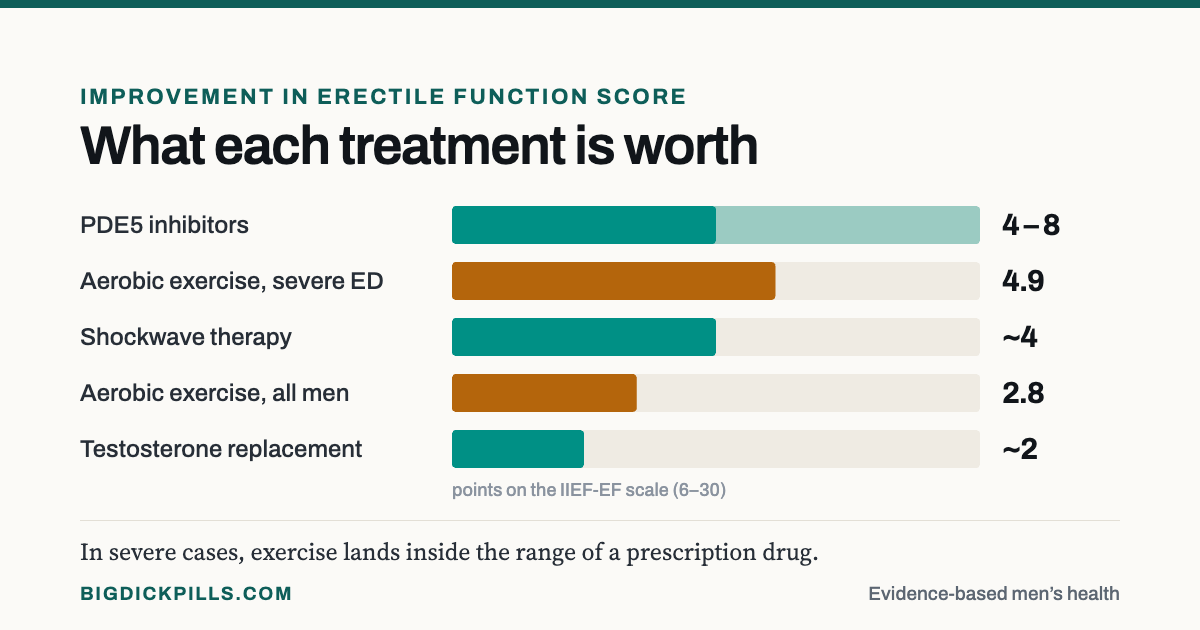
| How much PDE5 inhibitors help | 4 to 8 points on the 30-point IIEF erectile function scale |
| How much aerobic exercise helps | 2.8 points on average; 4.9 points in men with severe ED |
| How much shockwave therapy helps | About 4 points |
| How much testosterone replacement helps | About 2 points |
| Penile artery diameter | 1 to 2 mm, against 3 to 4 mm for a coronary artery |
| Typical warning time before heart symptoms | Two to five years |
| Absolute contraindication | Nitrate medication, in any form |
What does an erection actually require?
Four things have to work: desire, intact nerve signalling, healthy blood vessels, and adequate hormone levels. The one that fails most often, and the one that matters most for your health beyond the bedroom, is the blood vessels.
Mechanically, an erection is a hydraulic event. Nerve signals trigger the release of nitric oxide in the vessel walls, the smooth muscle relaxes, arterial inflow rises sharply, the erectile tissue fills, and the expanding tissue compresses the veins that would otherwise drain it. Blood in, blood trapped.
Every part of that depends on endothelium, the single-cell lining of your blood vessels, being able to produce nitric oxide on demand. Endothelial dysfunction is also the first step in atherosclerosis. This is not a coincidence or an analogy. It is the same tissue failing at the same job.
Why is ED a heart warning before it is a sex problem?
The explanation is almost crudely simple, and it is known as the artery size hypothesis.
Penile arteries are 1 to 2 mm in diameter. Coronary arteries are 3 to 4 mm.
A given thickness of plaque narrows a small pipe proportionally more than a large one. So a burden of atherosclerosis that is nowhere near enough to cause chest pain is already enough to impair erections. The penis is, in effect, an early-warning system with a smaller tolerance for error.
The clinical data match the mechanism:
- In roughly two-thirds of men who have both, erectile dysfunction came first.
- Coronary symptoms typically follow ED by two to three years.
- Heart attack or stroke typically follows by three to five years.
- Meta-analyses put the relative risk of cardiovascular events in men with ED at around 1.44 to 1.48, and of myocardial infarction specifically at up to 1.62.
The AUA’s guideline turns this into a clinical principle: men should be counselled that ED is a risk marker for underlying cardiovascular disease and other conditions that may warrant evaluation and treatment. The guideline also points to the Princeton III criteria for deciding which men need a cardiology opinion before starting treatment for the ED itself.
Read that in order. The recommendation is not “treat the ED and mention the heart.” It is that the ED is the finding, and what it points at may matter more.
This is the single strongest argument against buying something online to make the symptom go away. If it works, you have silenced an alarm without checking what set it off.
Related: Pornography and erectile function · Do enlargement pills work? · All erectile dysfunction articles
What tests should a doctor run?
Less than men fear. The guideline’s first statement is a clinical principle: a thorough medical, sexual and psychosocial history, a physical examination, and selective laboratory testing.
In practice that means questions about onset and pattern, your medications, your cardiovascular risk factors, and your relationship context; an examination including blood pressure; and bloods aimed at the common contributors: glucose or HbA1c, lipids, and a morning total testosterone, which the guideline recommends specifically (moderate recommendation, Grade C).
One question does most of the diagnostic work, and you can answer it before you go: did this come on gradually or suddenly, and do you still wake with erections? That distinction is covered in how to tell whether the cause is physical or psychological.
What are the treatment options, in order?
The guideline lays out options in a clear order, with the evidence grade attached to each.
| Option | What it is | AUA position |
|---|---|---|
| PDE5 inhibitors | Oral tablets: sildenafil, tadalafil and others. Taken correctly, effective for most men. | First-line, Strong, Grade B |
| Vacuum erection device | External pump with a constriction ring. No drugs, no systemic effects. | Moderate, Grade C |
| Intraurethral alprostadil | A pellet inserted into the urethra. First use should be tested in the office. | Conditional, Grade C |
| Intracavernosal injection | Injection into the erectile tissue. Highly effective; requires office training first. | Moderate, Grade C |
| Penile prosthesis | Surgical implant. For men in whom other options have failed or are unsuitable. | Strong recommendation to discuss |
Two practical points the ladder does not show. Testosterone is not on it. It is measured because deficiency can contribute and may need treating alongside, not because it is a treatment for erectile dysfunction in men whose levels are normal. And a substantial share of men who believe a tablet “did not work” were never properly instructed on dose, timing, or the fact that these drugs require arousal rather than replacing it.
How much does each treatment actually help?
Erectile function in trials is measured on the International Index of Erectile Function, on a scale from 6 to 30. Putting the interventions on one axis is unusually clarifying.
| Intervention | Typical IIEF-EF improvement |
|---|---|
| PDE5 inhibitors | 4 to 8 points |
| Shockwave therapy | about 4 points |
| Aerobic exercise | 2.8 points on average, 4.9 in men with severe ED |
| Testosterone replacement | about 2 points |
Exercise is not a curiosity on that list. In men with severe dysfunction it lands within range of a drug, which is not something that can be said about anything sold as a supplement. The trials behind it are in what exercise and diet actually do for erections.
What does ED not mean?
It is not an inevitable part of getting older. Prevalence rises with age because vascular disease, diabetes and medication use rise with age. Age is the company the cause keeps, not the cause.
It is usually not purely psychological. The idea that ED is mostly “in your head” is a leftover from before the vascular mechanism was understood. Anxiety is real, common, and often layered on top, but treating a vascular problem as a confidence problem wastes the warning.
Where should you start?
Get the cardiovascular question answered. Blood pressure, glucose, lipids, and an honest conversation about smoking and weight. If you do nothing else on this page, do that. The evidence says you may be several years ahead of a problem that is much easier to prevent than to survive.
Then treat the symptom, properly, with something that has been through trials. First-line means first-line.
And be careful what you buy in the meantime. The FDA’s own data on what is actually inside “natural” male enhancement products is covered in Viagra versus the natural alternatives, and it is worse than most men would guess.
Common questions about trouble getting or staying hard
Is trouble staying hard different from trouble getting hard?
Clinically they are treated as the same condition, but the pattern is a clue. Losing an erection partway through more often involves a venous leak or anxiety taking over mid-act, while never achieving one points more toward arterial inflow or nerve supply. Both are assessed the same way and respond to the same first-line treatment, so the distinction matters less than whether onset was sudden or gradual.
Is ED normal at my age?
Prevalence rises steadily with age, but common is not the same as normal, and age is never a sufficient explanation on its own. In a man under 50, new erectile dysfunction is unusual enough to warrant a cardiovascular and metabolic workup rather than reassurance. In an older man it is more common, but it still has a cause worth identifying.
Can I just buy the pills online instead of seeing a doctor?
You can, and the specific risk is that nobody screens you for nitrate medication, which is an absolute contraindication and can drop blood pressure dangerously. The second risk is missing what caused the ED. Men presenting with erectile dysfunction have markedly higher rates of undiagnosed diabetes, and a tablet treats the symptom while leaving that undetected.
How long before ED treatment works?
A PDE5 inhibitor works on the day you take it, but judging it takes longer. Salvage studies typically require at least four to six properly taken attempts at the maximum tolerated dose before calling it a failure. Exercise interventions took around six months at 160 minutes a week to produce their measured effect.
Can erectile dysfunction go away on its own?
Psychologically driven ED often resolves when the trigger does, particularly when it started suddenly after an identifiable event. Vascular ED generally does not reverse on its own, though the underlying risk factors are modifiable, and trials of weight loss and exercise show meaningful improvement in erectile function scores.
Sources
- Burnett AL, Nehra A, Breau RH, et al. Erectile Dysfunction: AUA Guideline, 2018. AUA guideline
- Gandaglia G, Briganti A, Jackson G, et al. Erectile dysfunction and cardiovascular disease. PubMed Central
- Silva AB, Sousa N, Azevedo LF, Martins C. Effect of aerobic exercise on erectile function: systematic review and meta-analysis of randomized controlled trials. Journal of Sexual Medicine, 2023. Journal of Sexual Medicine
This article is for information only and is not medical advice. It cannot account for your individual circumstances. Talk to a doctor about your own situation, particularly before starting or stopping any prescription medication.
Cite this page: Big Dick Pills, “Trouble Getting or Staying Hard: What It Means, and What Works”, bigdickpills.com/erectile-dysfunction/struggling-get-stay-hard/ (updated ).
Source links on this site are checked every month; last check . How sources are checked.