










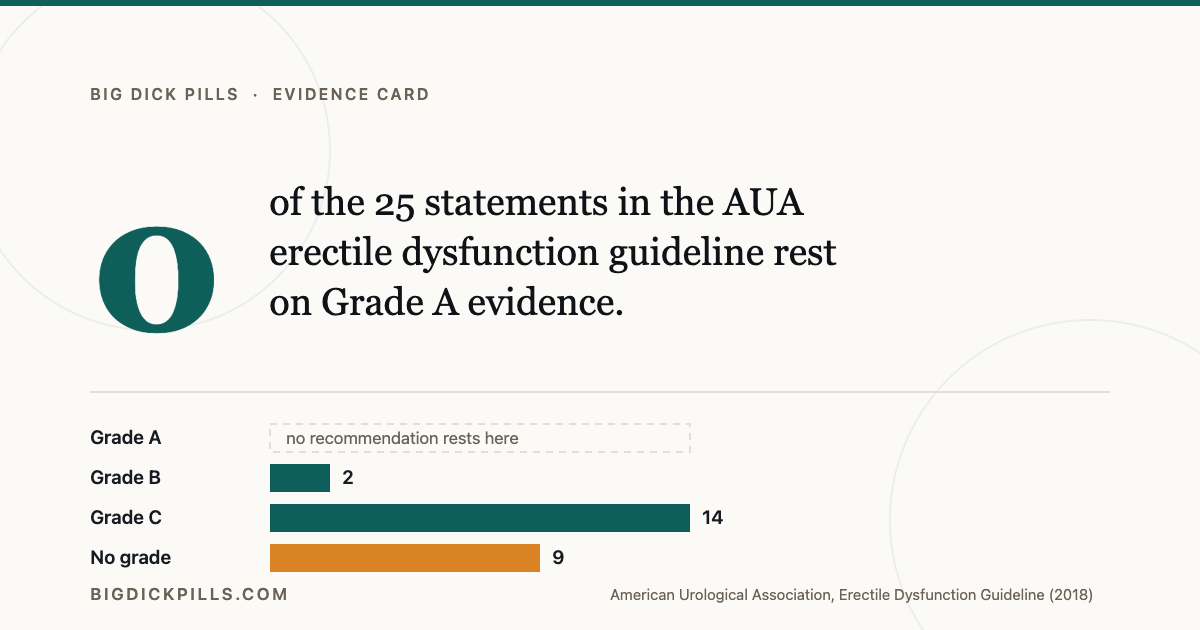
The AUA erectile dysfunction guideline reduced to its 25 statements, each with the two ratings the guideline itself keeps separate: how strongly the panel recommends it, and the grade of evidence behind it. The Evidence Card: The ED Treatment Evidence Card is the readable version with the print PDF; this page is the table, with CSV and JSON.
0 of 25
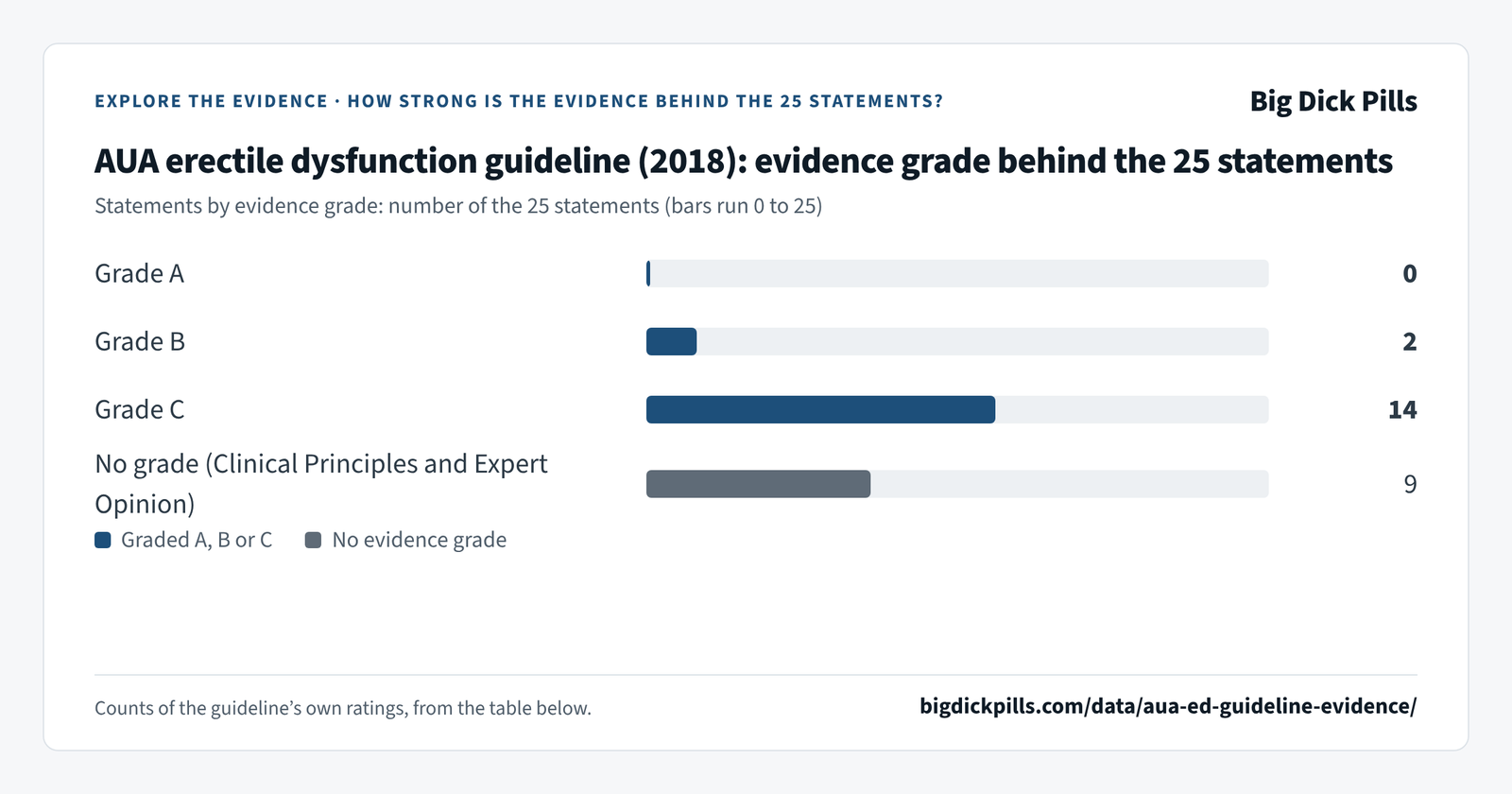
statements rest on Grade A evidence. 2 rest on Grade B, 14 on Grade C, and 9 carry no evidence grade (Clinical Principles and Expert Opinion).
| Statements | 25 |
|---|---|
| Strong recommendations | 4 |
| Moderate recommendations | 8 |
| Conditional recommendations | 4 |
| Clinical Principles / Expert Opinion | 6 / 3 |
| Source | Burnett AL et al., Erectile Dysfunction: AUA Guideline (2018) |
| Formats | CSV, JSON |
| License | CC BY 4.0, attribute Big Dick Pills |
| Checked | 24 September 2026 |
Explore the evidence
How strong is the evidence behind the 25 statements?
AUA erectile dysfunction guideline (2018): evidence grade behind the 25 statements
Statements by evidence grade: number of the 25 statements (bars run 0 to 25)
Graded A, B or CNo evidence grade
The guideline keeps two ratings separate: how strongly the panel recommends a statement, and the grade of evidence behind it. A low evidence grade means the trials are thin, not that the treatment fails. Source: Burnett et al., Erectile Dysfunction: AUA Guideline (2018).
AUA erectile dysfunction guideline (2018): recommendation strength of the 25 statements
Statements by recommendation strength: number of the 25 statements (bars run 0 to 25)
Strong, moderate or conditional recommendationClinical Principle or Expert Opinion
A strong recommendation on Grade C evidence is the panel’s judgement, and the table below shows both ratings so you can see which is which. Source: Burnett et al., Erectile Dysfunction: AUA Guideline (2018).
Counts of the guideline’s own ratings, from the table below. Not medical advice.
All 25 statements
Wording is our plain-language summary; the strength and grade are the guideline’s own.
| Treatment or action | What the guideline says | Recommendation strength | Evidence grade |
|---|---|---|---|
| Oral PDE5 inhibitors sildenafil, tadalafil, vardenafil, avanafil |
Should be discussed with every man with ED, unless contraindicated | Strong | B |
| PDE5i dose titration | Dose should be titrated for optimal effect | Strong | B |
| PDE5i usage instructions | Instructions should be given to maximise benefit | Strong | C |
| Penile prosthesis | Should be discussed as a treatment option | Strong | C |
| Vacuum erection device | Should be discussed as a treatment option | Moderate | C |
| Intracavernosal injections | Should be discussed as a treatment option | Moderate | C |
| Morning total testosterone | Should be measured in men with ED | Moderate | C |
| Lifestyle change diet, physical activity |
Improves overall health and may improve erectile function | Moderate | C |
| PDE5i plus testosterone | May be more effective together in men with testosterone deficiency | Moderate | C |
| Mental health referral | Should be considered to aid adherence and reduce anxiety | Moderate | C |
| Early PDE5i after prostate cancer treatment | Men should be told it may not improve spontaneous function | Moderate | C |
| Penile venous surgery | Not recommended | Moderate | C |
| Intraurethral alprostadil | Should be discussed as a treatment option | Conditional | C |
| Penile arterial reconstruction | May be considered in selected young men with focal arterial blockage | Conditional | C |
| Low-intensity shockwave therapy LI-ESWT, acoustic wave, GAINSWave |
Should be considered investigational | Conditional | C |
| Intracavernosal stem cell therapy | Should be considered investigational | Conditional | C |
| Platelet-rich plasma PRP, the “P-Shot” |
Should be considered experimental | Expert Opinion | None (ungraded) |
| History, examination, selective labs | Should be done in every man presenting with ED | Clinical Principle | None (ungraded) |
| ED as a cardiovascular warning | Men should be counselled that ED is a risk marker for heart disease | Clinical Principle | None (ungraded) |
| In-office test before intraurethral alprostadil | Should be performed | Clinical Principle | None (ungraded) |
| In-office test before injections | Should be performed | Clinical Principle | None (ungraded) |
| Counselling before prosthesis surgery | Post-operative expectations should be discussed | Clinical Principle | None (ungraded) |
| Prosthesis surgery during infection | Should not be performed | Clinical Principle | None (ungraded) |
| Validated questionnaires | Recommended to assess severity and track treatment | Expert Opinion | None (ungraded) |
| Specialised testing | May be necessary in some men to guide treatment | Expert Opinion | None (ungraded) |
How we built this
Each row is one numbered statement from the AUA guideline. The recommendation strength (Strong, Moderate, Conditional) and the evidence grade (A, B, C) are transcribed exactly as the guideline assigns them; statements the panel issued as Clinical Principles or Expert Opinion carry no grade and are marked as such rather than given one. The summary column is ours and is kept short on purpose; the guideline text is linked in the sources.
What this cannot tell you
A low evidence grade means the trials are thin, not that the treatment fails; a strong recommendation on Grade C evidence is the panel’s judgement, and the table shows both so you can see which is which. The guideline is written for clinicians treating populations. Not medical advice.
Use this data
The facts in this table (what a guideline says, what a label says, what a trial found) are not ours to own; repeat them anywhere. Our wording, table and layout are free to reuse, including commercially, under CC BY 4.0. Credit Big Dick Pills and link back; that is all we ask.
Download JSON for the AUA Erectile Dysfunction Guideline: Statements, Strength and Evidence Grade datasetThe same records; also embedded in this page as
bdp-ds-aua-json.Live JSONStable URL, CORS open: /data/aua-ed-guideline-evidence.json
JSON SchemaField definitions for every field in aua-ed-guideline-evidence.json.
The Evidence Card, print edition (PDF)Six pages: all 25 statements, the grade grid and the disclosure figures.
Sources
- Burnett AL, Nehra A, Breau RH, et al. Erectile Dysfunction: AUA Guideline. American Urological Association, 2018. AUA
- Half of ED treatment pages leave out that the treatment is investigational. Big Dick Pills, 12 September 2026. The disclosure figures on this page. Method and dataset
- Ergun O, Kim K, Kim MH, et al. Low-intensity shockwave therapy for erectile dysfunction. Cochrane Database of Systematic Reviews, 14 July 2025. Cochrane
Source links on this site are checked every month; last check . How sources are checked.