








 Topic hub
Erectile Dysfunction
Erectile dysfunction is common, treatable, and surrounded by more marketing than almost anything else in men’s health. What the guidelines say about causes, what the PDE5 inhibitors actually do, and when ED is a warning sign about your heart rather than your sex life.
Start here
Erectile dysfunction is not primarily a sexual problem. It is a vascular one that happens to show up during sex, and that distinction changes almost everything about how it should be investigated and treated.
An erection is a blood-flow event. It requires arteries that dilate on demand, a nervous system that signals correctly, hormones in a workable range, and an absence of the psychological interference that shuts the whole process down. Any of those four can fail. Most of the time, more than one is involved at once.
The arteries that supply the penis measure roughly 1 to 2 millimetres across. The coronary arteries that supply the heart measure 3 to 4. The same atherosclerotic plaque that has not yet meaningfully narrowed a coronary artery will already be causing trouble in a vessel half the width. That is the mechanism behind one of the most useful facts in men’s health: erectile dysfunction typically arrives two to five years before cardiac symptoms do.
The American Urological Association treats this seriously enough that counselling every man presenting with ED about his cardiovascular risk is a clinical principle, not a suggestion. A first appointment about erections that does not include blood pressure, lipids and a discussion of diabetes risk is an incomplete appointment.
What the evidence supports
PDE5 inhibitors are first-line and they work. Sildenafil, tadalafil and the rest are among the better-studied drugs in men’s health. They do not create erections out of nothing; they amplify the normal signalling pathway, which means they need arousal to work with. Men who conclude the tablet failed have often taken it on a full stomach, at too low a dose, or once.
Treating the symptom is not the same as treating the cause. A prescription that resolves the erection problem while leaving the untreated hypertension, prediabetes or sleep apnea underneath it has solved the least important half of the problem.
Lifestyle change has real trial evidence, which is unusual in this field. It is slower than a tablet and smaller in effect, and it works on the underlying vascular problem rather than around it. The two are not alternatives.
“Natural” alternatives are mostly a category error. The supplements marketed as natural Viagra either contain nothing that works or contain undeclared PDE5 inhibitors, which is the opposite of natural and considerably more dangerous than a prescription, because nobody has checked whether you are also taking nitrates.
Which article you need
If this is new and you want the overall picture (what it means, what it predicts, and what the treatment ladder actually looks like) start with trouble getting or staying hard.
If you want to know whether your problem is in your blood vessels or your head, there are reasonably reliable ways to tell without a clinic, and the physical-versus-psychological question covers them. Morning erections, situational variation and the speed of onset all carry information.
If a clinic has quoted you thousands for something a tablet costs pennies to try, the shockwave therapy evidence is worth an hour of your time first. Twenty-one randomised trials found a real effect that sits just below the size men actually perceive, the certainty rating is low, nine of those trials were paid for by the device makers, and the AUA still classes the treatment as investigational.
If a doctor has already offered you a prescription and you are trying to work out which one, the comparison between the four PDE5 inhibitors is the piece to read. The short version is that they work equally well and differ enormously in how long they last, and that most reported failures turn out to be dosing errors rather than the drug.
If you are weighing a prescription against something from a shop, the comparison between Viagra and “natural” fixes sets out what is actually in those products, including the FDA’s findings on undeclared drug ingredients.
If you would rather work on the cause than the symptom, what exercise and diet actually achieve covers the trials, the effect sizes and the realistic timeline.
And if the erections changed gradually rather than suddenly, what that says about your arteries is the most important article in this section. In men with confirmed coronary disease, two thirds developed the erectile dysfunction first, on average a little over three years before any cardiac symptom appeared.
And if the tablets have already failed you, what comes after them covers injections, vacuum devices and implants with their actual efficacy and complication rates. It also covers the more common finding: when 250 men referred as non-responders were examined properly, 68.8 percent had simply been taking the drug wrong.
If you want to see how strong the evidence behind each treatment actually is, the ED treatment evidence card lists every statement in the AUA guideline with the grade it carries, and our audit of ED treatment pages shows how often clinics leave out that shockwave, PRP and stem cell therapy are investigational.
What else is worth reading
Erectile dysfunction sits at the intersection of several other things on this site. Obstructive sleep apnea roughly doubles the odds of ED and is undiagnosed about eighty percent of the time. Antidepressants are a common and frequently unmentioned cause. Testosterone matters for desire more than for erections, which is a distinction that gets blurred constantly. And alcohol has an evidence base here that looks encouraging until you understand who ends up in the abstainer group.
If you take one thing from this section: a new erection problem in a man over 40 is a reason to have your cardiovascular risk assessed. Not eventually. Now.
Related topics
Several other sections overlap with this one. Hormones are covered in testosterone and male vitality, antidepressants and performance anxiety in mental health and libido, and the blood pressure, blood sugar and weight behind most vascular erection problems in weight and metabolic health and general men’s health. Finishing too soon is a separate condition, covered in premature ejaculation.
All articles in this section
-
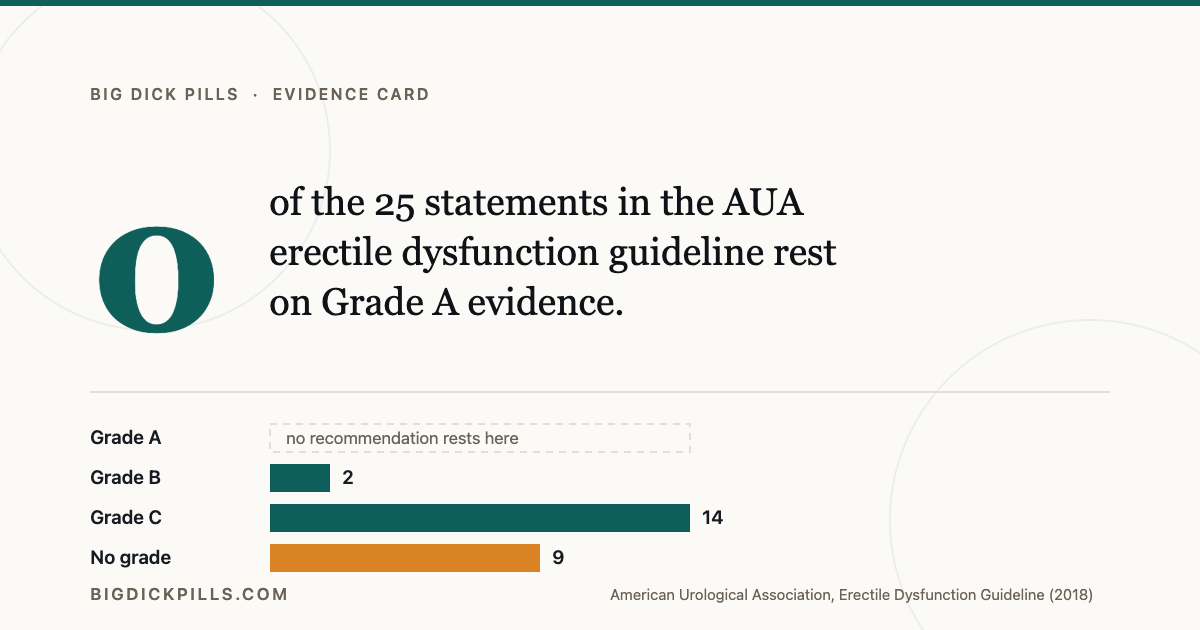
The ED Treatment Evidence Card
Every treatment in the AUA erectile dysfunction guideline, with the recommendation strength and evidence grade it actually carries. Zero statements rest on Grade A evidence.
-
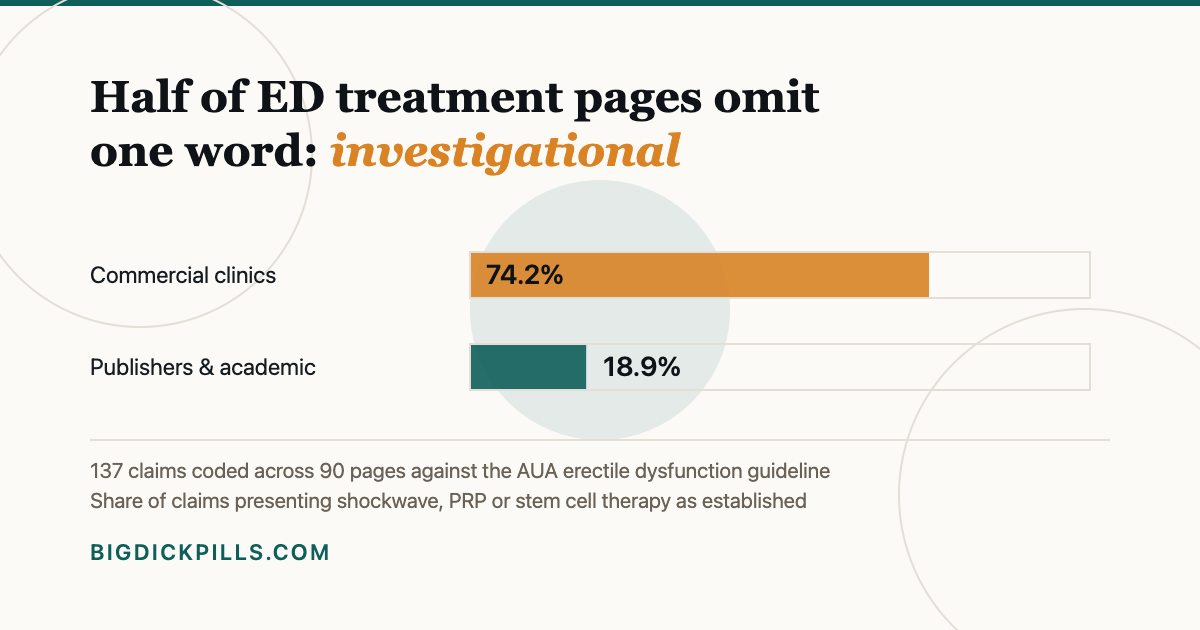
Half of ED Treatment Pages Leave Out That the Treatment Is Investigational
We coded 137 claims across 90 pages against the AUA guideline. Half omitted that shockwave, PRP and stem cell therapy are investigational, and commercial clinics omitted it four times as often as publishers.
-

When the Pills Do Not Work: Injections, Vacuum Devices and Implants
Around a third of men do not respond to PDE5 inhibitors, but most of them were taking the drug wrong. For those who genuinely fail, injections, vacuum devices and implants all have real numbers…
-

Erectile Dysfunction Is a Cardiovascular Symptom, and It Arrives First
The arteries that fail first are the smallest ones. In men with confirmed coronary disease, two thirds developed erectile dysfunction first, a mean of 38.8 months before any cardiac symptom.
-

Shockwave Therapy for ED: A Real Effect, Just Below What You Would Notice
Twenty-one randomised trials found a 3.89-point improvement in erectile function. The smallest change men actually notice is about 4 points. Nine of the trials were funded by the device makers, and the average course…
-
Viagra, Cialis and the Rest: You Are Choosing a Duration, Not a Strength
Sixteen randomised trials in 5,189 men found no difference in how well tadalafil and sildenafil work. What separates the four PDE5 inhibitors is half-life, food, and which side effect you would rather have.
-
Exercise and Diet for Erections: What the Trials Actually Show
Aerobic exercise improved erectile function by 4.9 points in men with severe dysfunction: within range of a prescription drug. The dose, the weight-loss trial, and the honest limits.
-
Viagra Versus “Natural” ED Fixes: The Difference Is Not What You Think
The FDA found hidden sildenafil in 47% of the adulterated sexual enhancement supplements it flagged. The reason a natural pill sometimes works is often that it is not natural.
-

Physical or Psychological? How to Tell Which Erection Problem You Have
Sudden onset with morning erections preserved points one way. Gradual onset with them fading points the other, and that version is telling you something about your arteries.
-
Trouble Getting or Staying Hard: What It Means, and What Works
Penile arteries are 1 to 2 mm across; coronary arteries are 3 to 4 mm. That is why erectile dysfunction usually arrives years before heart symptoms, and why the work-up matters as much as…