









 By
By 
In January 2026 the US Dietary Guidelines for Americans quietly dropped their numeric alcohol limits. The old advice, no more than two drinks a day for men, one for women, was replaced with a general instruction to drink less, with no number, no standard-drink definition and no cited evidence. Whatever else that is, it is not clarity.
Two major US reviews landed within weeks of each other in January 2025 and appeared to disagree. The Surgeon General’s advisory established alcohol as a causal contributor to at least seven cancers. The National Academies found moderate drinking associated with lower all-cause and cardiovascular mortality, at moderate certainty. Both can be true: alcohol raises cancer risk with no safe floor, while the cardiovascular signal is confounded and unreliable. For men specifically, chronic drinking lowers testosterone and raises estradiol, worsens sleep apnea measurably, and the apparent protection against erectile dysfunction in observational data is almost certainly an artefact of who abstains.
| Less than 1 drink per week | About 10.0% |
|---|---|
| 1 drink per day | About 11.4% |
| 2 drinks per day | About 13.1% |
| Surgeon General advisory (Jan 2025) | Alcohol is a causal contributor to at least seven cancers |
| National Academies review | Moderate drinking associated with lower all-cause mortality, moderate certainty |
| Why both can be true | Cancer risk has no safe floor; the cardiovascular signal is confounded |
| Effect on testosterone in men | Chronic drinking lowers it and raises estradiol |
| Effect on sleep apnea | Measurably worse |
| Apparent protection against ED in observational data | Almost certainly an artefact of who abstains |
Why did two 2025 reviews disagree about alcohol?
January 2025 produced two authoritative American assessments of alcohol, and the headlines made them sound contradictory.
The Surgeon General’s advisory named alcohol a leading preventable cause of cancer and called for cancer warning labels on alcoholic drinks. It identified causal links to at least seven cancer sites: breast, colorectum, esophagus, liver, mouth, pharynx and larynx. An MD Anderson survey found nearly 60% of US adults were unaware of, or uncertain about, the alcohol–cancer link at all.
The National Academies review, commissioned to inform the dietary guidelines, systematically reviewed evidence on moderate drinking, up to two drinks or 28 grams a day for men. It concluded, at moderate certainty, that moderate consumption is associated with lower all-cause mortality and lower cardiovascular mortality than never drinking. It also found, at moderate certainty, higher breast cancer risk in women, and could draw no conclusion at all on oral, pharyngeal, esophageal or laryngeal cancer.
No conclusion in that review reached high certainty. The committee said plainly that randomised trials would be required for that, and randomised trials of lifetime drinking do not exist and will not.
These findings are not actually in conflict. They are answers to different questions from different evidence bases. One asking whether alcohol causes cancer, which mechanistic and epidemiological evidence answers yes, and one asking what happens to the mortality of people who report drinking moderately, which is a question about a population, not a substance.
How much does alcohol raise cancer risk?
Relative risks are easy to misread. The advisory gives absolute lifetime figures, drawn from a cohort of 226,162 people, for a man’s cumulative risk of developing any alcohol-related cancer by age 80:
| Intake | Lifetime risk of an alcohol-related cancer |
|---|---|
| Less than 1 drink per week | about 10.0% |
| 1 drink per day | about 11.4% |
| 2 drinks per day | about 13.1% |

Read that honestly in both directions. Going from near-abstinence to two drinks a day moves roughly three men in every hundred from no alcohol-related cancer to one, which is a large number across a population and a modest one for any individual. It is also a real increase with no threshold below which risk stops rising. If you are trying to drink less, what the GLP-1 trials show about alcohol is covered separately.
Related: Which cholesterol number predicts a heart attack · All general men’s health articles
Is moderate drinking good for your heart?
The observation that moderate drinkers outlive abstainers is old, robust in the data, and probably wrong as a causal claim. Three problems recur.
Sick quitters. The “never drinks” category in cohort studies absorbs people who stopped because of illness, medication, or a drinking problem. Comparing drinkers to that group flatters drinking.
Moderate drinking travels with other things. In most Western cohorts, people who drink moderately are wealthier, more socially connected, more likely to be employed and more likely to exercise. Statistical adjustment is imperfect against a confounder that broad.
Genetic studies do not reproduce it. Mendelian randomisation designs, which use genetic variants affecting alcohol metabolism as a natural experiment and are less vulnerable to those confounders, have generally not found the cardiovascular benefit.
The National Academies committee was explicit that certainty was moderate at best and never high. The honest reading is that the protective signal may be real and small, or may be an artefact, and it is not a reason to start drinking, which is a conclusion every version of the evidence supports.

Does alcohol lower testosterone?
Here the men’s-health-specific evidence is more consistent than the mortality literature.
A meta-analysis pooling 21 studies and 10,199 men found that chronic alcohol consumption in otherwise healthy men was associated with significantly lower total testosterone, lower free testosterone and lower sex hormone binding globulin, alongside raised estradiol. Luteinising hormone was unchanged, which is informative, because it points to the problem being at the testis rather than the pituitary telling it to stop.
Two caveats worth stating. The analysis covered chronic exposure in healthy men, not acute drinking and not alcohol use disorder, where the effects are larger. And the mechanism is not fully worked out.
The practical point stands: if you are having your testosterone checked because you feel flat and tired, a habitual four drinks a night is part of the reading. What testosterone results actually mean is covered separately.
Does alcohol cause erectile dysfunction?
This one is genuinely counterintuitive, and it is a good test of whether you have absorbed the confounding problem above.
A dose-response meta-analysis of 24 studies and 154,295 men found that light-to-moderate drinking, under 21 drinks a week, was associated with lower odds of erectile dysfunction, at an odds ratio of 0.71. Heavy drinking above 21 a week showed no association either way. The curve was significantly non-linear, an inverted U.
Take that at face value and you would conclude that a couple of drinks a night is good for your erections. Almost certainly not. The same abstainer problem applies with extra force here: men who do not drink at all include men with diabetes, cardiovascular disease, liver disease and heavy medication burdens: all of which cause erectile dysfunction directly. And a study design that asks men to recall both their drinking and their erectile function has obvious limits.
What is not in dispute is the acute effect, which every man who has drunk heavily has observed for himself, and the chronic one: sustained heavy drinking damages nerves, vessels and the liver, and all three routes end at the same place. The ED section covers the causes that are actually worth investigating.
How does alcohol affect sleep?
The nightcap is the most defended and least defensible piece of drinking behaviour. Alcohol shortens the time it takes to fall asleep and degrades everything that happens afterwards.
A meta-analysis of studies measuring breathing during sleep found that after drinking, the apnea-hypopnea index rose by 3.98 events per hour and the lowest recorded oxygen saturation fell by 2.72%. Snoring got worse in people who already snored, though alcohol did not turn non-snorers into snorers, which suggests it worsens an existing airway problem rather than creating one.
Four events per hour sounds trivial until you notice it is most of the width of the mild category. A man sitting at an index of 12 is moderate by the time he has had three drinks. The sleep apnea article explains why that matters more than it sounds.
So how much is safe to drink?
The federal guidelines no longer give one, which leaves you assembling it yourself. What the evidence supports:
- There is no intake at which cancer risk stops rising. Less is lower. That is the shape of the curve, and it has no flat portion at the bottom.
- The cardiovascular benefit is not solid enough to act on, and no version of the evidence recommends starting to drink.
- Pattern matters as much as volume. Fourteen drinks over a week is a different exposure from fourteen on a Saturday, and the second is worse for essentially every outcome.
- The old two-a-day figure is still a reasonable ceiling for a man who drinks, not because it is safe, but because it is where the evidence of harm becomes hard to argue with.
- If you drink to sleep, to unwind, or to have sex, the drinking is treating a problem that has a better treatment. That is the most useful thing on this page.
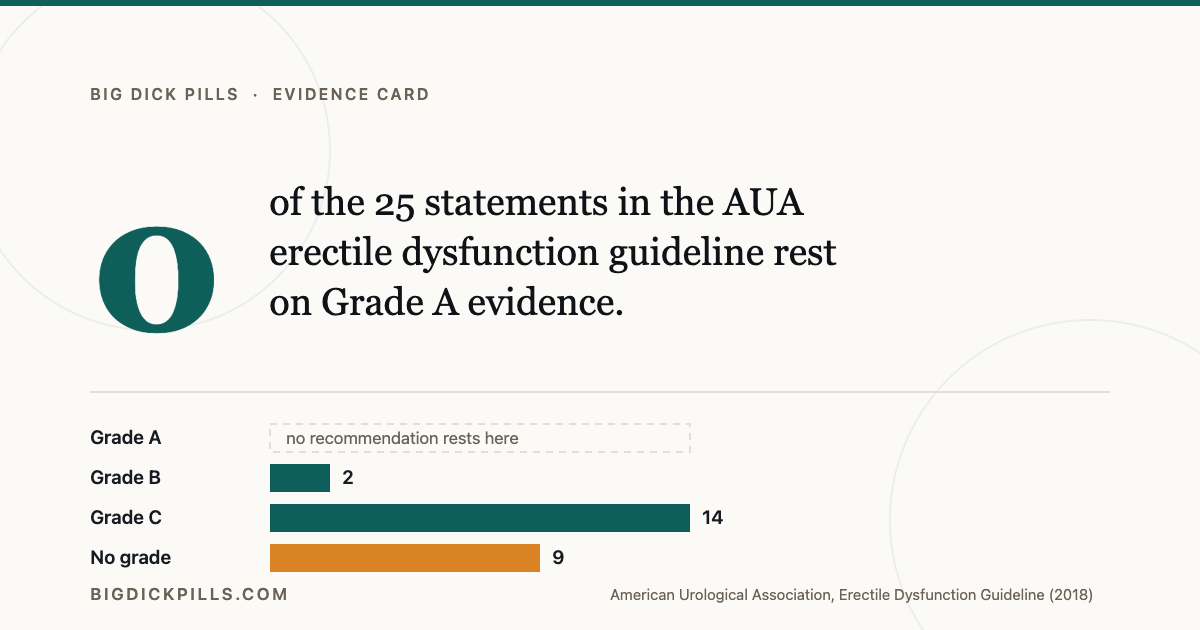
Screening for unhealthy alcohol use is a Grade B recommendation for every adult in the United States, meaning your doctor is supposed to ask, and the conversation is a covered service. The rest of the screening list is here.
Common questions about alcohol and men’s health
How much does alcohol increase cancer risk?
In absolute terms: lifetime risk of an alcohol-related cancer is about 10.0 percent at less than one drink a week, 11.4 percent at one drink a day, and 13.1 percent at two drinks a day. The Surgeon General advisory of January 2025 established alcohol as a causal contributor to at least seven cancers, with no safe floor.
Is moderate drinking actually good for your heart?
The National Academies review did find moderate drinking associated with lower all-cause and cardiovascular mortality at moderate certainty, but the signal is heavily confounded. The comparison group of abstainers includes people who stopped drinking because they became unwell, which makes drinkers look healthier than they are.
Does alcohol lower testosterone?
Chronic drinking does, and it also raises estradiol. That is a direct hormonal effect rather than an indirect one through weight or sleep, though those add to it. A single heavy night is not the concern; sustained intake is.
Does alcohol cause erectile dysfunction?
Acutely, yes, and most men have experienced it. Observational data sometimes appear to show moderate drinkers having less erectile dysfunction than abstainers, but that is almost certainly an artefact of who abstains, since people often stop drinking because of illness. Alcohol also worsens sleep apnea, which is independently linked to ED.
How much alcohol is safe for a man?
There is no threshold below which cancer risk disappears, which is the finding that changed the framing. The reasonable reading of both 2025 reviews together is that less is better for cancer risk, that the apparent cardiovascular benefit is unreliable, and that the specific male effects on testosterone and sleep argue for less rather than more.
Sources
- Office of the Surgeon General. Alcohol and Cancer Risk: The U.S. Surgeon General’s Advisory, 2025. NCBI Bookshelf
- National Academies of Sciences, Engineering, and Medicine. Review of Evidence on Alcohol and Health, 2025. National Academies
- Santi D, et al. The chronic alcohol consumption influences the gonadal axis in men: results from a meta-analysis. Andrology, 2024. Andrology
- Alcohol intake and risk of erectile dysfunction: a dose–response meta-analysis of observational studies. International Journal of Impotence Research, 2018. IJIR
- Burgos-Sanchez C, et al. Impact of Alcohol Consumption on Snoring and Sleep Apnea: A Systematic Review and Meta-analysis. Otolaryngology–Head and Neck Surgery, 2020. OHNS
- US 2025–2030 Dietary Guidelines: Addressing Alcohol Intake Recommendations. HCPLive, 2026. HCPLive
This article is for information only and is not medical advice. It cannot account for your individual circumstances. Talk to a doctor about your own situation, particularly before starting or stopping any prescription medication.
Cite this page: Big Dick Pills, “Alcohol and Men’s Health: What the 2025 Reviews Actually Found”, bigdickpills.com/general-health/alcohol-and-mens-health/ (updated ).
Source links on this site are checked every month; last check . How sources are checked.