







 By
By 
One of the more interesting things about the GLP-1 era is that a side effect nobody was looking for turned up in enough anecdotes to become a research question. People kept saying, unprompted, that they had stopped wanting to drink.
Get emergency care now if you are on a GLP-1 medication and have severe abdominal pain that does not go away, especially with vomiting – this can signal pancreatitis, a rare but serious risk of these drugs.
See a doctor before starting if you have a personal or family history of medullary thyroid carcinoma or MEN 2 syndrome – these are the FDA’s specific contraindications, not general caution.
A routine visit is fine to discuss weight or metabolic health generally, including whether a GLP-1 medication is appropriate for you.
Who to see: a primary care doctor can start the conversation; an endocrinologist or obesity-medicine specialist can manage more complex cases.
Worth asking: what happens when you stop the medication – most people regain weight without ongoing lifestyle support, which is worth planning for up front.
Two randomised trials have now tested it. A phase 2 trial of 48 adults with alcohol use disorder found that nine weeks of low-dose semaglutide reduced how much they drank in a laboratory setting, with medium-to-large effect sizes, and cut drinks per drinking day and craving. A larger trial of 108 people with alcohol use disorder and obesity, run alongside cognitive behavioural therapy for 26 weeks, found a 41.1% reduction in heavy drinking days against 27.4% on placebo. The signal is real. The trials are small and short, the doses were low, and no GLP-1 is approved for alcohol use disorder.
| Trial 1 design | 48 adults with alcohol use disorder, 9 weeks, low-dose semaglutide, laboratory drinking measure |
|---|---|
| Trial 1 result | Reduced laboratory drinking with medium-to-large effect sizes; fewer drinks per drinking day; less craving |
| Trial 2 design | 108 people with alcohol use disorder and obesity, 26 weeks, alongside cognitive behavioural therapy |
| Trial 2 result | 41.1% reduction in heavy drinking days vs 27.4% on placebo |
| Doses used | Low, below typical weight-management doses |
| Approval status | No GLP-1 is approved for alcohol use disorder anywhere |
| Overall read | The signal is real; the trials are small and short |
Why do people on GLP-1s drink less?
Anecdote is a poor guide to pharmacology, and the history of medicine is full of effects that were obvious to everyone and turned out not to exist. But anecdote is a perfectly good guide to what to test, and the reports here were unusual in two respects: they were unsolicited, and they described a loss of interest rather than an effort of will.
People were not saying the drug helped them resist. They were saying the wanting had gone quiet. That is a specific enough claim to design a trial around.
What did the first randomised trial find?
The first randomised test was published in JAMA Psychiatry. It enrolled 48 adults with alcohol use disorder, 71% female, mean age 39.9, who were not seeking treatment for their drinking, at a US academic medical centre.
Doses were low by weight-loss standards: 0.25 mg weekly for four weeks, 0.5 mg for four weeks, then 1.0 mg for one week. For comparison, the weight indication goes to 2.4 mg.
The primary measure was a laboratory self-administration test, participants were given access to alcohol and researchers measured what they actually drank, rather than relying on recall. Semaglutide reduced grams of alcohol consumed and peak breath alcohol concentration, with medium-to-large effect sizes.
Outside the laboratory, it reduced drinks per drinking day and craving, with the effect growing over time, small in weeks 1 to 4, large by weeks 5 to 8, reaching a Cohen’s d of 0.80 for drinks per drinking day at the higher dose.
One finding cuts against a simple reading: semaglutide did not change average drinks per calendar day. It changed how much people drank when they drank, not how often they drank at all.
Related: Tirzepatide vs semaglutide · All weight and metabolic health articles
What did the larger trial find?
The second trial was bigger, longer and enrolled people who wanted help. It randomised 108 treatment-seeking patients with both alcohol use disorder and obesity to weekly semaglutide or placebo for 26 weeks. Everyone also received standard cognitive behavioural therapy.
Heavy drinking days fell by 41.1% in the semaglutide group against 27.4% on placebo, so the drug added roughly 14 percentage points on top of what therapy alone achieved.
The researchers put the number needed to treat at 4.3, which compares favourably with approved medications for alcohol use disorder, where the figure is typically 7 or higher. Adverse effects were mainly gastrointestinal, described as transient and mild.
What has not been established yet?
Four things are worth holding onto before anyone treats this as settled.
The trials are small. Forty-eight and 108 participants. These are the sizes at which promising findings frequently fail to replicate.
They are short. Nine weeks and 26 weeks. Alcohol use disorder is a condition measured in decades.
The populations were specific. The larger trial required obesity alongside alcohol use disorder. An earlier study found no overall effect on heavy drinking, with benefit confined to the obesity subgroup, which suggests the effect may not generalise to people of normal weight.
It is not an approved use. No GLP-1 is licensed for alcohol use disorder anywhere. Prescribing for it is off-label, and obtaining the drug for this reason outside a clinical relationship means the compounded market, with everything that entails.
Why would a diabetes drug affect drinking?
The plausible account is that GLP-1 receptors are not confined to the gut. They appear in brain regions involved in reward and motivation: the same circuitry that governs appetite for food also handles appetite for other things.
If that is right, the drugs are not treating alcohol specifically. They are turning down a general reward signal, and alcohol is one of the things that signal points at. That would also explain scattered reports about nicotine and other compulsive behaviours, though those are anecdote at the stage this was two years ago.
Why does this matter more for men?
Both trials skewed female: 71% in the smaller one. Men drink more, drink more heavily, and have higher rates of alcohol use disorder than women in most populations, which means the group with the most to gain is the group least represented in the evidence.
It also intersects with everything else on this site. Chronic drinking lowers testosterone and raises estradiol, across 21 studies and 10,199 men. It worsens sleep apnea by about four events an hour. It is a cause of erectile dysfunction by three separate routes. A drug that reduced heavy drinking would improve all of those downstream, but so would reducing heavy drinking by any other means.
What should you actually do with this?
If you are already on a GLP-1 for weight and have noticed you are drinking less, that is consistent with the trial evidence and is a genuine benefit worth keeping.
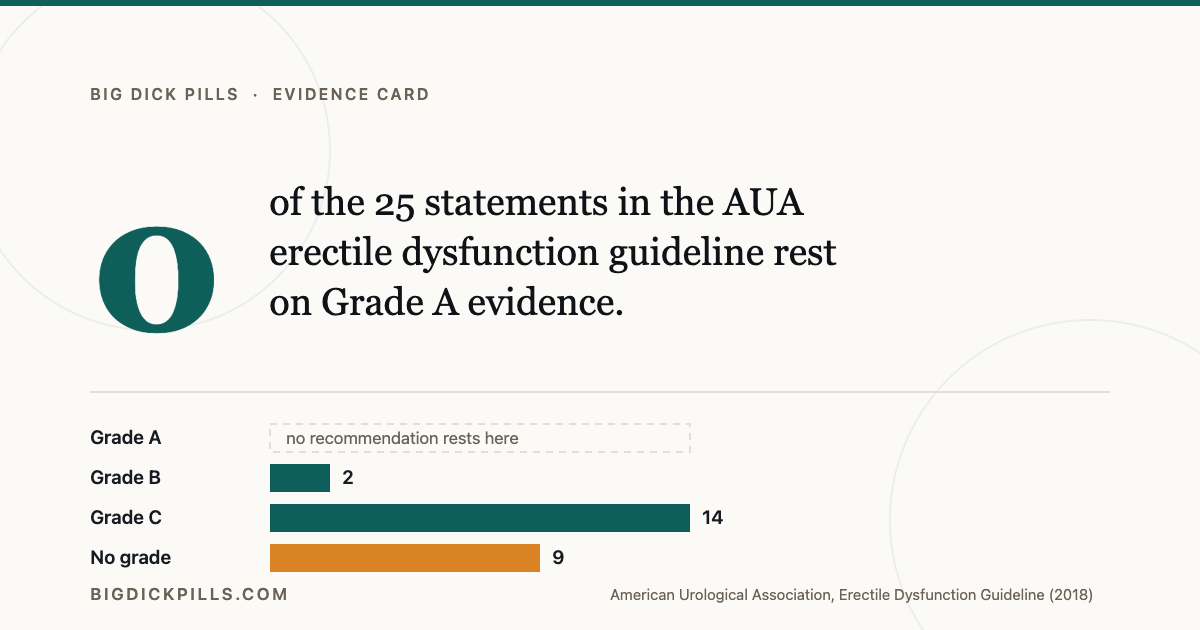
If you are drinking in a way that worries you, the route to help is not a weight-loss drug obtained on the strength of two small trials. Screening for unhealthy alcohol use is a Grade B recommendation for every adult in the United States, which means your doctor is supposed to ask and the conversation is a covered service. The treatments that are approved have decades of evidence behind them.
And if you are considering a GLP-1 primarily for this reason, the honest position is that the science is early, promising, and not yet a basis for treatment. That may change. It has not changed yet.
This is a sensitive area, and if drinking is affecting your health or your life, a doctor is a better first call than a website. The wider alcohol evidence is here.
Common questions about GLP-1s and alcohol
Do GLP-1 drugs reduce alcohol cravings?
Two randomised trials now say yes. A nine-week trial in 48 adults found reduced laboratory drinking with medium-to-large effect sizes, fewer drinks per drinking day and less craving. A 26-week trial in 108 people found a 41.1 percent reduction in heavy drinking days against 27.4 percent on placebo. The signal is consistent but the trials are small.
Is semaglutide approved for alcohol use disorder?
No. No GLP-1 is approved for alcohol use disorder in any jurisdiction. The evidence is at the stage of promising phase 2 results, and the doses used in these trials were lower than typical weight-management doses. Anyone prescribing for this indication is working well ahead of the evidence.
Can you drink alcohol while taking a GLP-1?
There is no absolute prohibition, but two practical issues apply. Alcohol on a substantially reduced food intake hits harder and faster. And alcohol is calorie-dense and appetite-disinhibiting, which works directly against what the drug is doing.
Why would a weight loss drug affect drinking at all?
The leading explanation is that GLP-1 receptors are present in brain regions involved in reward and craving, not only in appetite regulation. If the drugs damp reward signalling generally rather than food reward specifically, an effect on alcohol follows naturally. That mechanism is plausible and not yet established.
Should I take a GLP-1 to cut down my drinking?
Not on this evidence alone, and not instead of treatment that works. Alcohol use disorder has established treatments with far larger evidence bases. What these findings reasonably support is a conversation with a clinician if you are already a candidate for a GLP-1 and also drinking more than you want to.
Sources
- Hendershot CS, et al. Once-Weekly Semaglutide in Adults With Alcohol Use Disorder: A Randomized Clinical Trial. JAMA Psychiatry, 2025. JAMA Psychiatry
- National Institutes of Health. Adding weekly GLP-1 to cognitive behavioral therapy further reduces heavy drinking. NIH
- Effects of glucagon-like peptide-1 receptor agonists on alcohol consumption: a systematic review and meta-analysis. eClinicalMedicine. eClinicalMedicine
This article is for information only and is not medical advice. It cannot account for your individual circumstances. Talk to a doctor about your own situation, particularly before starting or stopping any prescription medication. Alcohol use disorder is a serious condition and is best discussed with a clinician.
Cite this page: Big Dick Pills, “GLP-1s and Alcohol: The Craving Signal, and What the Trials Actually Show”, bigdickpills.com/weight-metabolic/glp1-and-alcohol/ (updated ).
Source links on this site are checked every month; last check . How sources are checked.