









 By
By 
This is the question that determines whether a GLP-1 is a treatment you take or a course you finish, and there is a specific trial that answers it. The answer is not encouraging, and it is not a reason to avoid the drugs. It is a reason to understand what you are starting.
Get emergency care now if you are on a GLP-1 medication and have severe abdominal pain that does not go away, especially with vomiting – this can signal pancreatitis, a rare but serious risk of these drugs.
See a doctor before starting if you have a personal or family history of medullary thyroid carcinoma or MEN 2 syndrome – these are the FDA’s specific contraindications, not general caution.
A routine visit is fine to discuss weight or metabolic health generally, including whether a GLP-1 medication is appropriate for you.
Who to see: a primary care doctor can start the conversation; an endocrinologist or obesity-medicine specialist can manage more complex cases.
Worth asking: what happens when you stop the medication – most people regain weight without ongoing lifestyle support, which is worth planning for up front.
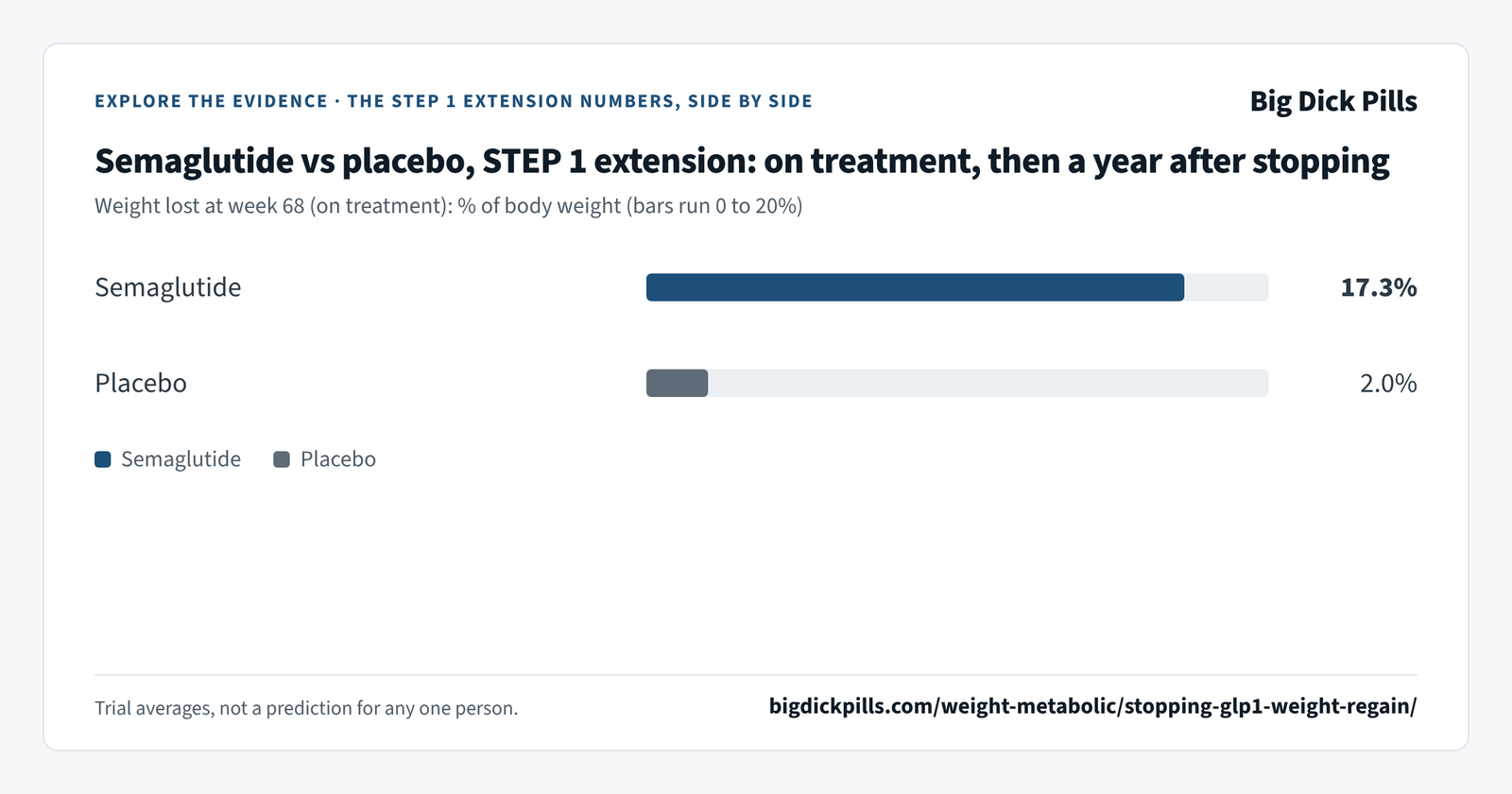
In the STEP 1 extension, participants who had lost 17.3% of their body weight on semaglutide regained about two-thirds of it within a year of stopping. Net loss from where they started was 5.6%. Blood pressure returned to baseline. But 48% still held onto at least 5% weight loss, and the lipid and inflammation improvements partly persisted. It is a chronic-condition drug, not a course of treatment.

| Weight lost on treatment (STEP 1, week 68) | 17.3% |
|---|---|
| Regained in the year after stopping | About two-thirds of it (+11.6 percentage points) |
| Net loss from baseline at week 120 | 5.6% |
| Still holding at least 5% loss at week 120 | 48.2% |
| Blood pressure after stopping | Returned to baseline |
| Lipid and inflammation markers | Improvements partly persisted |
| What this means | A chronic-condition drug, not a course of treatment |
What happens when you stop taking semaglutide?
STEP 1 was the trial that established semaglutide 2.4 mg for weight loss. A subset of 327 participants (228 on semaglutide, 99 on placebo) were followed for a further year after the treatment stopped, with no drug and no continued lifestyle support.
That design is what makes it useful. It is not a study of people who chose to stop; it is a controlled observation of what the body does when the drug is removed.
What comes back, and what does not?
| Semaglutide | Placebo | |
|---|---|---|
| Weight change at week 68 (on treatment) | −17.3% | −2.0% |
| Regained over the following year | +11.6 points | +1.9 points |
| Net change at week 120 | −5.6% | −0.1% |
| Still holding ≥5% loss at week 120 | 48.2% | , |
Two readings of that table are both true, and most coverage picks one.
The pessimistic reading: two-thirds of the loss came back in twelve months, and the trajectory at the end of the follow-up was still upward. There is no reason to think it stopped at 5.6%.
The optimistic reading: a year after stopping, the average participant was still 5.6% lighter than when they started, and almost half retained a clinically meaningful loss. That is better than most weight-loss interventions manage while people are still doing them.
On the cardiometabolic markers, the split was similar. Blood pressure improvements reverted to baseline. Lipid profile and C-reactive protein, a marker of inflammation, retained some benefit relative to where participants started, though most variables drifted back toward baseline.
Related: GLP-1 side effects · Who qualifies for a GLP-1 · All weight and metabolic health articles
Explore the evidence
The STEP 1 extension numbers, side by side
Semaglutide vs placebo, STEP 1 extension: on treatment, then a year after stopping
Weight lost at week 68 (on treatment): % of body weight (bars run 0 to 20%)
Regained over the following year: percentage points of body weight (bars run 0 to 20)
Net weight lost at week 120: % of the starting weight (bars run 0 to 20%)
SemaglutidePlacebo
A subset of 327 participants (228 on semaglutide, 99 on placebo) was followed for a further year after treatment stopped, with no drug and no continued lifestyle support. Source: Wilding et al., STEP 1 trial extension, 2022.
Trial averages, not a prediction for any one person. Not medical advice.
Why does the weight come back?
Not because of willpower, and not because the drug did something that needed undoing.
These drugs work by mimicking a gut hormone that signals fullness and slows stomach emptying. While the drug is present, appetite is suppressed and portions shrink without effort. Remove it and that signal goes; appetite returns to where the body’s own regulation puts it.
The body also defends a reduced weight actively. After substantial weight loss, resting energy expenditure falls by more than the loss of tissue alone accounts for, and hunger hormones shift in the direction of eating more. That response is well documented across every kind of weight loss, and it does not switch off with time.
So the regain is the expected behaviour of a system whose only counterweight has been removed. It is the same reason blood pressure rises again when an antihypertensive is stopped, and nobody describes that as the patient failing.
Is a GLP-1 a course or a permanent treatment?
This is the honest way to think about it, and it has practical consequences.
If obesity is a chronic condition and these drugs treat it, then stopping is not “finishing”. It is discontinuing treatment for a condition that is still there. On current evidence, sustained benefit requires sustained treatment.
The counterpoint worth acknowledging: the SELECT trial followed people for up to four years and found weight loss continued to about week 65 and then held steady for the remaining years, with no rebound while treatment continued. So the drugs do not stop working. The plateau is real and stable; it is the withdrawal that is the problem.
Two things follow. Budget for a prescription rather than a course. These are expensive, insurance coverage for weight indications is inconsistent, and running out is not a neutral event. And if cost or supply is likely to force a stop, that is worth discussing with a prescriber before starting rather than after.
What should you actually do about it?
Do not treat the drug as the whole intervention. The period on treatment, when appetite is genuinely easier to manage, is the best opportunity you will get to build the habits that have to carry the weight afterwards. That is not a moralising point; it is the practical implication of a drug that makes the hard part temporarily easy.
Protect muscle while you are losing. Weight regained after a loss tends to come back disproportionately as fat, so lean tissue lost on the way down is not automatically recovered. That is the main argument for resistance training and adequate protein throughout: the body composition data are here.
Know that a lower dose may hold what a higher dose achieved. Maintenance dosing is an active area of practice, and it is a conversation worth having rather than a binary between full dose and nothing.
And if the underlying question is whether these drugs are worth starting at all, the efficacy and cardiovascular data are in what the trials actually show.
Common questions about stopping a GLP-1
Will I regain all the weight if I stop Ozempic or Wegovy?
Most of it, but not all. In the STEP 1 withdrawal extension, people who had lost 17.3 percent regained roughly two-thirds within a year, leaving a net loss of 5.6 percent from where they started. Nearly half were still holding at least a 5 percent loss at the two-year mark.
How fast does the weight come back?
Regain begins within weeks of stopping and continues over about a year. The mechanism is straightforward: appetite suppression ends, so the appetite returns, and with it the intake that produced the original weight. There is no evidence these drugs reset a long-term set point.
Can you taper off a GLP-1 instead of stopping abruptly?
Tapering is commonly done and may soften the transition, but it does not change the underlying picture, because the effect depends on the drug being present. What appears to matter more is what replaces it: sustained resistance training, protein intake and the behavioural changes built while on treatment.
Do the health benefits disappear too?
Not all of them. Blood pressure returned to baseline in the withdrawal study, but lipid and inflammatory improvements partly persisted. That pattern suggests some benefit is carried by the weight itself and some by changes that outlast it.
Is it worth taking a GLP-1 if the weight returns?
That depends on what you are treating. For someone with established cardiovascular disease, the trial evidence is about preventing cardiac events rather than about the number on the scale. For weight alone, the honest framing is a long-term treatment for a chronic condition, in the same way blood pressure medication works only while taken.
Sources
- Wilding JPH, Batterham RL, Davies M, et al. Weight regain and cardiometabolic effects after withdrawal of semaglutide: the STEP 1 trial extension. Diabetes, Obesity and Metabolism, 2022. PubMed
- Ryan DH, Lingvay I, Deanfield J, et al. Long-term weight loss effects of semaglutide in obesity without diabetes in the SELECT trial. Nature Medicine, 2024. Nature Medicine
This article is for information only and is not medical advice. It cannot account for your individual circumstances. Talk to a doctor about your own situation, particularly before starting or stopping any prescription medication.
Cite this page: Big Dick Pills, “What Happens When You Stop a GLP-1”, bigdickpills.com/weight-metabolic/stopping-glp1-weight-regain/ (updated ).
Source links on this site are checked every month; last check . How sources are checked.