










 By
By 
These are the most effective weight-loss drugs ever brought to market, and the trial evidence behind them is unusually good. There is also a finding in that evidence that men in particular should know, and that almost nobody reports.
Get emergency care now if you are on a GLP-1 medication and have severe abdominal pain that does not go away, especially with vomiting – this can signal pancreatitis, a rare but serious risk of these drugs.
See a doctor before starting if you have a personal or family history of medullary thyroid carcinoma or MEN 2 syndrome – these are the FDA’s specific contraindications, not general caution.
A routine visit is fine to discuss weight or metabolic health generally, including whether a GLP-1 medication is appropriate for you.
Who to see: a primary care doctor can start the conversation; an endocrinologist or obesity-medicine specialist can manage more complex cases.
Worth asking: what happens when you stop the medication – most people regain weight without ongoing lifestyle support, which is worth planning for up front.
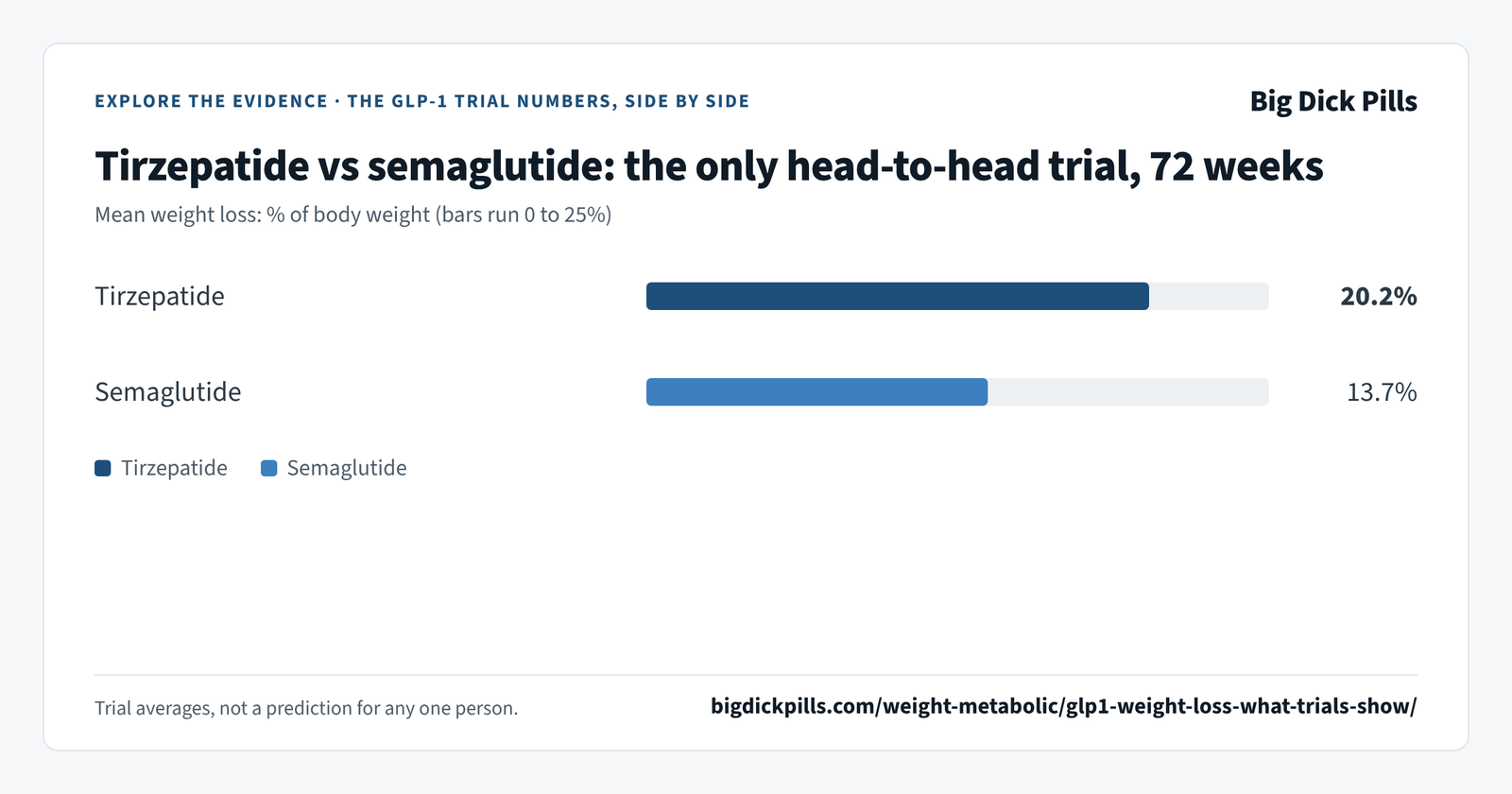
In the only head-to-head trial, tirzepatide produced 20.2% weight loss at 72 weeks against 13.7% for semaglutide. In the 17,604-patient SELECT trial, semaglutide cut major cardiac events by 20% in people with existing heart disease and no diabetes. This is a cardiovascular drug that also causes weight loss. But in SELECT, men lost 7.5% of body weight where women lost 11.1%. And stopping brings most of it back.

| Best head-to-head result | Tirzepatide 20.2% weight loss at 72 weeks vs semaglutide 13.7% |
|---|---|
| Weight lost in kilograms | 22.8 kg vs 15.0 kg |
| Cardiovascular benefit | 20% reduction in major cardiac events (SELECT, 17,604 patients) |
| Who that benefit applied to | People with existing heart disease and no diabetes |
| Weight loss in men vs women (SELECT) | 7.5% in men, 11.1% in women |
| What happens on stopping | Most of the weight returns |
| Discontinuation from gut side effects | 2.7% tirzepatide, 5.6% semaglutide |
How much weight do you actually lose on a GLP-1?
SURMOUNT-5 is the trial that matters most for this question, because it put the two drugs against each other rather than against placebo. It randomised 751 adults with obesity and no diabetes, mean age 45, to maximum tolerated doses of either drug for 72 weeks.
| At 72 weeks | Tirzepatide | Semaglutide |
|---|---|---|
| Mean weight loss | 20.2% | 13.7% |
| Mean weight lost | 22.8 kg (50 lb) | 15.0 kg (33 lb) |
| Waist circumference | −18.4 cm | −13.0 cm |
| Stopped due to GI side effects | 2.7% | 5.6% |
Tirzepatide won on every measure in that trial, including tolerability. It acts on two receptors, GLP-1 and GIP, rather than one, which is the usual explanation offered for the difference.
For context on how large these numbers are: the lifestyle intervention trials that represent the best non-drug results produce roughly 5 to 10% weight loss, and bariatric surgery produces 25 to 30%. These drugs sit between the two, closer to surgery than to dieting.
Explore the evidence
The GLP-1 trial numbers, side by side
Tirzepatide vs semaglutide: the only head-to-head trial, 72 weeks
Mean weight loss: % of body weight (bars run 0 to 25%)
Weight lost in kilograms: average kilograms lost (bars run 0 to 25)
Stopped for gut side effects: % of people (bars run 0 to 10%)
TirzepatideSemaglutide
The page’s own table of the only head-to-head trial: weight lost, kilograms, and the share who stopped because of gut side effects.
Semaglutide vs placebo in the SELECT trial (17,604 people), 208 weeks
Mean weight loss at 208 weeks: % of body weight (bars run 0 to 25%)
SemaglutidePlacebo
SELECT enrolled people aged 45 and over with established cardiovascular disease and no diabetes; it was not primarily a weight-loss trial.
Weight loss on semaglutide in SELECT: men vs women
Weight loss: % of body weight (bars run 0 to 25%)
MenWomen
As the page reports it: weight loss in men vs women in SELECT, 7.5% in men and 11.1% in women.
Trial averages, not a prediction for any one person. Not medical advice.
How much weight do men lose on GLP-1 drugs?
This is the part worth slowing down for.
The SELECT trial followed 17,604 people on semaglutide for up to five years and published its weight data separately. Mean weight loss at 208 weeks was 10.2% against 1.5% on placebo: sustained, with no rebound over four years, and a waist reduction of 7.7 cm.
But broken down by sex, the treatment difference was 11.1% in women and 7.5% in men.
Men lost meaningfully less. That is not a reason not to take them. 7.5% sustained for four years is a large and clinically valuable result, and it is more than most men achieve by any other means. But if your expectations were set by before-and-after photographs, the trial average for a man is lower than the number in your head, and knowing that in advance is the difference between a drug that worked and a drug that disappointed you.
Worth noting too that the SELECT figure is lower than the SURMOUNT-5 and STEP figures for a reason: SELECT enrolled people with established cardiovascular disease, at a lower dose ceiling in some cases, and followed them far longer.
Related: Which cholesterol number predicts a heart attack · All weight and metabolic health articles
Do GLP-1 drugs protect your heart?
SELECT was not primarily a weight-loss trial. It enrolled people aged 45 and over with a BMI of 27 or above, established cardiovascular disease, and no diabetes, and asked whether semaglutide prevented heart attacks and strokes.
It did. Major adverse cardiac events (cardiovascular death, non-fatal heart attack, non-fatal stroke) fell by 20%, with all three components contributing.
That result reframes the whole category. Before it, this was a cosmetic drug with metabolic benefits and an unknown long-term profile. After it, semaglutide is a cardiovascular drug in people with heart disease and obesity, and the weight loss is one of several mechanisms by which it appears to work.
It matters more for men than the headline suggests, because the population SELECT studied (middle-aged, overweight, existing cardiovascular disease) is exactly the population in which erectile dysfunction shows up as an early vascular warning. The same arteries are involved.
What are the side effects, and who stops taking them?
The side effects are overwhelmingly gastrointestinal, and they cluster during dose escalation: nausea, vomiting, diarrhoea, constipation. Most are mild to moderate and most settle.
The discontinuation figures from SURMOUNT-5 are the useful measure of how bad they get in practice: 5.6% stopped semaglutide because of them, 2.7% stopped tirzepatide. So roughly one man in twenty on semaglutide, and one in forty on tirzepatide, found them intolerable.
Rarer but more serious concerns that belong in the conversation with a prescriber: gallbladder disease (rapid weight loss of any kind raises gallstone risk), pancreatitis, and a boxed warning about thyroid C-cell tumours based on rodent data, which makes these drugs unsuitable for anyone with a personal or family history of medullary thyroid carcinoma or MEN2.
The muscle question (whether the weight coming off is fat or lean tissue) gets its own page, because the answer is more reassuring than the headlines and more actionable than most coverage admits. See what the body composition data actually show.
How long do you have to stay on a GLP-1?
Indefinitely, on current evidence, and this is the single most under-communicated fact in the category.
When semaglutide was withdrawn in the STEP 1 extension, participants regained about two-thirds of the lost weight within a year, and blood pressure returned to baseline. The full numbers are in what happens when you stop.
Obesity behaves like a chronic condition in this respect. Nobody expects blood pressure to stay down after stopping an antihypertensive, and the same logic applies here, but the marketing rarely frames it that way, and people budget for a course rather than for a prescription they keep.
Who are these drugs actually for?
The approved indication is a BMI of 30 or above, or 27 and above with a weight-related condition: high blood pressure, type 2 diabetes, sleep apnoea, dyslipidaemia. That is the population the trials studied and the population the results apply to.
Two things are worth adding for men specifically.
If your testosterone is low and you are carrying excess weight, the weight is a plausible cause. Fat tissue converts testosterone to oestradiol and suppresses the signal to produce more. Weight loss reverses it measurably: a low-calorie diet raised total testosterone by about 83 ng/dL on average, and bariatric surgery by about 250. The numbers are here. Nobody has yet published equivalent figures for GLP-1-driven weight loss at scale, so that specific claim is not yet evidenced, but the mechanism is the same one.
Do not buy these from a website that does not want to see you. The compounded market has its own set of problems, and they changed substantially when the shortage ended: covered here.
Common questions about GLP-1 weight loss drugs
How much weight will I lose on a GLP-1?
In trials, 13.7 percent of body weight on semaglutide and 20.2 percent on tirzepatide over 72 weeks. Men consistently lose less than women: in the large cardiovascular trial men lost 7.5 percent where women lost 11.1 percent. Trial participants also receive structured support that most people buying privately do not.
Are GLP-1 drugs good for your heart?
For one specific group, the evidence is strong. In 17,604 people with established cardiovascular disease and no diabetes, semaglutide reduced major cardiac events by 20 percent. That is a cardiovascular drug that also causes weight loss, and it is the finding that changed how these drugs are viewed. It does not automatically extend to people without existing heart disease.
What happens when you stop taking a GLP-1?
Most of the weight comes back. These drugs work by suppressing appetite while they are present; they do not reset a set point. Trial data on withdrawal show substantial regain, which is why the honest framing is a long-term treatment rather than a course.
Do I have to take a GLP-1 forever?
On current evidence, keeping the weight off means staying on the drug, in the same way that blood pressure medication works only while you take it. Some people step down to a maintenance dose. Anyone presenting this as a twelve-week programme is not describing what the trials found.
Are GLP-1 drugs safe?
The common side effects are gastrointestinal and mostly settle: nausea in about 44 percent, diarrhoea 30 percent, vomiting 24 percent. There is a boxed warning about thyroid C-cell tumours seen in rodents, and the drugs are contraindicated outright in anyone with a personal or family history of medullary thyroid carcinoma or MEN 2.
Sources
- Lincoff AM, Brown-Frandsen K, Colhoun HM, et al. Semaglutide and cardiovascular outcomes in obesity without diabetes (SELECT). New England Journal of Medicine, 2023. PubMed
- Ryan DH, Lingvay I, Deanfield J, et al. Long-term weight loss effects of semaglutide in obesity without diabetes in the SELECT trial. Nature Medicine, 2024. Nature Medicine
- Aronne LJ, Horn DB, le Roux CW, et al. Tirzepatide as compared with semaglutide for the treatment of obesity (SURMOUNT-5). American College of Cardiology
- Wilding JPH, Batterham RL, Davies M, et al. Weight regain and cardiometabolic effects after withdrawal of semaglutide: the STEP 1 trial extension. Diabetes, Obesity and Metabolism, 2022. PubMed
This article is for information only and is not medical advice. It cannot account for your individual circumstances. Talk to a doctor about your own situation, particularly before starting or stopping any prescription medication.
Cite this page: Big Dick Pills, “GLP-1 Weight Loss Drugs: What the Trials Actually Show”, bigdickpills.com/weight-metabolic/glp1-weight-loss-what-trials-show/ (updated ).
Source links on this site are checked every month; last check . How sources are checked.