









 By
By 
There is a real medical condition here, it has a proper definition, and it is diagnosed in a specific way that most of the clinics advertising to you do not follow. Knowing the difference is worth more than anything else on this page.
Get emergency care now if you are on testosterone therapy and develop sudden leg swelling and pain, chest pain, or shortness of breath – these can signal a blood clot, a recognized risk of TRT.
See a doctor soon if you have low-testosterone symptoms (fatigue, low libido, mood changes) and have not had bloodwork, or if you are on TRT and have not had follow-up labs in the recommended window.
A routine visit is fine to discuss symptoms that are mild or have been stable for a while.
Who to see: a primary care doctor can order initial labs; an endocrinologist or urologist specializing in men’s health manages ongoing TRT.
Worth asking: what your actual free and total testosterone numbers were, and whether TRT’s known risks (blood clots, fertility suppression, polycythemia) were discussed before starting.
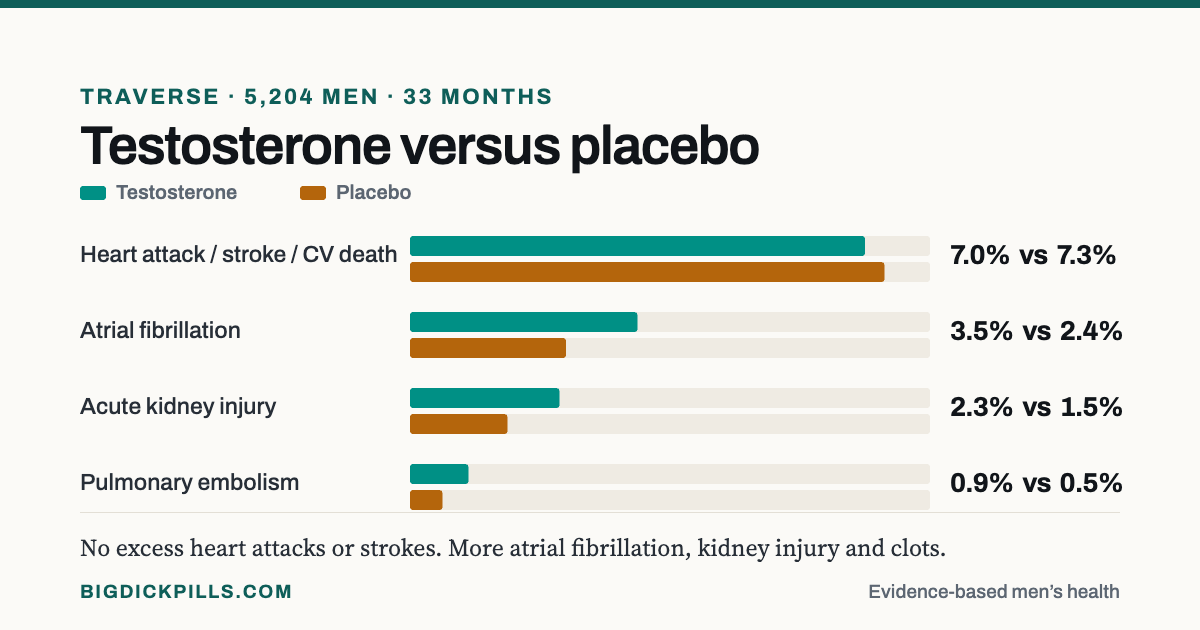
The diagnosis requires a total testosterone below 300 ng/dL on two separate early-morning blood draws, plus symptoms. One afternoon test is not a diagnosis. Treatment reliably improves sexual desire; in the largest trial of older men it did not improve energy or walking ability. A 5,204-man trial found no increase in heart attacks or strokes, but did find more atrial fibrillation, pulmonary embolism and kidney injury. And it will stop your sperm production.
| Diagnostic threshold | Total testosterone below 300 ng/dL |
|---|---|
| How many tests | Two separate draws, both early morning |
| Plus | Symptoms consistent with deficiency |
| What one afternoon test proves | Nothing; levels vary substantially through the day |
| What treatment reliably improves | Sexual desire and function |
| What it did not improve in the largest trial of older men | Energy, fatigue, or walking ability |
| Cardiac safety (5,204-man trial) | No increase in heart attack or stroke |
| But increased | Atrial fibrillation, pulmonary embolism, acute kidney injury |
| Effect on fertility | Shuts down sperm production |
Read your own testosterone result against the guideline with the free lab reader.
What testosterone level counts as low?
The American Urological Association’s guideline sets the threshold plainly: a total testosterone below 300 ng/dL is a reasonable cut-off supporting a diagnosis of low testosterone. That is a moderate recommendation on Grade B evidence: a sensible line, not a law of nature.
The next statement is the one that matters more, and it carries the guideline’s strongest rating. Diagnosis requires two total testosterone measurements, taken on separate occasions, both in the early morning. Strong recommendation, Grade A evidence.
There is a straightforward physiological reason. Testosterone follows a daily rhythm, peaking in the early morning and falling through the day. A blood draw at four in the afternoon can put a perfectly normal man under 300 ng/dL. Levels also swing day to day in the same individual. One test tells you about one moment.
If a clinic tested you once, at whatever time you happened to walk in, and then offered you treatment, they did not diagnose you. They measured you.
Can you diagnose low T from symptoms?
The guideline’s third statement requires low testosterone combined with symptoms or signs. Both halves are necessary, and the reason is that the symptom list is almost uselessly non-specific on its own.
Low energy. Reduced libido. Difficulty concentrating. Low mood. Loss of muscle, gain of fat. Poor sleep.
Every one of those is also produced by depression, sleep apnoea, thyroid disease, anaemia, a demanding job, a new baby, or simply being tired. The entire “low T” marketing category rests on the fact that this list describes a very large share of men over forty at any given moment. Recognising yourself in it is not evidence of anything.
The reverse is also true and less often said: a man can have a testosterone of 250 ng/dL and no symptoms, and the guideline does not consider that a condition requiring treatment.
Related: All testosterone articles
What should be checked before starting treatment?
Two things, and both are strong recommendations rather than optional extras.
Haemoglobin and haematocrit. Testosterone stimulates red blood cell production, and a meaningful number of men on treatment develop polycythaemia: blood that is too thick. The guideline requires measuring these before starting and informing the patient of the risk. Strong recommendation, Grade A.
PSA, in men over 40. A clinical principle, to exclude an existing prostate cancer before starting. This is not the same as saying testosterone causes prostate cancer. The modern evidence does not support that, but you do not want to begin treatment with an undiagnosed cancer already present.
Once on treatment, levels should be measured every six to twelve months.
What does testosterone treatment actually fix?
The most useful evidence here comes from the Testosterone Trials: 790 men aged 65 and over, across twelve US sites, in a coordinated set of randomised trials. The results were mixed in a way that is genuinely informative.
| Outcome tested | Result |
|---|---|
| Sexual function | Improved. Testosterone increased sexual desire and function in men with low sexual function. |
| Physical function | Did not improve walking ability in the trial designed to test it. |
| Vitality | Did not improve fatigue or low energy. |
That pattern is worth sitting with, because it is close to the inverse of how testosterone is marketed. The thing it reliably improved was libido. The things it did not improve were energy and physical capability, which are precisely what the advertising promises.
When the trials’ data were pooled, walking speed and distance did show some improvement, and there was some benefit for mood and depressive symptoms. But the individual trials designed to answer those questions came back negative, and that is the more conservative reading.
What testosterone does for erections specifically is a narrower question with a clearer answer, covered in testosterone, libido and erections.
Is testosterone therapy bad for your heart?
For years the honest answer was that nobody knew. The AUA guideline still reflects that, requiring clinicians to counsel patients that it cannot be stated definitively whether testosterone therapy increases or decreases cardiovascular risk.
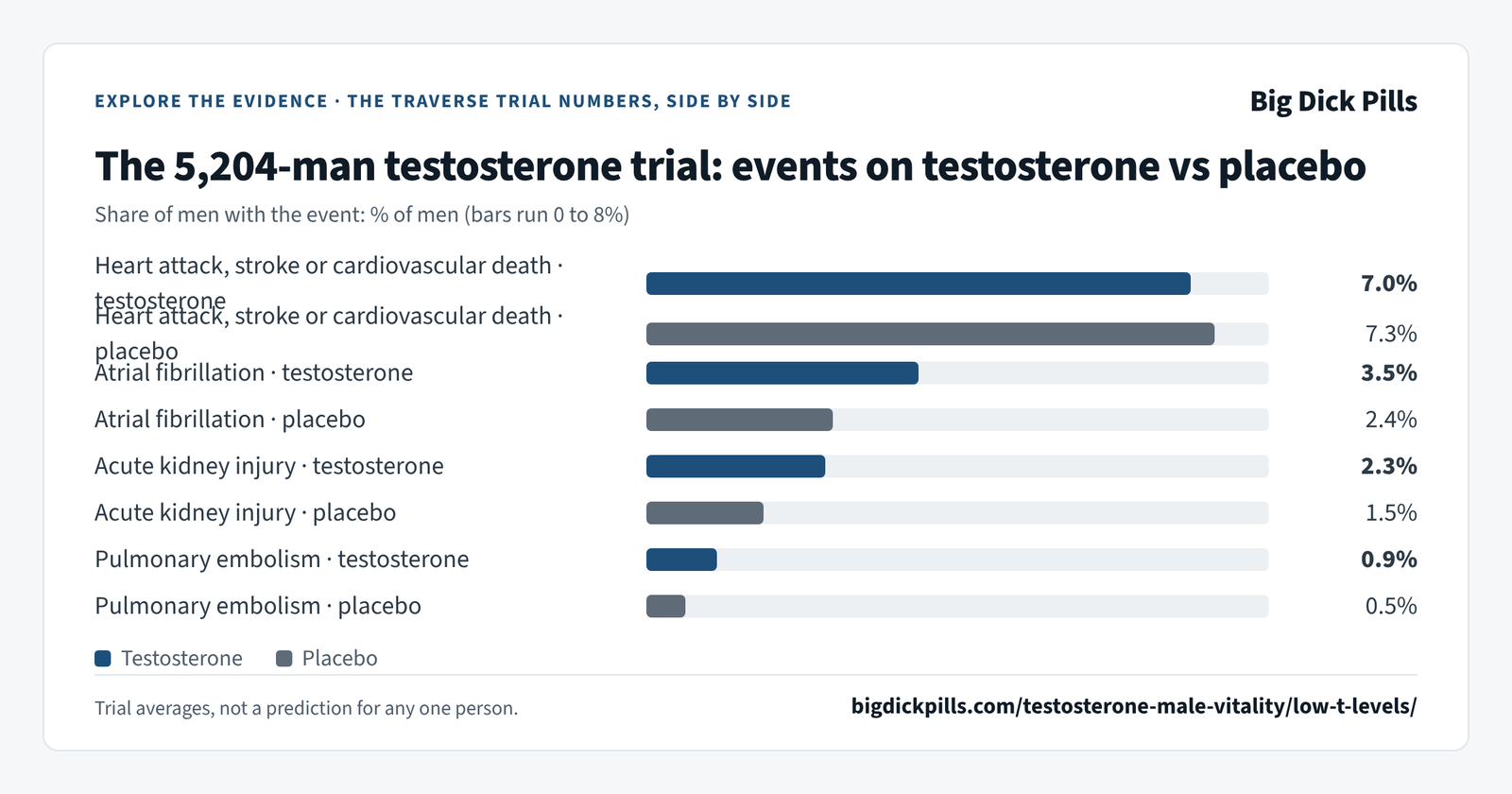
Then the TRAVERSE trial reported. It randomised 5,204 men aged 45 to 80, all with symptomatic hypogonadism confirmed by two fasting morning measurements under 300 ng/dL, and all with existing cardiovascular disease or high risk of it. Dosing targeted 350 to 750 ng/dL. Mean follow-up was 33 months.
The primary result: major adverse cardiac events occurred in 7.0% on testosterone against 7.3% on placebo: a hazard ratio of 0.96, meeting the criteria for non-inferiority. On the specific question of heart attacks and strokes, testosterone did not make things worse.
Three other findings were less reassuring and get quoted far less often:
- Atrial fibrillation: 3.5% on testosterone versus 2.4% on placebo
- Acute kidney injury: 2.3% versus 1.5%
- Pulmonary embolism: 0.9% versus 0.5%
And there is a boundary on what the trial can tell you. It studied men with a confirmed diagnosis, on carefully monitored doses aimed at a normal range. It says nothing about younger men, men without hypogonadism, athletes using supraphysiological doses, or anyone taking testosterone without the monitoring the trial provided. A result obtained under strict conditions does not transfer to a clinic that skips them.
Explore the evidence
The TRAVERSE trial numbers, side by side
The 5,204-man testosterone trial: events on testosterone vs placebo
Share of men with the event: % of men (bars run 0 to 8%)
TestosteronePlacebo
Main result: major adverse cardiac events in 7.0% on testosterone against 7.3% on placebo, a hazard ratio of 0.96, meeting the criteria for non-inferiority.
Trial averages, not a prediction for any one person. Not medical advice.
Does testosterone therapy affect fertility?
Exogenous testosterone suppresses your body’s own production, and with it, sperm production. This is not a rare side effect. It is the mechanism, testosterone was studied as a male contraceptive for exactly this reason.
The guideline is unambiguous. The long-term impact on sperm production must be discussed with any patient interested in future fertility, and testosterone should not be prescribed to men currently trying to conceive. Both are strong recommendations on Grade A evidence.
Recovery data offer some reassurance, with caveats. In men who had normal fertility to begin with, the likelihood of returning to a sperm concentration of 20 million per millilitre was 67% at six months after stopping, 90% at twelve months, and 100% at twenty-four. But those figures come from contraception studies in men with normal baseline function. Among men who became azoospermic while on testosterone therapy, roughly 65% recovered.
If you might want children, this belongs in the conversation before the first injection, not after.
How do you tell a real assessment from a sales funnel?
Four questions answer it.
Did they test twice, both times in the early morning? If not, there is no diagnosis, whatever the paperwork says.
Did they check haematocrit and, if you are over 40, PSA, before prescribing? The guideline requires it.
Did anyone ask whether you want children? A prescriber who does not ask is not following the guideline.
Did anyone look for a cause? Obesity, poor sleep, alcohol and opioids all lower testosterone, and several of them are reversible. If you are carrying significant excess weight, losing it raises testosterone measurably, see what actually raises testosterone naturally, where the numbers are larger than most men expect.
And if you are considering a supplement instead, the testing on testosterone boosters is not encouraging.
Common questions about low testosterone
What testosterone level is considered low?
Below 300 ng/dL total testosterone, measured on two separate early-morning blood draws, together with symptoms consistent with deficiency. All three elements are required. A single reading, particularly an afternoon one, is not a diagnosis, because testosterone follows a daily rhythm and peaks in the morning.
Why do you need two morning blood tests?
Because testosterone varies substantially both through the day and between days. Levels peak in the early morning and fall through the afternoon, so an afternoon draw can show a low result in a man with entirely normal production. Two morning tests reduce the chance that a single unrepresentative reading leads to lifelong treatment.
Will testosterone give me more energy?
The evidence does not support that expectation. In the largest trial of older men, testosterone improved sexual desire and function but did not improve fatigue, low energy or walking ability. Energy is the symptom most heavily marketed and the one the trials most clearly failed to move.
Does testosterone therapy make you infertile?
It suppresses sperm production, often profoundly, because supplying testosterone externally shuts down the signalling that drives the testes to make both testosterone and sperm. Any man who might want children should have this conversation before starting, not after, and should ask about alternatives that raise testosterone without suppressing fertility.
Is testosterone therapy safe for your heart?
A trial of 5,204 men at high cardiovascular risk found no increase in heart attacks or strokes, which resolved a long-standing question. It did find more atrial fibrillation, more pulmonary embolism and more acute kidney injury. So the headline concern was not confirmed, but the drug is not free of cardiovascular consequences.
Sources
- Mulhall JP, Trost LW, Brannigan RE, et al. Evaluation and Management of Testosterone Deficiency: AUA Guideline, 2018. AUA guideline
- Lincoff AM, Bhasin S, Flevaris P, et al. Cardiovascular safety of testosterone-replacement therapy (TRAVERSE). New England Journal of Medicine, 2023. New England Journal of Medicine
- Snyder PJ, Bhasin S, Cunningham GR, et al. Effects of testosterone treatment in older men (The Testosterone Trials). New England Journal of Medicine, 2016. New England Journal of Medicine
- Desai A, Yassin M, Cayetano A, et al. Understanding and managing the suppression of spermatogenesis caused by testosterone replacement therapy and anabolic-androgenic steroids. Therapeutic Advances in Urology, 2022. Therapeutic Advances in Urology
This article is for information only and is not medical advice. It cannot account for your individual circumstances. Talk to a doctor about your own situation, particularly before starting or stopping any prescription medication.
Cite this page: Big Dick Pills, “Low Testosterone: What the Number Means, and How It Is Properly Diagnosed”, bigdickpills.com/testosterone-male-vitality/low-t-levels/ (updated ).
Source links on this site are checked every month; last check . How sources are checked.