
 By
By 
This is the category where the honest answer is closest to a flat no, and where the gap between what is advertised and what has been demonstrated is widest. It is also the category this site is named after, which makes writing it plainly a small matter of principle.
A systematic review of every study of enlargement in men of normal size (17 studies, 1,192 men) found extenders produced under 2 cm of flaccid length, injectables carried a high complication rate, and no technique had ever been externally validated. Its conclusion was that these interventions “should remain a last option, considered unethical outside of clinical trials.” The intervention that worked best in that review was not a device or an operation. It was being told, accurately, what normal is.
| Evidence base | 17 studies, 1,192 men of normal size |
|---|---|
| Extenders | Under 2 cm of flaccid length, after months of daily wear |
| Vacuum pumps | Temporary erection, not a size change |
| Injectable fillers | High complication rate: migration, nodules, deformity |
| Techniques externally validated | None |
| The review conclusion | Should remain a last option, considered unethical outside clinical trials |
| What worked best in the review | Being told accurately what normal is |
| Pills and creams | Do not appear, because there is nothing to review |
What does the research on penis enlargement actually cover?
In 2019 a group at King’s College London published a systematic review with an unusually well-chosen scope: interventions in normal men complaining of small penis size. Not men with a medical condition — men whose anatomy was within the normal range and who wanted it changed.
They found 17 studies covering 21 interventions. Of 1,192 men screened, 773 completed follow-up: 248 non-surgical and 525 surgical. The interventions included extenders, injectables and vacuum devices on the non-surgical side, and suspensory ligament incision, tissue grafting, flaps and penile disassembly on the surgical side.
Their assessment of the literature is the part worth quoting: the quality of the studies was poor in terms of both patient selection and outcome assessment, and none of the techniques was externally validated. That is a description of an entire field, not of one bad paper.
Which enlargement methods work?
| Method | What the evidence shows |
|---|---|
| Traction devices (extenders) | The only non-surgical approach with measured gains, and they were under 2 cm, in flaccid length, after months of daily wear. |
| Vacuum pumps | Assessed in the review. They produce a temporary erection, which is why they are a legitimate treatment for erectile dysfunction. That is not the same as a size change. |
| Injectable fillers | A high complication rate. Migration, nodules, deformity and disfigurement are documented. |
| Suspensory ligament incision | The most common operation. Releases the ligament so more of the shaft sits outside the body. Changes flaccid appearance more than erect function, and can destabilise the erection. |
| Grafts, flaps, disassembly | Complications were described as not infrequent. None externally validated. |
| Pills, creams, patches | Do not appear in the review, because there is nothing to review. |
| Jelqing and manual exercises | Also absent, for the same reason. Covered separately. |
The non-surgical options are examined in more detail in what extenders and pumps actually achieve. The summary is that one of them has a small, real, flaccid-length effect and the rest do not.
What worked best in the review?
Buried in that review is the most useful sentence in this entire subject area. Where counselling was provided, it was effective, with the majority of men coming to understand that their penis was normal, and being unwilling to undergo any further treatment.
Read that carefully. When men who wanted surgery were given accurate information about the distribution of normal size, most of them stopped wanting surgery.
That is a treatment result. It is just not one anybody can build a business on, which is presumably why you have never seen it advertised.
Why do men want this?
The demand is not tracking the anatomy, and the survey data makes that unusually clear.
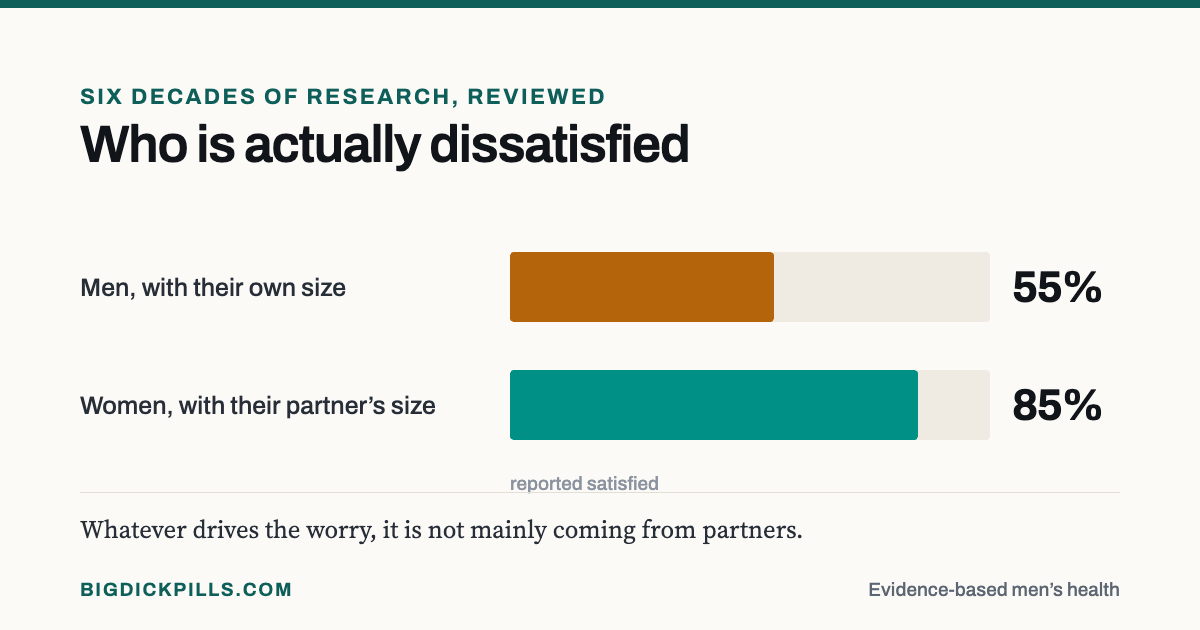
A review spanning six decades of research found that 55% of men were satisfied with their own size, while 85% of women reported being satisfied with their partner’s. Meanwhile 66% of men described their own as average, which is to say, a large number of men believe they are average and are dissatisfied anyway.
The same review found that men presenting with size complaints had no clinical micropenis. Not few. None. And when asked where the belief came from, 63% traced it to comparisons in childhood and 37% to adult imagery encountered in adolescence.
So the market is being served a solution to a problem that, in the overwhelming majority of cases, is not anatomical. The numbers behind that are in what the measurements actually say.
When is size a genuine medical question?
Micropenis is a real diagnosis, defined as a stretched length more than 2.5 standard deviations below the mean. It is uncommon, it is usually identified in childhood, and it is associated with endocrine conditions that need proper assessment.
Significant size change can also follow Peyronie’s disease, prostate surgery or trauma, and in those situations reconstructive options exist and are appropriate, because there is an actual deficit to restore.
None of that is what the enlargement industry is selling to, and conflating the two is how a cosmetic procedure with an unvalidated evidence base gets framed as medicine.
Where should you start?
If the question is “does it work”, for men of normal size, essentially no, and the best available review says offering it outside a trial is unethical.
If the question underneath it is “am I normal”, that one has a real answer with 15,521 men behind it, and it is worth reading before spending money on anything.
And if the distress is significant rather than idle, that is treatable too. The reviewers recommend proper assessment followed by education and short-term structured psychotherapy: an approach with better evidence behind it than any device in this article.
Common questions about penis enlargement
Does penis enlargement actually work?
A systematic review of 17 studies covering 1,192 men of normal size found extenders produced under 2 cm of flaccid length after months of daily wear, injectables carried a high complication rate, and no technique had ever been externally validated. Its conclusion was that these interventions should remain a last option and are considered unethical outside clinical trials.
What is the most effective enlargement method?
Traction devices are the only non-surgical approach with measured gains, and those gains are small and in flaccid length. The intervention that performed best in the systematic review was not a device or an operation at all: it was accurate counselling about what normal size actually is.
Do penis enlargement pills work?
No, and they do not appear in the review because there is nothing to review. No oral supplement has ever been shown to change penis size, and no mechanism exists by which one could, since size is set by the dimensions of the erectile chambers and the fibrous sheath around them rather than by blood flow capacity.
Are penis fillers safe?
The systematic review recorded a high complication rate, with migration, nodules, deformity and disfigurement all documented. These are cosmetic injections into an area with limited capacity to correct a bad result, which is why guideline bodies treat them cautiously and why no major urological body endorses cosmetic enlargement in men with normal anatomy.
How do I know if my size is actually a problem?
Most men who believe they are too small are of ordinary size, which is the most consistent finding in this entire field. Micropenis, the actual medical diagnosis, means an erect length under three inches and is rare. If preoccupation is affecting your relationships or mood, that is a real problem with real treatments, none of which involve a device.
Sources
- Marra G, Drury A, Tran L, Veale D, Muir GH. Systematic review of surgical and nonsurgical interventions in normal men complaining of small penis size. Sexual Medicine Reviews, 2020. Sexual Medicine Reviews
- Wylie KR, Eardley I. Penile size and the “small penis syndrome”. BJU International, 2007. BJU International
- Veale D, Miles S, Bramley S, Muir G, Hodsoll J. Am I normal? A systematic review and construction of nomograms for flaccid and erect penis length and circumference in up to 15,521 men. BJU International, 2015. BJU International
This article is for information only and is not medical advice. It cannot account for your individual circumstances. Talk to a doctor about your own situation, particularly before starting or stopping any prescription medication.