 By
By 
This is the article that should exist before any of the others. Almost every man who goes looking for a way to change his anatomy is starting from a belief about where he sits in the distribution, and that belief is usually wrong in a specific and predictable direction.
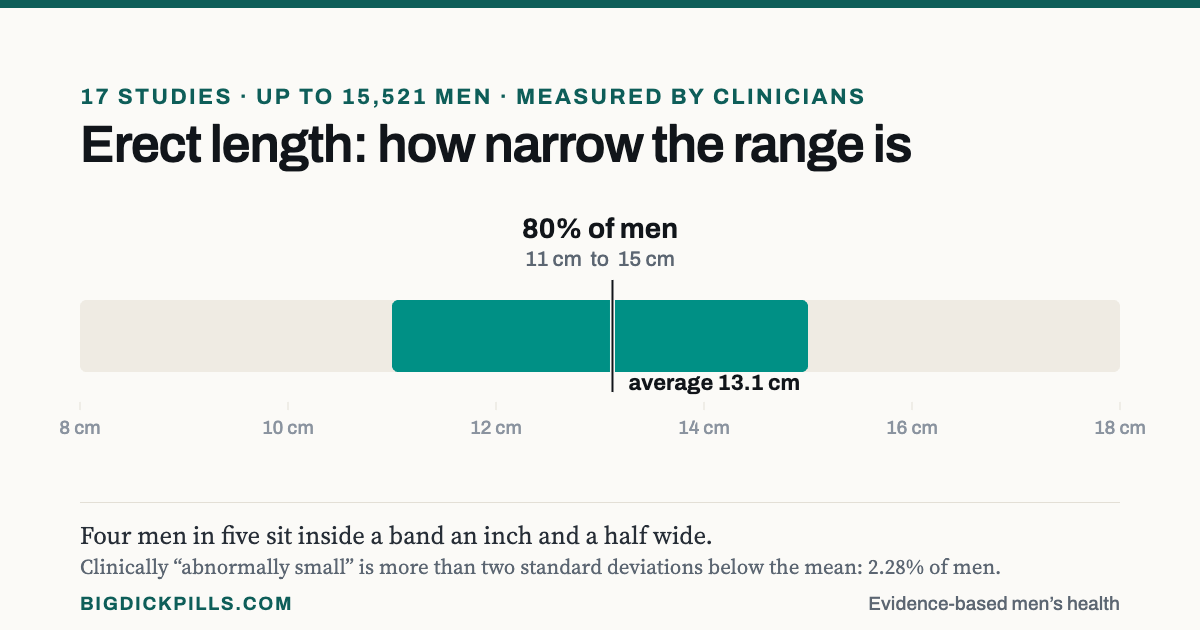
Across 17 studies and up to 15,521 men measured by professionals, mean erect length was 13.12 cm — 5.2 inches. The 10th percentile was about 11 cm and the 85th about 15 cm, which means four fifths of all men sit inside a band roughly 4 cm wide. Meanwhile 55% of men are satisfied with their own size against 85% of women satisfied with their partner’s. And among men presenting to clinics with size complaints, the rate of actual micropenis was zero.
The measurements
The reference study here is a 2015 systematic review that pooled 17 studies in which men were measured by health professionals rather than reporting their own figures — a distinction that matters enormously, since self-reported data in this area is unreliable in an obvious direction.
| Measurement | Mean |
|---|---|
| Flaccid length | 9.16 cm (3.6 in) |
| Stretched flaccid length | 13.24 cm (5.2 in) |
| Erect length | 13.12 cm (5.2 in) |
| Flaccid circumference | 9.31 cm (3.7 in) |
| Erect circumference | 11.66 cm (4.6 in) |
The erect average is 5.2 inches. That figure is consistently lower than what men estimate the average to be, and consistently lower than the numbers that circulate informally.
Why the curve is flatter than you think
The averages matter less than the shape of the distribution, and the shape is the genuinely surprising part.
On the nomogram, the 10th percentile is about 11 cm (4.3 in) and the 85th percentile is about 15 cm (5.9 in). Roughly four men in five fall between those two figures — inside a band about 4 cm wide, an inch and a half.
One of the commentators on the study described the curve as looking strikingly flat, and noted that you have to go to the extremes, the top or bottom five or ten percent, before real differences appear.
The clinical threshold for abnormally small is more than two standard deviations below the mean, which by definition covers 2.28% of men. Micropenis proper is defined at 2.5 standard deviations below the mean and is rarer still, usually identified in childhood, and associated with endocrine conditions requiring assessment.
So the distribution has very little room in it for the belief most worried men hold. If you are meaningfully below average, you are in a narrow band. If you are unusual, you are in a very narrow one.
The satisfaction gap
A review covering six decades of research on this subject found the following, and the two figures are best read side by side.
| Group | Satisfied |
|---|---|
| Men, with their own size | 55% |
| Women, with their partner’s size | 85% |
Nearly half of men are dissatisfied. Fifteen percent of women are. Whatever is driving the dissatisfaction, it is not primarily coming from partners.
The same review found 66% of men described their own size as average — meaning a large number of men simultaneously believe they are typical and are unhappy about it. That is not a measurement problem. It is a different problem wearing a measurement’s clothes.
Where the belief comes from
When men presenting with size concerns were asked where the belief originated, the answers clustered:
- 63% traced it to comparisons made in childhood.
- 37% traced it to adult imagery encountered during adolescence.
Both sources share a structural bias. Childhood comparison happens in changing rooms, where you see other boys flaccid, from above, at an angle that foreshortens your own view of yourself and not theirs. Adult imagery is a selected sample, professionally lit and shot to exaggerate — not a random draw from the distribution above.
And in the studies reviewed, the men making these complaints had no clinical micropenis. Not a low rate. None.
Why your own measurement probably misleads you
Two systematic errors run in the same direction.
The angle. Looking down at yourself is foreshortened. Looking at anyone else, or at an image, is not. This is a genuine optical effect and it applies every time, which is why a mirror gives a noticeably different impression.
The technique. Clinical measurement is taken along the top from the pubic bone to the tip, with the ruler pressed firmly in to compress the fat pad, because that pad varies with body weight and can conceal a centimetre or more. Most casual measurement does not press in, and measures from the skin surface. Arousal level, temperature and time of day all move the number too.
The 13.12 cm average above was measured properly, by professionals, using the pressed technique. Comparing a casual self-measurement against it is not comparing like with like, and the error runs against you.
When it is worth getting help, and what helps
If this preoccupies you — if you avoid situations, avoid relationships, check repeatedly, or think about it daily — that is worth taking seriously on its own terms, independent of any measurement. Severe preoccupation with a body part that appears normal to others is the definition of body dysmorphic disorder, and it is a treatable condition rather than a character flaw.
The evidence on what helps is unusually clear. Reviewers recommend proper urological, psychosexual and psychological assessment, followed by education, self-awareness work and short-term structured psychotherapy. In the systematic review of enlargement interventions, where counselling was provided it was effective — the majority of men came to understand that they were normal and were unwilling to undergo further treatment.
That is a better-evidenced outcome than anything in the enlargement literature, which the same reviewers concluded should be a last option and is considered unethical outside clinical trials.
The most useful thing on this page is probably still the first table. Most men who are worried about this are worried about being in a position they are not in.
Sources
- Veale D, Miles S, Bramley S, Muir G, Hodsoll J. Am I normal? A systematic review and construction of nomograms for flaccid and erect penis length and circumference in up to 15,521 men. BJU International, 2015. BJU International
- Wylie KR, Eardley I. Penile size and the “small penis syndrome”. BJU International, 2007. BJU International
- Marra G, Drury A, Tran L, Veale D, Muir GH. Systematic review of surgical and nonsurgical interventions in normal men complaining of small penis size. Sexual Medicine Reviews, 2020. Sexual Medicine Reviews
This article is for information only and is not medical advice. It cannot account for your individual circumstances. Talk to a doctor about your own situation, particularly before starting or stopping any prescription medication.