
 By
By 
There is a large industry built on the idea that a daily capsule will increase your semen volume. It has a plausible story behind it: sperm are vulnerable to oxidative stress, antioxidants reduce oxidative stress, therefore antioxidants should improve semen. Zinc and folate show up in seminal fluid, so topping them up should help.
That story has been tested. Properly, in randomized controlled trials, with thousands of men. This article is about what those trials found, because the answer is not what the supplement aisle implies, and in one large study, the supplement group did measurably worse on a key marker than the placebo group.
The best available evidence does not support taking supplements to increase semen volume. The American Urological Association’s position is that their benefits are “of questionable clinical utility.” If your volume has genuinely dropped, the useful move is finding out why, not buying a bottle.
| FAZST trial | 2,370 men, folic acid and zinc, no benefit |
|---|---|
| Antioxidant evidence | 90 trials, still inconclusive |
| AUA position | Benefits of questionable clinical utility |
| Lower reference limit for volume | 1.4 mL |
| More is worse | Excessive antioxidant intake can itself be harmful |
| What actually moves volume | Abstinence interval, completeness of collection, and treating an underlying cause |
| The useful move if volume dropped | Finding out why, not buying a bottle |
What counts as low semen volume?
The World Health Organization publishes reference values for semen analysis, updated in 2021 for the sixth edition of its laboratory manual. The lower reference limit for semen volume is 1.4 mL.
For context, here are the full 2021 lower reference limits:
| Parameter | Lower reference limit |
|---|---|
| Semen volume | 1.4 mL |
| Sperm concentration | 16 million/mL |
| Total sperm number | 39 million per ejaculate |
| Progressive motility | 30% |
| Normal morphology | 4% |
| Vitality | 54% |
| pH | 7.2 |
Two things are worth understanding about that table before you measure yourself against it.
These are fifth-percentile values, not a pass/fail line. They come from men whose partners conceived naturally within a year. Being below one of them means you sit in the bottom 5% of that group for that measure. It does not mean you are infertile, and being above them does not guarantee fertility.
Volume and count are different things. This confusion is everywhere, including in how these products are marketed. Semen volume is how much fluid you ejaculate — mostly contributions from the seminal vesicles and prostate. Sperm count is how many sperm are in it. You can have normal volume and almost no sperm, or low volume and a perfectly good concentration. Low volume is called hypospermia; low sperm concentration is oligospermia. Products that promise “more volume” and then cite sperm-count research are trading on the fact that most people don’t distinguish them.
Do zinc and folic acid increase semen volume?
Folic acid and zinc are the two ingredients most consistently sold for male fertility. In 2020, they were tested in the largest trial of its kind.
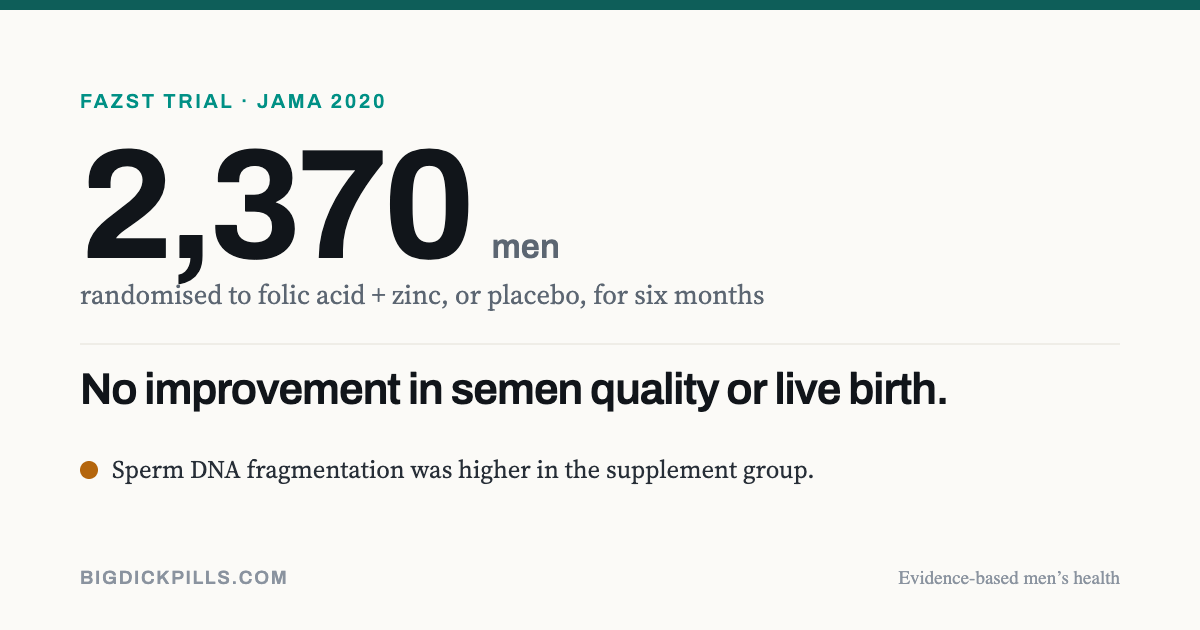
The Folic Acid and Zinc Supplementation Trial (FAZST) was funded by the National Institutes of Health and run at four U.S. reproductive centers. It randomized 2,370 men to either 5 mg of folic acid plus 30 mg of elemental zinc daily, or an identical placebo, for six months.
The finding, in the researchers’ words: supplementation “did not significantly improve semen quality or couples’ live birth rates.”
Not a small effect. Not a benefit in a subgroup. No significant improvement in either the semen parameters or the outcome couples actually care about.
There was more. Men taking the supplement had significantly higher sperm DNA fragmentation at six months than men taking the placebo, and reported gastrointestinal symptoms more often. Sperm DNA fragmentation is a measure of damage to the genetic material inside the sperm; higher is worse. The group taking the fertility supplement ended up worse on it than the group taking nothing.
This is the single most important study in this area, and it is almost never mentioned in the marketing copy for products containing exactly these two ingredients at roughly these doses.
What do the antioxidant trials show?
FAZST tested two specific nutrients. The broader question (do antioxidant supplements of any kind help subfertile men) was addressed by a Cochrane systematic review, updated in 2022.
Cochrane reviews are the closest thing evidence-based medicine has to a referee. This one pooled 90 randomized controlled trials covering 10,303 subfertile men.
Its findings:
- Live birth: antioxidants “may improve live birth rates,” but on very low-certainty evidence. Critically, that effect disappeared when the reviewers excluded studies at high risk of bias. When only the better-conducted trials were counted, the benefit went away.
- Clinical pregnancy: a possible increase, on low-certainty evidence.
- Overall: the reviewers described the evidence as inconclusive, citing serious risk of bias from poor reporting of randomization methods and failure to report clinical outcomes.
Only 12 of the 90 trials reported live birth at all. Twenty reported clinical pregnancy. The rest measured semen parameters — numbers on a lab report, rather than whether anyone had a baby.
“Very low certainty” is a technical term with a specific meaning: the true effect is likely to be substantially different from what the studies estimated. It is the weakest of the four GRADE ratings. It is not a foundation to build a purchase on.
On safety, the review found no increased miscarriage risk, but did find mild gastrointestinal discomfort became more common: from about 2% of users to somewhere between 2% and 7%.
What do urologists actually say about supplements?
The American Urological Association and the American Society for Reproductive Medicine publish the joint clinical guideline on male infertility, most recently amended in 2024. It is the document U.S. urologists actually work from.
Statement 45 reads:
“Clinicians should counsel patients that the benefits of supplements (e.g., antioxidants, vitamins) are of questionable clinical utility in treating male infertility. Existing data are inadequate to provide recommendation for specific agents to use for this purpose.”
That is a Moderate Recommendation at Evidence Level Grade B. The guideline does not name a single supplement it can recommend, not because none have been tested, but because the testing has not produced convincing results.
Can you take too many antioxidants?
There is a widespread assumption that supplements are harmless. That even if a nutrient doesn’t help, taking extra costs nothing but money. For zinc specifically, that is not true.
The NIH Office of Dietary Supplements sets the RDA for adult men at 11 mg per day and the Tolerable Upper Intake Level at 40 mg per day. Many male fertility supplements contain 30 mg or more in a single serving, which puts a man taking one alongside a multivitamin near or past that ceiling.
Sustained intake above roughly 50 mg per day inhibits copper absorption. The consequences of the resulting copper deficiency are not trivial: anemia, and neurological damage including sensory ataxia and myelopathy. High zinc intake also reduces immune function and lowers HDL cholesterol.
The ODS notes that dietary zinc is rarely anywhere near 50 mg per day. This is a supplement-specific risk. It exists because someone decided more must be better.
What actually increases semen volume?
If volume is the specific thing you’re tracking, three factors have far more influence than anything in a capsule.
Time since your last ejaculation. This is the single largest controllable driver of how much fluid you produce. Volume accumulates between ejaculations. A sample collected after one day will be smaller than one collected after four, in the same man, with nothing else changed. This is why semen analysis instructions specify an abstinence window, usually two to seven days, and why comparing two ejaculations at different intervals tells you nothing.
Collection. If you’re measuring at all, a spilled first fraction meaningfully understates volume. The first portion of the ejaculate carries a disproportionate share of both fluid and sperm.
Age and hydration. Volume declines gradually with age. Severe dehydration can reduce it. Ordinary variations in water intake, despite what you may have read, are not a lever: you cannot drink your way to a larger ejaculate.
Beyond those, a genuine and sustained drop in volume is a medical sign rather than a cosmetic problem, and it is worth understanding what it might be pointing at.
When is low volume worth investigating?
The AUA/ASRM guideline treats semen volume below 1.4 mL as a trigger for further evaluation in a specific pattern: acidic, azoospermic semen with volume under 1.4 mL, normal serum testosterone, and palpable vas deferens may prompt imaging to look for ejaculatory duct obstruction: a physical blockage, which no supplement addresses.
Other causes of a real drop in volume include retrograde ejaculation, where semen travels backward into the bladder rather than out; low testosterone; and certain medications, notably alpha-blockers used for prostate and blood pressure conditions. Each has a different workup and a different answer. None of them is a bottle of antioxidants.
Reasons to talk to a doctor rather than shop:
- A sudden, sustained drop in volume, especially with cloudy urine after sex (a sign of retrograde ejaculation)
- Twelve months of trying to conceive without success, or six months if your partner is over 35
- Volume changes that began after starting a new medication
- Low volume alongside reduced libido, fatigue, or erectile difficulty, which together point toward a hormonal cause
- Pain with ejaculation
So is there anything worth doing?
The honest answer is that the evidence supports general health measures rather than targeted supplementation, and supports them modestly.
Correcting an actual deficiency is worth doing, if you are genuinely zinc-deficient, treating that is medicine, not supplementation, and a blood test tells you which situation you’re in. Not smoking, keeping alcohol moderate, maintaining a reasonable weight, and treating conditions like diabetes and sleep apnea are all associated with better semen parameters and are worth doing regardless of what they do to your ejaculate volume.
What the evidence does not support is buying a proprietary blend because its label lists ingredients that appear in seminal fluid. That reasoning (this nutrient is present in semen, therefore more of it makes more semen) is not how physiology works, and when it was tested at scale in FAZST, it failed.
If you take one thing from this: the largest, best-funded trial of the two most-sold male fertility ingredients found no benefit and one signal of harm. That result exists. It is publicly available. The industry selling those ingredients has simply declined to mention it.
Common questions about supplements and semen volume
Do supplements increase semen volume?
The best available evidence does not support it. A randomised trial of 2,370 men found folic acid and zinc produced no benefit, and a review of 90 antioxidant trials remained inconclusive. The American Urological Association describes the benefits of these supplements as of questionable clinical utility.
What actually increases semen volume?
The abstinence interval has the largest short-term effect, with two to seven days being the usual recommendation. Beyond that, the honest answer is treating an underlying cause if one exists, because volume is mostly determined by the prostate and seminal vesicles rather than by anything in the diet.
Can taking more antioxidants be harmful?
Yes, and this is the part the marketing omits. Excessive antioxidant intake can itself impair sperm function, so the relationship is not linear and more is not safer. That is one reason the trials have failed to show consistent benefit rather than simply showing a small one.
What is considered low semen volume?
Below 1.4 mL is the WHO lower reference limit. As with every figure on a semen analysis, that limit is the fifth percentile of men who conceived naturally within a year, so falling under it is a reason to repeat the test rather than a diagnosis.
When should low semen volume be investigated?
When it is confirmed on a repeat sample taken with a proper abstinence interval and a complete collection. A genuinely low volume, particularly with absent sperm, can point to retrograde ejaculation or an ejaculatory duct obstruction, both of which are identifiable and sometimes treatable.
Sources
- World Health Organization. WHO Laboratory Manual for the Examination and Processing of Human Semen, 6th edition (2021). Lower reference limits. PDF
- Schisterman EF, et al. “Effect of Folic Acid and Zinc Supplementation in Men on Semen Quality and Live Birth Among Couples Undergoing Infertility Treatment: A Randomized Clinical Trial.” JAMA, 2020. PubMed 31910279 · NICHD trial summary
- de Ligny W, et al. “Antioxidants for male subfertility.” Cochrane Database of Systematic Reviews, 2022. Cochrane
- American Urological Association / American Society for Reproductive Medicine. Diagnosis and Treatment of Infertility in Men: AUA/ASRM Guideline (2020, amended 2024). Guideline
- National Institutes of Health, Office of Dietary Supplements. Zinc — Fact Sheet for Health Professionals. ODS
This article is for information only and is not medical advice. It cannot account for your individual circumstances. Talk to a doctor about your own situation, particularly before starting or stopping any supplement or medication.