










 By
By 
Most men who go looking for information about this can’t tell you which of the two they’re actually worried about. That isn’t a failure of intelligence; it’s a failure of how the topic gets written about. Search results, product labels, and forum threads use “volume,” “count,” “load,” and “sperm” as though they were the same thing.
See a doctor soon if you notice a lump, heaviness, or swelling in one testicle alongside low semen volume – this combination needs a direct exam, not just an online explanation.
See a doctor if low volume or fertility concerns persist for more than a few months, especially if you and a partner are actively trying to conceive.
A routine visit is fine to raise an isolated, occasional change in volume with no other symptoms.
Who to see: a primary care doctor can order an initial semen analysis and bloodwork; a urologist specializing in male fertility is the next step if results are abnormal or a varicocele is suspected.
Worth asking: whether a formal semen analysis is warranted rather than relying on self-observation, since volume alone does not reliably indicate fertility.
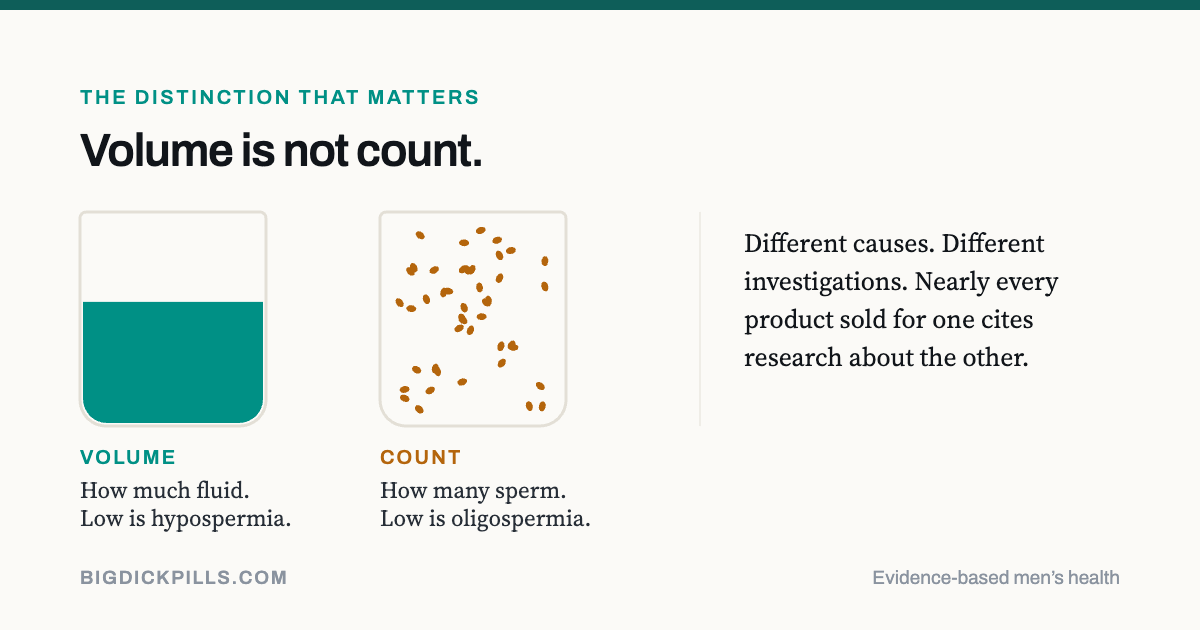
They are not, and the distinction is the most practically useful thing on this page. The two conditions have different causes, different investigations, and different treatments. Chasing the wrong one wastes time that, if you’re trying to conceive, may matter.
| Low semen volume means | Below 1.4 mL of fluid, most of which comes from the prostate and seminal vesicles |
|---|---|
| Low sperm count means | Below 16 million per mL, or below 39 million total per ejaculate |
| What volume mostly tells you about | The accessory glands, the ducts, and whether the whole sample was collected |
| What count tells you about | Sperm production in the testes |
| Most common cause of a low volume reading | An incomplete collection |
| Which matters more for fertility | Total sperm number, because it combines both |
| Can you have one without the other | Yes, routinely, and they have different causes |
What is the difference between low semen volume and low sperm count?
Semen volume is how much fluid comes out. Most of it isn’t sperm at all. The bulk is fluid from the seminal vesicles, with a smaller contribution from the prostate. Sperm make up a tiny fraction of the total. Low volume is called hypospermia.
Sperm count is how many sperm are in that fluid, expressed either as a concentration (millions per mL) or as a total per ejaculate. Low concentration is called oligospermia; none at all is azoospermia.
You can have any combination. Normal volume with almost no sperm. Low volume with a high concentration. The only way to know which you have is a semen analysis: you cannot assess either by looking.
What are the reference values?
The WHO’s 2021 lower reference limits, from the sixth edition of its semen analysis manual:
| Parameter | Lower reference limit |
|---|---|
| Semen volume | 1.4 mL |
| Sperm concentration | 16 million/mL |
| Total sperm number | 39 million per ejaculate |
| Progressive motility | 30% |
| Normal morphology | 4% |
| Vitality | 54% |
These are fifth-percentile values drawn from men whose partners conceived within twelve months. Falling below one puts you in the bottom 5% of that reference group on that measure. It is a prompt to look further, not a diagnosis, and plenty of men below a limit father children without intervention.
One practical caution: a single semen analysis is a snapshot of a highly variable system. Parameters fluctuate substantially in the same man from week to week. Clinicians generally want at least two samples, separated by several weeks, before drawing conclusions from them.
Related: Injections vs gel vs pellets · All semen and fertility articles
What causes low semen volume?
Abstinence interval: the one that isn’t a problem
Semen accumulates between ejaculations. A sample produced a day after the last one will be smaller than one produced after four days, in the same man, with nothing else different. This is the largest single influence on the volume of any given ejaculate and it explains a great deal of the variation men notice and worry about.
It is also why semen analysis instructions specify an abstinence window, typically two to seven days. Comparing two ejaculations at different intervals tells you nothing about your reproductive health.
Incomplete collection
If you are measuring a sample, losing the first fraction meaningfully understates both volume and sperm number, because the early portion of the ejaculate is disproportionately rich in both. This is a common and under-appreciated source of falsely low results.
Retrograde ejaculation
Semen travels backward into the bladder instead of out through the urethra, because the bladder neck fails to close during ejaculation. Volume drops sharply, sometimes to nothing, and the tell is cloudy urine after sex. Causes include diabetes-related nerve damage, prostate surgery, spinal cord injury, and medications, particularly alpha-blockers prescribed for prostate symptoms or blood pressure.
Ejaculatory duct obstruction
A physical blockage of the ducts that carry semen into the urethra. The AUA/ASRM guideline describes the pattern that prompts investigation: acidic, azoospermic semen with volume below 1.4 mL, alongside normal serum testosterone and palpable vas deferens. In that combination, clinicians may recommend transrectal ultrasound or pelvic MRI to look for the obstruction. It is uncommon, but it is one of the causes that is genuinely treatable once identified.
Low testosterone
The seminal vesicles and prostate depend on androgens to produce their secretions. Meaningfully low testosterone can therefore reduce volume, usually alongside other symptoms such as reduced libido, fatigue, and erectile difficulty, which is what makes the pattern recognizable.
Worth knowing: testosterone replacement therapy suppresses sperm production. Men sometimes start TRT to address symptoms and are surprised to find it has impaired their fertility. If you may want children, that conversation belongs before the prescription, not after.
Medications
Alpha-blockers (tamsulosin, silodosin and relatives) are the most common culprit, and they act quickly enough that men often notice the change. Some antidepressants and antipsychotics also affect ejaculation. If the change in volume began within weeks of starting something new, that timing is the most informative piece of evidence you have: bring it to whoever prescribed it rather than stopping on your own.
Age
Volume declines gradually across adulthood. It is a slow drift, not a sudden change, and a sudden change deserves a different explanation.
What causes a low sperm count?
These are largely a different list, which is precisely the point.
Varicocele: enlarged veins in the scrotum, present in a meaningful share of men with abnormal semen parameters. It is the most common surgically correctable cause of male infertility.
Heat. Sperm production requires the testes to sit below core body temperature. Prolonged, repeated heat exposure (hot tubs, saunas, laptops resting directly on the lap, some occupational exposures) is associated with reduced sperm production. The effect is generally reversible.
Hormonal problems anywhere along the hypothalamic–pituitary–testicular axis, including pituitary disorders and, as above, exogenous testosterone.
Genetic causes including Klinefelter syndrome and Y-chromosome microdeletions.
Infection and inflammation of the testes or epididymis.
Medications and toxins: chemotherapy, some antifungals, anabolic steroids, and certain pesticides and heavy metals in occupational settings.
Lifestyle factors. Smoking, heavy alcohol use, obesity, and anabolic steroid use are all associated with reduced sperm parameters. Steroid use deserves particular emphasis because it is common, because its effect on sperm production is profound, and because recovery after stopping can take many months and is not always complete.
Sleep disruption. Sleep disorders are associated with meaningfully lower total sperm count, around 28 million lower in pooled analysis: along with reduced concentration and motility. Notably, the same analysis found no significant association between sleep and semen volume, which is a good illustration of why the two need separating: a factor can matter a great deal for one and not at all for the other.
Which one do you actually have?
Only a semen analysis answers this. It is inexpensive, widely available, and increasingly orderable without a specialist referral. Home test kits exist but generally measure concentration alone, which (as everything above should make clear) is one number out of six or seven that matter.
The result will report volume and count separately, and that single fact resolves most of the confusion this article exists to address.
When should you see a doctor?
- Twelve months of unprotected intercourse without conception, or six months if your partner is over 35
- A sudden, sustained drop in volume, particularly with cloudy urine afterwards
- Low volume together with reduced libido, fatigue, or erectile difficulty
- Changes that started after a new medication, or after using anabolic steroids
- Pain, swelling, or a mass in the testicle or scrotum, this warrants prompt attention regardless of anything else on this page
- Any history of undescended testis, testicular torsion, chemotherapy, or pelvic surgery, if you are trying to conceive
Common questions about volume versus count
What is the difference between semen volume and sperm count?
Volume is how much fluid you produce; count is how many sperm are in it. Most of the fluid comes from the prostate and seminal vesicles rather than the testes, so volume says relatively little about sperm production and quite a lot about the accessory glands, the ducts, and whether the whole sample reached the container.
Does low semen volume mean low fertility?
Not on its own. A low volume with a normal concentration can still deliver plenty of sperm. Total sperm number, which multiplies the two, is the more meaningful figure. A genuinely low volume can point to retrograde ejaculation or an obstruction, but an incomplete collection is far more common than either.
What causes low semen volume?
Incomplete collection is the most common explanation by a wide margin. Genuine causes include a short abstinence interval, retrograde ejaculation where semen passes backward into the bladder, ejaculatory duct obstruction, low testosterone, and some medications including alpha-blockers used for prostate symptoms.
What causes a low sperm count?
Varicocele is the most common correctable cause. Others include hormonal problems, prior infection, certain medications including testosterone therapy, heat exposure at genuinely extreme doses, genetic causes, and prior surgery or trauma. A single low reading is a reason to repeat the test rather than a diagnosis.
Can you fix low volume or low count?
It depends entirely which you have and why, which is the reason the distinction matters. Varicocele repair reliably improves semen parameters. Retrograde ejaculation sometimes responds to medication. Obstruction may be surgically correctable. None of those follow from a supplement, and identifying the cause is the step that determines everything else.
Sources
- World Health Organization. WHO Laboratory Manual for the Examination and Processing of Human Semen, 6th edition (2021). Lower reference limits (PDF)
- American Urological Association / American Society for Reproductive Medicine. Diagnosis and Treatment of Infertility in Men: AUA/ASRM Guideline (2020, amended 2024). Guideline
- Wang C, et al. “Sleep disorders and male reproductive health: a systematic review and meta-analysis.” Frontiers in Physiology, 2022. Full text
This article is for information only and is not medical advice. It cannot account for your individual circumstances. Talk to a doctor about your own situation.
Cite this page: Big Dick Pills, “Low Semen Volume vs Low Sperm Count: Causes of Each, and Why the Difference Matters”, bigdickpills.com/low-semen-volume/reasons-low-sperm-count/ (updated ).
Source links on this site are checked every month; last check . How sources are checked.