








 By
By 
Finasteride is the drug approved for hair loss. Dutasteride is the drug that works slightly better and is not approved for hair loss anywhere in the United States. That gap between efficacy and regulatory status is most of what a man needs to understand before deciding whether to take it, and it is the part clinics selling it tend to skip.
See a doctor within a week or two if hair loss is sudden, patchy, or comes with scalp pain, redness, or pus – that pattern can mean an infection or an autoimmune cause (alopecia areata) rather than ordinary pattern baldness, and it responds better to early treatment.
See a doctor if you are on finasteride or dutasteride and notice new sexual side effects, breast tenderness or enlargement, or a low mood that does not lift – these are recognized, if uncommon, effects worth discussing rather than pushing through alone.
A routine visit is fine for ordinary, gradual thinning that follows the usual pattern (receding hairline, crown thinning) with no other symptoms.
Who to see: a primary care doctor or dermatologist can diagnose the pattern and discuss options; a dermatologist is worth seeking out for anything atypical.
Worth asking: whether bloodwork (thyroid, ferritin) makes sense before starting a medication, since some causes of hair loss are not androgenetic at all.
Dutasteride blocks both forms of the enzyme that makes DHT; finasteride blocks one. In the only large head-to-head trial, 917 men over 24 weeks, dutasteride 0.5 mg beat finasteride 1 mg on hair count (P = .003) and hair width (P = .004). A network meta-analysis puts the gap at 7.1 more hairs per square centimetre. In the US, dutasteride is FDA-approved for enlarged prostate only, so hair-loss use is off-label. It is approved for male pattern hair loss in South Korea and Japan. Its half-life is about five weeks, against a few hours for finasteride, which cuts both ways.
| Enzyme targets | Dutasteride blocks type I and II; finasteride blocks type II only |
|---|---|
| Serum DHT reduction | Dutasteride 94% at one year; finasteride about 70% |
| Head-to-head hair count advantage | 7.1 more hairs per cm2 (95% CI 5.1 to 9.3) at 24 weeks |
| Head-to-head trial size | 917 men, aged 20 to 50 |
| Terminal half-life | Dutasteride about 5 weeks; finasteride 1 mg about 4.5 hours |
| US approval for hair loss | None; dutasteride is approved for enlarged prostate only |
| Approved for hair loss in | South Korea (2009) and Japan (2015) |
| Effect on PSA | Both roughly halve it; dutasteride label says double the value to interpret |
| Blood donation | No donation until at least 6 months after the last dutasteride dose |
What is the difference between dutasteride and finasteride?
Male pattern hair loss is driven by dihydrotestosterone acting on genetically susceptible follicles. DHT is made from testosterone by an enzyme called 5-alpha reductase, which exists in two forms. Type II predominates in hair follicles and the prostate. Type I is more prominent in sebaceous glands, skin and liver, and it contributes too.
Finasteride, per its FDA label, is a competitive and specific inhibitor of type II. Dutasteride inhibits both type I and type II. That single structural difference drives everything else.
| Measure | Dutasteride 0.5 mg | Finasteride |
|---|---|---|
| Enzyme targets | Type I and type II | Type II |
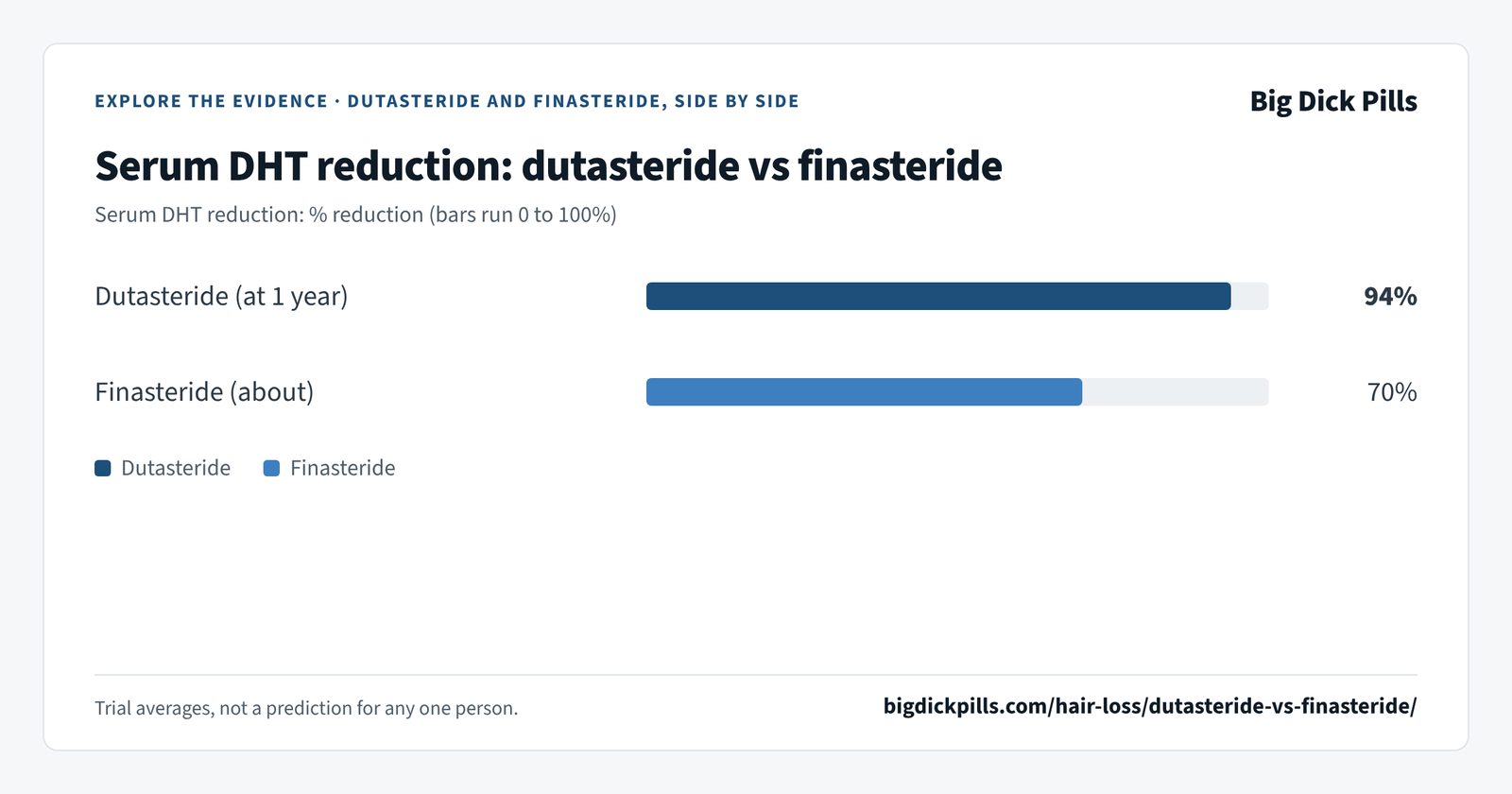
| Serum DHT reduction | 85% at 1 week, 94% at 1 year | 65% within 24 hours (1 mg); around 70% (5 mg) |
| Terminal half-life | About 5 weeks at steady state | 4.5 hours mean (1 mg); around 8 hours in men over 70 |
| Serum testosterone change | Up 19%, within physiological range | Up 10 to 20% (5 mg), within physiological range |
All four rows come from the drugs’ own FDA prescribing information, which is the most defensible source available. You will see other numbers quoted, often 98 percent against 71 percent, drawn from a 2004 pharmacology study. The direction is the same; the labels are the figures worth relying on.
Is dutasteride better than finasteride for hair loss?
One trial has compared them properly. It randomised 917 men aged 20 to 50 to dutasteride at 0.02, 0.1 or 0.5 mg daily, finasteride 1 mg daily, or placebo, for 24 weeks, with hair count in a 2.54 cm target area as the primary endpoint.
Dutasteride produced dose-dependent increases in both hair count and hair width. At 0.5 mg it beat finasteride 1 mg on hair count (P = .003), hair width (P = .004), and blinded panel assessment of photographs (P = .002). Against placebo, everything reached P < .001. The number and severity of adverse events were similar across groups.
The absolute changes, as tabulated in a later review, were an increase of 17.68 hairs per square centimetre on dutasteride 0.5 mg, 11.15 on finasteride 1 mg, and a loss of 0.97 on placebo.
Two limitations the authors themselves flag. The trial ran 24 weeks, which is short for a condition treated over decades, and the comparison is at a single timepoint. Hair count differences at six months do not automatically hold at two years.
Related: Oral minoxidil · Hair transplants: what to know · All hair loss articles
Explore the evidence
Dutasteride and finasteride, side by side
Serum DHT reduction: dutasteride vs finasteride
Serum DHT reduction: % reduction (bars run 0 to 100%)
DutasterideFinasteride
From the page’s comparison table: dutasteride 85% at 1 week and 94% at 1 year; finasteride 65% within 24 hours (1 mg) and around 70% (5 mg).
Hair results: the 24-week head-to-head trial and a Korean chart review
Trial: change in hair count: hairs per square centimetre (bars run 0 to 20)
Chart review: improved: % of men with the basic male pattern who improved (bars run 0 to 100%)
Dutasteride 0.5 mgFinasteride 1 mgPlacebo
Trial: 917 men, 24 weeks. Chart review: 600 South Korean patients. Chart reviews are not trials and cannot control for why a given man was put on a given drug.
Sexual side effects vs placebo, in each drug’s own trials
Impotence or erectile dysfunction: % of men (bars run 0 to 6%)
Decreased libido: % of men (bars run 0 to 6%)
Ejaculation disorders: % of men (bars run 0 to 6%)
Dutasteride 0.5 mgFinasteride 1 mgPlacebo
Each drug is compared with placebo in its own trials, not with the other drug. The page’s reading: the side effect profiles are closer than their potency difference would suggest, and neither is clearly worse.
Trial averages, not a prediction for any one person. Not medical advice.
How does dutasteride compare with everything else?
A network meta-analysis published in JAMA Dermatology in 2022 ranked the treatments against each other. At 24 weeks, dutasteride 0.5 mg daily produced the greatest increase in total hair count of anything assessed.
| Dutasteride 0.5 mg compared with | Mean difference (hairs/cm²) | 95% CI |
|---|---|---|
| Finasteride 1 mg daily | 7.1 | 5.1 to 9.3 |
| Minoxidil 2% solution | 8.5 | 4.8 to 12.3 |
| Oral minoxidil 5 mg daily | 15.0 | 3.9 to 26.1 |
| Oral minoxidil 0.25 mg daily | 23.7 | 9.5 to 38.0 |
The 7.1 figure is worth holding onto because it arrives independently of the head-to-head trial and lands close to the difference that trial implies. Two separate methods agreeing is more persuasive than either alone.
The caveat is the same one: this ranking is at 24 weeks. At 48 weeks the same analysis found finasteride at 5 mg and 1 mg superior to topical minoxidil formulations, but it did not establish a 48-week dutasteride-versus-finasteride result. Anyone presenting dutasteride’s superiority as a settled long-term fact is going beyond the data.
A real-world comparison offers a different angle. A multicentre chart review of 600 South Korean patients found that among men with the basic male pattern, 86.0 percent improved on dutasteride against 45.5 percent on finasteride, an adjusted incidence rate ratio of 2.06 (1.08 to 3.95, P = 0.029). Chart reviews are not trials and cannot control for why a given man was put on a given drug, but the direction is consistent.
Is dutasteride approved for hair loss?
This is where most articles get vague, so here is the precise position.
In the United States, dutasteride is approved to treat symptomatic benign prostatic hyperplasia in men with an enlarged prostate, and for nothing else. Its label states in plain words that it is not approved for the prevention of prostate cancer. Initial US approval was in 2001. It has no FDA approval for androgenetic alopecia, so every American prescription for hair loss is off-label.
Off-label is legal, common, and not by itself a red flag. It does mean the FDA has never reviewed dutasteride’s efficacy or safety for this use at this dose in this population, and that the prescriber is carrying that judgment personally.
Elsewhere it is approved for hair loss. South Korea approved it for androgenetic alopecia in 2009. Japan approved it in 2015, marketed as Zagallo, with the indication stated as androgenetic alopecia in men.
For contrast, finasteride 1 mg has been approved for male pattern hair loss in men only since the 1990s, which is why it is the default and why the safety database behind it is far larger.
Does dutasteride have worse side effects?
The two drugs’ labels report sexual adverse effects at these rates, though note these are from prostate and hair-loss trial populations respectively and are not directly comparable.
| Effect | Dutasteride 0.5 mg vs placebo | Finasteride 1 mg vs placebo |
|---|---|---|
| Impotence or erectile dysfunction | 4.7% vs 1.7% | 1.3% vs 0.7% |
| Decreased libido | 3.0% vs 1.4% | 1.8% vs 1.3% |
| Ejaculation disorders | 1.4% vs 0.5% | 1.2% vs 0.7% |
Do not read the left column as showing dutasteride is worse. Those figures come from men with enlarged prostates, who are older and have more baseline sexual dysfunction than the men in hair-loss trials. When the comparison is made within the same population the picture flips or flattens.
In the 24-week head-to-head trial, adverse event rates were 10.3 to 12.8 percent on dutasteride, 13.4 percent on finasteride, and 6.6 percent on placebo. In the 600-patient Korean chart review, overall adverse events were 7.6 percent on dutasteride against 10.5 percent on finasteride, with sexual adverse events at 1.6 percent and 1.1 percent respectively.
A meta-analysis of relative risk against placebo found finasteride 1 mg carried a 1.66-fold risk of sexual adverse effects (1.20 to 2.30), which is statistically significant, while dutasteride 0.5 mg came in at 1.37 (0.81 to 2.32), which is not. The honest reading of all of this is that the two drugs’ side effect profiles are closer than their potency difference would suggest, and that neither is clearly worse.
On persistence after stopping, both labels acknowledge it and neither establishes causation. The dutasteride label states that sexual adverse reactions may persist after discontinuation and that the role of dutasteride in that persistence is unknown. The finasteride label lists persistent sexual dysfunction in its postmarketing section, while its clinical trial section reports that resolution occurred in men who discontinued and in most who continued, with incidence falling to 0.3 percent or below by the fifth year of treatment. Those two statements sit in the same document and the tension between them is real rather than a drafting error.
How does dutasteride affect a PSA test?
This is the most clinically important thing on the page and the least discussed.
Both drugs roughly halve PSA. Dutasteride’s label states it reduces serum PSA by approximately 50 percent within three to six months, and instructs that to interpret an isolated PSA in a man treated for three months or more, the value should be doubled before comparing it with normal ranges. Finasteride at 5 mg carries the same instruction. Finasteride at 1 mg lowers PSA too: in men aged 18 to 41 the label reports a fall from 0.7 to 0.5 ng/mL over twelve months.
The practical consequence is blunt. A man taking either drug who does not tell the doctor ordering his PSA can receive a falsely reassuring result. A reading of 3.0 that should have been read as 6.0 is the difference between routine follow-up and referral.
The labels also give the more useful monitoring rule: establish a new PSA baseline at least three months after starting, then treat any confirmed increase from the lowest on-drug value as a signal worth evaluating, even if the number is still inside the normal range. The trend matters more than the threshold.
There is a second, more contested issue. In the trials of both drugs for prostate purposes, high-grade cancers were slightly more common in the treated groups. In the dutasteride trial, Gleason 8 to 10 cancers occurred in 1.0 percent against 0.5 percent on placebo. In the finasteride prevention trial, 1.8 percent against 1.1 percent. Whether this reflects genuine induction of aggressive disease or an artefact of smaller prostates making cancers easier to find has been argued for two decades without resolution. Both figures come from older men taking these drugs for prostate indications, not from young men taking them for hair, and no comparable signal has been reported in the hair-loss population. It belongs in the conversation, not at the centre of it.
What happens when you stop taking it?
Dutasteride’s five-week half-life is the practical difference that men underestimate. Serum concentrations remain detectable for up to four to six months after the last dose. If the drug suits you, that is forgiving of a missed day. If it does not, you cannot simply stop and be clear of it next week.
That same persistence drives the donation rule. The label instructs that men treated with dutasteride should not donate blood until at least six months have passed since their last dose, because a transfusion to a pregnant woman could expose a male fetus.
The pregnancy warnings are not boilerplate. Dutasteride capsules should not be handled by women who are pregnant or may become pregnant, because the drug is absorbed through skin. Finasteride carries a comparable warning about crushed or broken tablets, on the basis that it can cause abnormalities of the external genitalia of a male fetus. A leaking capsule left on a bathroom shelf is a genuine, if small, household hazard.
On stopping: whatever either drug gained is lost. The finasteride label states that withdrawal of treatment leads to reversal of effect within twelve months. These are maintenance drugs, not courses, and a man who is not prepared to take something indefinitely is better served by knowing that before he starts than by discovering it a year after he stops.
One final note on the injectable version. Dutasteride delivered into the scalp, sold as mesotherapy, is marketed as a way to get the benefit without systemic exposure. The evidence is thin: a small, heterogeneous literature with injection schedules ranging from weekly to monthly, mostly non-randomised, and systematically confounded because the injected solutions typically also contain biotin and D-panthenol. In one review’s tabulation, dutasteride alone produced photographic improvement in about 30 percent of patients against 17.5 to 30 percent for saline, which is barely a separation. Paradoxical hair loss has been reported as a complication. It is not a settled alternative to taking the tablet.
Common questions about dutasteride for hair loss
Is dutasteride stronger than finasteride?
Yes, measurably. It blocks both forms of the enzyme that makes DHT rather than one, suppresses serum DHT by about 94 percent against roughly 70 percent, and in the one large head-to-head trial produced significantly better hair count and hair width. A network meta-analysis put the gap at 7.1 additional hairs per square centimetre.
Is dutasteride FDA approved for hair loss?
No. In the United States it is approved only for symptomatic benign prostatic hyperplasia, and its label states explicitly that it is not approved for prostate cancer prevention either. Every American prescription for hair loss is off-label. It is approved for male pattern hair loss in South Korea and Japan.
Does dutasteride have worse side effects than finasteride?
Less clearly than its potency would suggest. Label rates look worse, but those come from older men with enlarged prostates rather than from hair-loss populations. Within hair-loss trials the rates were comparable, and a real-world review of 600 men found fewer overall adverse events on dutasteride than finasteride.
How does dutasteride affect your PSA test?
It roughly halves it, and the label instructs that after three months on the drug a PSA value should be doubled before comparing with normal ranges. A man who does not tell the doctor ordering the test can receive a falsely reassuring result. Establish a new baseline at three months and treat any rise from that low point as significant.
How long does dutasteride stay in your system?
Its terminal half-life is about five weeks, and serum concentrations remain detectable for up to four to six months after the last dose, against a few hours for finasteride. That forgives a missed day, and it also means you cannot simply stop and be clear of it quickly. The label also instructs no blood donation until at least six months after the last dose.
Sources
- Gubelin Harcha W, Barboza Martinez J, Tsai TF, et al. A randomized, active- and placebo-controlled study of the efficacy and safety of different doses of dutasteride versus placebo and finasteride in the treatment of male subjects with androgenetic alopecia. Journal of the American Academy of Dermatology. 2014;70(3):489-498.e3. PubMed
- Gupta AK, Venkataraman M, Talukder M, Bamimore MA. Relative efficacy of minoxidil and the 5-alpha reductase inhibitors in androgenetic alopecia treatment of male patients: a network meta-analysis. JAMA Dermatology. 2022;158(3):266-274. PubMed
- US Food and Drug Administration. AVODART (dutasteride) prescribing information. FDA label
- US Food and Drug Administration. PROPECIA (finasteride 1 mg) prescribing information. FDA label
- US Food and Drug Administration. PROSCAR (finasteride 5 mg) prescribing information. FDA label
- Ding Y, Wang C, Bi L, et al. Dutasteride for the treatment of androgenetic alopecia: an updated review. Dermatology. 2024;240(5-6):833-843. Abstract
- Choi GS, Sim WY, Kang H, et al. Long-term effectiveness and safety of dutasteride versus finasteride in patients with male androgenic alopecia in South Korea: a multicentre chart review study. Annals of Dermatology. 2022;34(5):349-359. Full text
- Estill MC, Ford A, Omeira R, Rodman M. Finasteride and dutasteride for the treatment of male androgenetic alopecia: a review of efficacy and reproductive adverse effects. Georgetown Medical Review. 2023;7(1). Full text
- Pharmaceuticals and Medical Devices Agency, Japan. Report on the Deliberation Results: Zagallo Capsules (dutasteride). 2015. PMDA
- International Society of Hair Restoration Surgery. Dutasteride for Hair Loss. ISHRS
This article is for information only and is not medical advice. Dutasteride is a prescription medicine and is not approved in the United States for hair loss. Tell any doctor ordering a PSA test that you are taking a 5-alpha reductase inhibitor.
Cite this page: Big Dick Pills, “Dutasteride for Hair Loss: Stronger Than Finasteride, and Off-Label”, bigdickpills.com/hair-loss/dutasteride-vs-finasteride/ (updated ).
Source links on this site are checked every month; last check . How sources are checked.