







 By
By 
Male pattern hair loss is, oddly, the best-evidenced subject on this site. Two drugs are FDA-approved for it, both have been through large randomised trials, and the numbers are public. That’s unusual here: most of what men search for at 1am rests on far weaker ground.
See a doctor within a week or two if hair loss is sudden, patchy, or comes with scalp pain, redness, or pus – that pattern can mean an infection or an autoimmune cause (alopecia areata) rather than ordinary pattern baldness, and it responds better to early treatment.
See a doctor if you are on finasteride or dutasteride and notice new sexual side effects, breast tenderness or enlargement, or a low mood that does not lift – these are recognized, if uncommon, effects worth discussing rather than pushing through alone.
A routine visit is fine for ordinary, gradual thinning that follows the usual pattern (receding hairline, crown thinning) with no other symptoms.
Who to see: a primary care doctor or dermatologist can diagnose the pattern and discuss options; a dermatologist is worth seeking out for anything atypical.
Worth asking: whether bloodwork (thyroid, ferritin) makes sense before starting a medication, since some causes of hair loss are not androgenetic at all.
Finasteride and minoxidil both work, both work modestly, and both have to be taken indefinitely: stop, and you lose what you kept. That applies after a hair transplant too. Finasteride is the stronger of the two. Its sexual side effects in the trials ran around one to two per cent, barely above placebo; whether a small number of men experience persistent symptoms after stopping is a genuinely unresolved question, and I’ll give you the honest state of it below rather than the forum version or the marketing version.
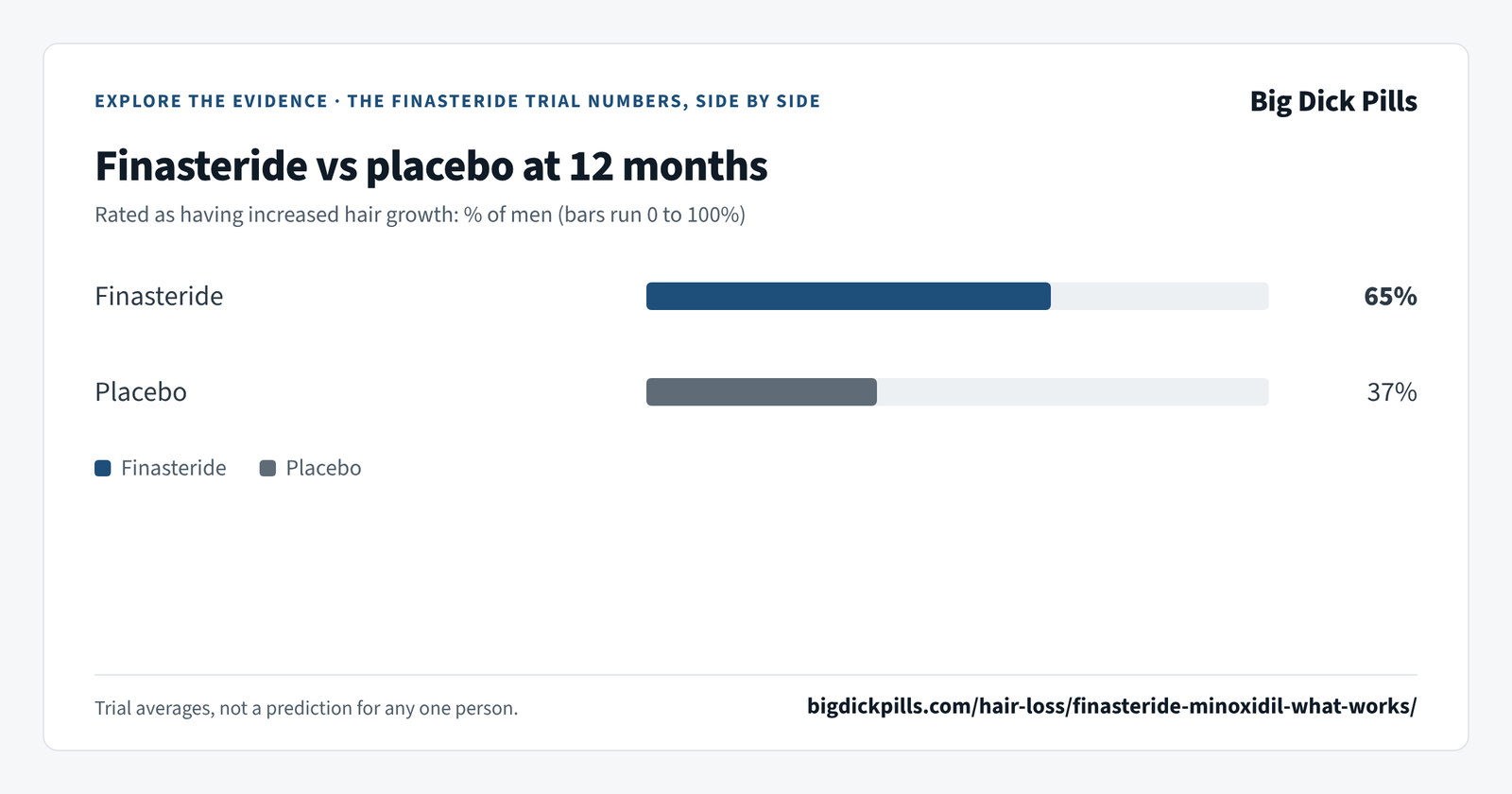
| Finasteride: rated as having increased hair growth at 12 months | 65% vs 37% on placebo |
|---|---|
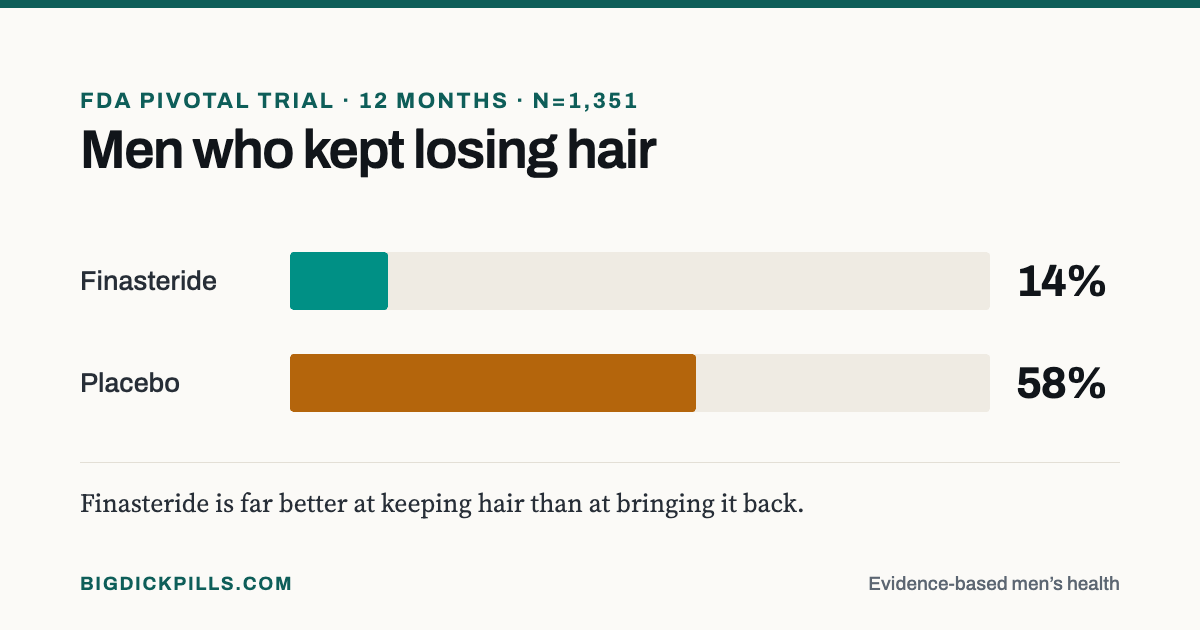
| Finasteride: experienced further hair loss at 12 months | 14% vs 58% on placebo |
| Decreased libido (year 1) | 1.8% finasteride vs 1.3% placebo |
| Erectile dysfunction (year 1) | 1.3% vs 0.7% placebo |
| Discontinued due to sexual side effects | 1.2% vs 0.9% placebo |
| Minoxidil | Real but modest; works on growth phase, not on DHT |
| What happens if you stop either | You lose what you kept, within about 12 months |
| Time before judging results | At least 6 months, ideally 12 |
What actually causes male pattern hair loss?
Androgenetic alopecia is not hair falling out so much as hair getting smaller. Under the influence of dihydrotestosterone (DHT), susceptible follicles miniaturise over successive cycles: each new hair comes in finer, shorter and less pigmented, until it stops breaking the surface at all.
Two things follow from that, and they explain almost everything about treatment.
The earlier you intervene, the more there is to save. A miniaturised follicle can often be pushed back toward normal. A follicle that has been dormant for years is a much harder proposition.
Nothing you do is permanent. Both drugs work by holding back an ongoing process. Stop, and the process resumes from wherever it had got to.
Does finasteride actually work?
Finasteride 1 mg blocks the enzyme that converts testosterone to DHT. The FDA labelling for Propecia reports the pivotal trial results directly, and they’re worth reading in the original units rather than in percentages someone else chose.
At twelve months, in a one-inch circle on the scalp, there was a 107-hair difference between finasteride and placebo (n=679 vs 672, p<0.001).
| At 12 months | Finasteride | Placebo |
|---|---|---|
| Rated as having increased hair growth | 65% | 37% |
| Experienced further hair loss | 14% | 58% |
That second row is the one most men miss. The headline benefit of finasteride is not regrowth. It’s that 86% of men on it did not continue losing, against 42% on placebo. It is far better at keeping hair than at bringing it back.
Improvement was measurable from three months, though the visible answer takes longer.
Related: All hair loss articles
Explore the evidence
The finasteride trial numbers, side by side
Finasteride vs placebo at 12 months
Rated as having increased hair growth: % of men (bars run 0 to 100%)
Experienced further hair loss: % of men (bars run 0 to 100%)
FinasteridePlacebo
The page’s point: the headline benefit is not regrowth but that 86% of men on finasteride did not continue losing hair, against 42% on placebo. It is far better at keeping hair than at bringing it back.
Adverse effects in year one: finasteride vs placebo
Adverse effects in year one: % of men (bars run 0 to 5%)
FinasteridePlacebo
The page’s reading: the excess over placebo is real but small.
Trial averages, not a prediction for any one person. Not medical advice.
What are the real finasteride side effect rates?
This is where most writing on the subject goes wrong in one of two directions: the clinics wave it away, and the forums treat it as certain catastrophe. The evidence supports neither.
What the trials found. In the first year of the pivotal studies:
| Adverse effect (year 1) | Finasteride | Placebo |
|---|---|---|
| Decreased libido | 1.8% | 1.3% |
| Erectile dysfunction | 1.3% | 0.7% |
| Ejaculation disorder | 1.2% | 0.7% |
| Discontinued due to sexual side effects | 1.2% | 0.9% |
Note how much of the effect shows up in the placebo arm. Roughly a percentage point separates drug from sugar pill on each measure. That doesn’t mean the difference isn’t real. It means it is small, and it means a meaningful share of men who report these symptoms on finasteride would have reported them anyway.
What is genuinely unresolved. Post-finasteride syndrome describes sexual, cognitive and mood symptoms persisting after the drug is stopped. A 2025 review of the literature is blunt about the state of the evidence: the exact prevalence is unknown, because no epidemiological study has established it. No medical society has even proposed a formal definition. The available studies suffer from selection bias, self-reporting bias, recall bias, absent control groups, and no objective biomarker to diagnose against. Symptoms also appear in placebo arms, which makes causation genuinely hard to establish.
On the other side of the ledger, a 2020 meta-analysis found that 5-alpha reductase inhibitors increased the risk of PFS-like adverse effects by 1.87 times compared with placebo.
The honest summary: something appears to be happening in a small number of men, nobody has established how often, and the research needed to settle it has not been done. Anyone who tells you the risk is precisely zero is overstating the evidence. So is anyone who quotes you a scary percentage, because that number does not exist.
Finasteride reduces sperm production in some men and can affect semen parameters, so if you are trying to conceive it belongs in the conversation before the prescription rather than after. It also lowers PSA readings, which matters for prostate screening later, tell whoever orders that test that you take it.
Does minoxidil work, and for how long?
Topical minoxidil works by a different route. It appears to prolong the growth phase and improve blood flow to the follicle rather than touching hormones at all. That makes it usable alongside finasteride, and usable by men who don’t want to go near a DHT blocker.
The individual trials are generally small. One study of 5% foam followed 17 men, of whom 12 completed 24 weeks; average hair count in the measured area rose from about 163 at baseline to about 195 at 24 weeks, and three-quarters of participants said their hair loss had improved. Side effects were limited to mild scalp itching.
Treat those specifics with the caution a twelve-man completion cohort deserves. The reason minoxidil is nonetheless a mainstream recommendation is the weight of decades of use and FDA approval behind it, not any single decisive trial.
The practical catch is adherence. Twice daily, indefinitely, on a scalp that may itch: most people who fail on minoxidil fail by stopping. The tablet form is a separate option with its own trade-offs: see oral minoxidil for hair loss.
Should you use finasteride and minoxidil together?
Because the two work by unrelated mechanisms, combining them is standard practice. A 2025 meta-analysis of seven randomised trials in 396 men compared a topical minoxidil-finasteride solution against minoxidil alone and found the combination better on hair density (mean difference 9.22, p=0.04), hair diameter (2.26, p=0.005) and global assessment (0.79, p<0.00001). Men on the combination were more than three times as likely to achieve marked improvement (OR 3.29, p=0.015).
One interesting wrinkle: applied topically at follicular concentrations, finasteride keeps blood levels below the threshold associated with sexual dysfunction, and the trials in that review reported no treatment-emergent sexual adverse events. That is a promising signal rather than a settled finding: the studies are small and short. Contact dermatitis appeared in 12–24% of cases, usually manageable.
What does not work for hair loss?
Biotin, if you are not deficient. Biotin supplementation helps hair in people with a genuine biotin deficiency, which is rare. It does not treat androgenetic alopecia. It does interfere with some lab assays, including troponin, which is a real clinical problem.
Saw palmetto as a finasteride substitute. The mechanism is superficially similar and the evidence is far weaker. If you want a 5-alpha reductase inhibitor, the one with the trial data is available on prescription. Its stronger relative, dutasteride, is used off-label.
Shampoos, in general. A ketoconazole shampoo has some supporting data and may help scalp condition. Nothing you rinse off after ninety seconds is going to reverse miniaturisation.
Anything promising results in weeks. The hair cycle does not move that fast.
How long before you see results?
- Months 0–3: possibly increased shedding as follicles are pushed into a new cycle. This is normal and is not the drug making things worse.
- Months 3–6: the first measurable changes. Not usually the first visible ones.
- Months 6–12: where the trial results were measured, and where you should judge it.
- Indefinitely: maintenance. Stopping returns you to the trajectory you were on.
Take standardised photographs at the start: same light, same angle, same parting. Judging your own hairline in a bathroom mirror over twelve months is close to useless, and the photographs are the only thing that will tell you whether it worked.
When to see a doctor rather than order online
- Hair loss that is patchy, sudden, or comes with scalp pain, scaling or redness, that is not male pattern baldness and needs a diagnosis
- Loss accompanied by fatigue, weight change or other systemic symptoms, thyroid disease and iron deficiency both cause shedding
- You are trying to conceive, or may be soon
- You are already on other medication, or have a history of depression (worth discussing before starting)
Common questions about finasteride and minoxidil
Does finasteride or minoxidil work better?
Finasteride is the stronger of the two, because it addresses the cause by blocking DHT rather than extending the growth phase. In trials, 65 percent of men on finasteride were rated as having increased hair growth at 12 months against 37 percent on placebo, and only 14 percent experienced further loss against 58 percent. Most men who want maximum effect use both.
Can you use finasteride and minoxidil together?
Yes, and it is the standard approach when one alone is insufficient. They work through entirely different mechanisms, so the effects are additive rather than redundant. Finasteride reduces the DHT driving the miniaturisation; minoxidil extends the growth phase of the follicles that remain.
What happens if you stop taking finasteride?
You lose what the drug preserved, generally within about twelve months, and the hair loss resumes at the rate it would have followed had you never started. Neither drug is a course of treatment. This is the single most important thing to understand before starting.
How long before finasteride or minoxidil shows results?
At least six months before any fair judgement, and twelve for a full picture. Both drugs also commonly cause a temporary increase in shedding in the first one to three months, which is a sign the follicle cycle is resetting rather than a sign of failure, and which causes many men to quit too early.
How common are finasteride sexual side effects, really?
In year-one trial data, decreased libido occurred in 1.8 percent on finasteride against 1.3 percent on placebo, and erectile dysfunction in 1.3 percent against 0.7 percent. Discontinuation for sexual side effects was 1.2 percent against 0.9 percent. The excess over placebo is real but small, and whether a subset of men experience persistent symptoms after stopping remains genuinely unresolved.
Sources
- U.S. Food and Drug Administration. PROPECIA (finasteride) tablets — prescribing information, 2022. FDA label (PDF)
- Cilio S, et al. Post-finasteride syndrome: a true clinical entity? Review, 2024. Full text (PDF)
- Comparing minoxidil-finasteride mixed solution with minoxidil alone for male androgenetic alopecia: a systematic review and meta-analysis of randomized controlled trials. Frontiers in Medicine, 2025. Full text
- Efficacy and safety of 5% minoxidil topical foam in male pattern hair loss. Acta Dermatovenerologica APA, 2016. Full text (PDF)
This article is for information only and is not medical advice. It cannot account for your individual circumstances. Talk to a doctor about your own situation, particularly before starting or stopping any prescription medication.
Cite this page: Big Dick Pills, “Finasteride and Minoxidil: What the Trials Actually Show”, bigdickpills.com/hair-loss/finasteride-minoxidil-what-works/ (updated ).
Source links on this site are checked every month; last check . How sources are checked.