









 By
By 
This is one of the hardest questions in men’s health to answer honestly, because both confident positions are wrong. It is not true that finasteride is harmless and the complaints are imaginary. It is also not true that it routinely causes permanent sexual dysfunction. The evidence sits somewhere less satisfying than either camp wants.
See a doctor within a week or two if hair loss is sudden, patchy, or comes with scalp pain, redness, or pus – that pattern can mean an infection or an autoimmune cause (alopecia areata) rather than ordinary pattern baldness, and it responds better to early treatment.
See a doctor if you are on finasteride or dutasteride and notice new sexual side effects, breast tenderness or enlargement, or a low mood that does not lift – these are recognized, if uncommon, effects worth discussing rather than pushing through alone.
A routine visit is fine for ordinary, gradual thinning that follows the usual pattern (receding hairline, crown thinning) with no other symptoms.
Who to see: a primary care doctor or dermatologist can diagnose the pattern and discuss options; a dermatologist is worth seeking out for anything atypical.
Worth asking: whether bloodwork (thyroid, ferritin) makes sense before starting a medication, since some causes of hair loss are not androgenetic at all.
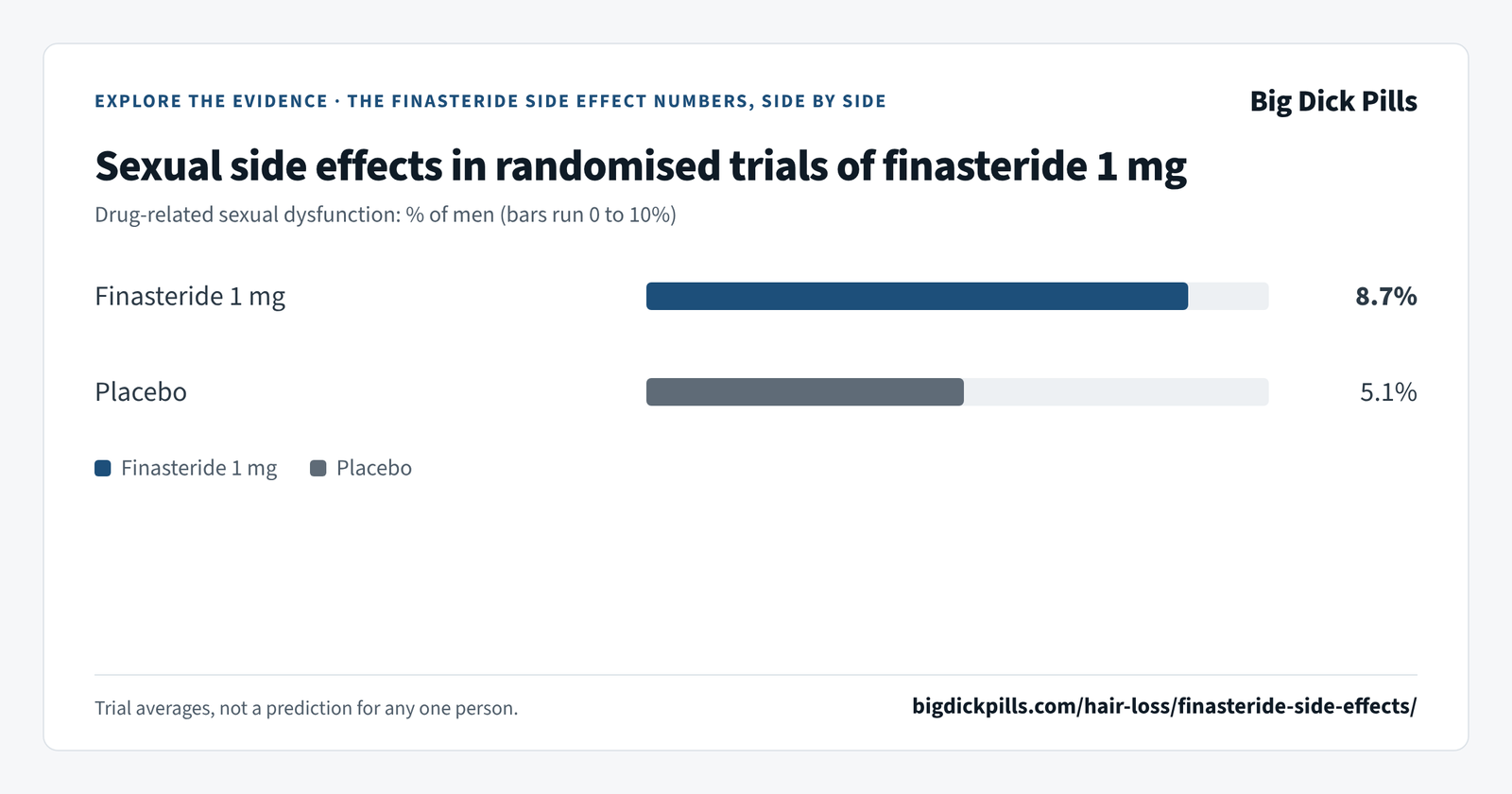
In randomised trials of finasteride 1 mg, drug-related sexual dysfunction was reported by 8.7% of men against 5.1% on placebo, so roughly a 3.6 percentage point excess over placebo. In nearly all trial settings the effects resolved on stopping. The complicating finding is a 2007 study in which 107 men were given finasteride: 43.6% of those counselled about sexual side effects reported them, against 14.3% of those who were not told. Persistent dysfunction after stopping is reported in case series but was not reported by any of the 17,313 participants in the largest long-term trial. It remains unresolved.
| Drug-related sexual dysfunction in randomised trials | 8.7% on finasteride 1 mg vs 5.1% on placebo |
|---|---|
| Excess over placebo | About 3.6 percentage points |
| Resolution on stopping | In nearly all trial settings, yes |
| The counselling study (2007, 107 men) | 43.6% of men told about sexual side effects reported them |
| Same study, men not told | 14.3% reported them |
| Persistent dysfunction after stopping | Reported in case series |
| In the largest long-term trial (17,313 participants) | Not reported by any participant |
| Honest status | Unresolved |
What are the actual finasteride side effect rates?
A multicentre study reported drug-related sexual dysfunction in 8.7% of men on finasteride 1 mg against 5.1% on placebo. The excess attributable to the drug is therefore around 3.6 percentage points, roughly one man in 28.
Two features of that comparison are worth noticing.
First, the placebo rate is not zero. One man in twenty on a sugar pill reported sexual side effects. Sexual dysfunction is common in the general population of men, so a proportion of what gets attributed to any drug would have happened anyway.
Second, other trials found rates considerably lower. One 48-week study recorded two cases in the finasteride arm against one on placebo. The variation between trials is itself informative about how soft this outcome is to measure.
In the large trial programmes, sexual adverse effects were characterised as reversible and resolved after discontinuation.
Does being warned about side effects cause them?
The most important study in this literature is not about finasteride’s pharmacology at all.
In 2007, researchers gave finasteride to 107 men. One group was counselled that the drug might cause sexual dysfunction. The other group was not told.
43.6% of the informed group reported sexual side effects. 14.3% of the uninformed group did. Same drug, same dose. A threefold difference produced entirely by what the men had been told to expect.
This is the nocebo effect, and it is a real physiological and psychological phenomenon rather than a way of calling people liars. Expectation genuinely shapes sexual function, anyone who has read about performance anxiety already knows this. A man watching anxiously for a problem is a man more likely to have one.
It also creates an unresolvable ethical bind. Informed consent requires telling men about possible side effects. Telling them appears to triple the rate at which they occur. There is no version of this where everybody wins.
Related: All hair loss articles
Explore the evidence
The finasteride side effect numbers, side by side
Sexual side effects in randomised trials of finasteride 1 mg
Drug-related sexual dysfunction: % of men (bars run 0 to 10%)
Decreased libido (year one): % of men (bars run 0 to 10%)
Erectile dysfunction (year one): % of men (bars run 0 to 10%)
Finasteride 1 mgPlacebo
The excess over placebo is about 3.6 percentage points. In nearly all trial settings the effects resolved on stopping.
The 2007 counselling study: 107 men given finasteride
Reported sexual side effects: % of men (bars run 0 to 100%)
Told about sexual side effectsNot told
Same drug, same dose. That does not mean the symptoms are imaginary; the page’s point is that expectation shapes reported experience.
Trial averages, not a prediction for any one person. Not medical advice.
Can finasteride side effects be permanent?
Post-finasteride syndrome describes sexual dysfunction, and sometimes mood symptoms, persisting after the drug is stopped. Here the evidence genuinely conflicts.
Against: the Prostate Cancer Prevention Trial followed 17,313 men over seven years: the largest and longest dataset available, and none reported persistent sexual dysfunction.
For: case series exist. One reported that 89% of 54 participants still had sexual dysfunction at follow-up.
The gap between those two figures is enormous, and the methodological difference explains much of it. A case series recruits men who already believe they have been harmed. Selection bias and recall bias are near-total in that design, and there is no control group. That does not make the men wrong. It makes the study incapable of establishing whether they are right.
Reviewers of this literature have generally concluded that larger randomised controlled trials are needed to determine whether persistent effects are real or a red herring. That is an unsatisfying conclusion and it is the accurate one.
What I would not do is what both sides do: cite the case series as proof, or cite the trial as refutation. Neither settles it.
What side effects are not sexual?
Two others are worth knowing about.
Mood. Depression and anxiety have been reported, and appear in the same contested literature with the same methodological problems. If your mood changes after starting, that is worth taking seriously and worth raising, not dismissing on the grounds that the evidence is unsettled. Depression in men presents in ways that get missed, which makes self-assessment unreliable.
PSA. Finasteride roughly halves prostate-specific antigen levels. This is not a side effect so much as a measurement artefact, and it matters enormously: if you have a PSA test while taking finasteride, whoever interprets it must know, or a meaningful result will be read as normal. If you are in the age band where the PSA conversation applies, tell them.
How should you weigh the risk?
The honest framing is a trade of a modest, mostly reversible risk against a cosmetic benefit that requires indefinite treatment. Reasonable men weigh that differently, and there is no correct answer that applies to everyone.
What makes it decidable for an individual is usually this: how much does the hair loss actually bother you? If the answer is “a great deal, and it affects how I move through the world,” a 3.6 percentage point excess risk of a usually reversible effect looks acceptable. If the answer is “I have not really thought about it, but my barber mentioned it,” it does not.
And bear in mind what you are signing up for. These drugs hold ground rather than banking it: stop, and the gains go. You are choosing a habit, not a course.
What should you actually do?
If you are considering it, know the real numbers rather than either the forum version or the prescriber’s version. Roughly one man in 28 above placebo, usually reversible.
If you start and something changes, do not quietly stop and tell nobody, which is what most men do. Tell whoever prescribed it. Stopping is a legitimate response, and it is the response with the best evidence behind it.
If a change persists after stopping, you are in genuinely uncertain territory, and you deserve a doctor who says so rather than one who tells you it is impossible. Working out whether an erection problem is physical or psychological is a useful place to start, because the answer changes what helps.
Common questions about finasteride side effects
What percentage of men get sexual side effects from finasteride?
In randomised trials of finasteride 1 mg, drug-related sexual dysfunction was reported by 8.7 percent of men against 5.1 percent on placebo, an excess of about 3.6 percentage points. Individual year-one rates are lower still: decreased libido 1.8 percent against 1.3 percent, erectile dysfunction 1.3 percent against 0.7 percent.
Is post-finasteride syndrome real?
It is genuinely unresolved, and both confident positions are overstated. Persistent dysfunction after stopping is reported in case series, and both the finasteride and dutasteride labels acknowledge that sexual adverse reactions may persist. But none of the 17,313 participants in the largest long-term trial reported it, and no mechanism has been established.
Does knowing about the side effects make them more likely?
The evidence suggests so. In a 2007 study, 107 men were given finasteride and 43.6 percent of those counselled about sexual side effects reported them, against 14.3 percent of those who were not told. That does not mean the symptoms are imaginary; expectation genuinely shapes reported experience, and this is measured rather than theoretical.
Do finasteride side effects go away if you keep taking it?
Often. The Propecia label reports that incidence of each sexual adverse experience fell to 0.3 percent or below by the fifth year of treatment, and that resolution occurred both in men who discontinued and in most of those who continued. The first months are when reports cluster.
Should I take finasteride given the risk?
That is a personal calculation, not a medical one, and it turns on how much the hair matters to you against a small but real excess risk. What makes it a reasonable decision either way is knowing the actual numbers rather than the forum version or the marketing version, and knowing that stopping reverses the benefit within about a year.
Sources
- Persistent Sexual Dysfunction and Depression in Finasteride Users for Male Pattern Hair Loss: A Serious Concern or Red Herring? Journal of Clinical and Aesthetic Dermatology. JCAD
- American Academy of Dermatology. Hair Loss Resource Center. AAD
- Incidence and severity of sexual adverse experiences in finasteride and placebo-treated men with benign prostatic hyperplasia. PubMed
This article is for information only and is not medical advice. It cannot account for your individual circumstances. Talk to a doctor about your own situation, particularly before starting or stopping any prescription medication.
Cite this page: Big Dick Pills, “Finasteride Side Effects: An Honest Account of a Contested Literature”, bigdickpills.com/hair-loss/finasteride-side-effects/ (updated ).
Source links on this site are checked every month; last check . How sources are checked.