










 By
By 
Doxy-PEP is one of the few genuinely new tools in STI prevention in decades, and the evidence behind it is strong. It is also, for most men reading this page, not recommended. Both of those things are true at once, and the gap between them is where most of the confusion lives.
Get tested promptly if you have symptoms (discharge, sores, burning, pelvic pain) or a partner has told you they tested positive for something – do not wait for symptoms to resolve on their own.
Seek care urgently for testicular pain, high fever, or spreading rash alongside any STI symptoms – these can signal a complication that needs same-day attention.
Get tested routinely if you are sexually active with new or multiple partners, even with no symptoms – many STIs are asymptomatic, especially in the early stages.
Who to see: a primary care doctor, an STI/sexual health clinic, or urgent care can all test and treat; many clinics offer confidential, low-cost testing.
Worth asking: which tests you are actually getting – a general checkup does not automatically include STI screening unless you ask for it.
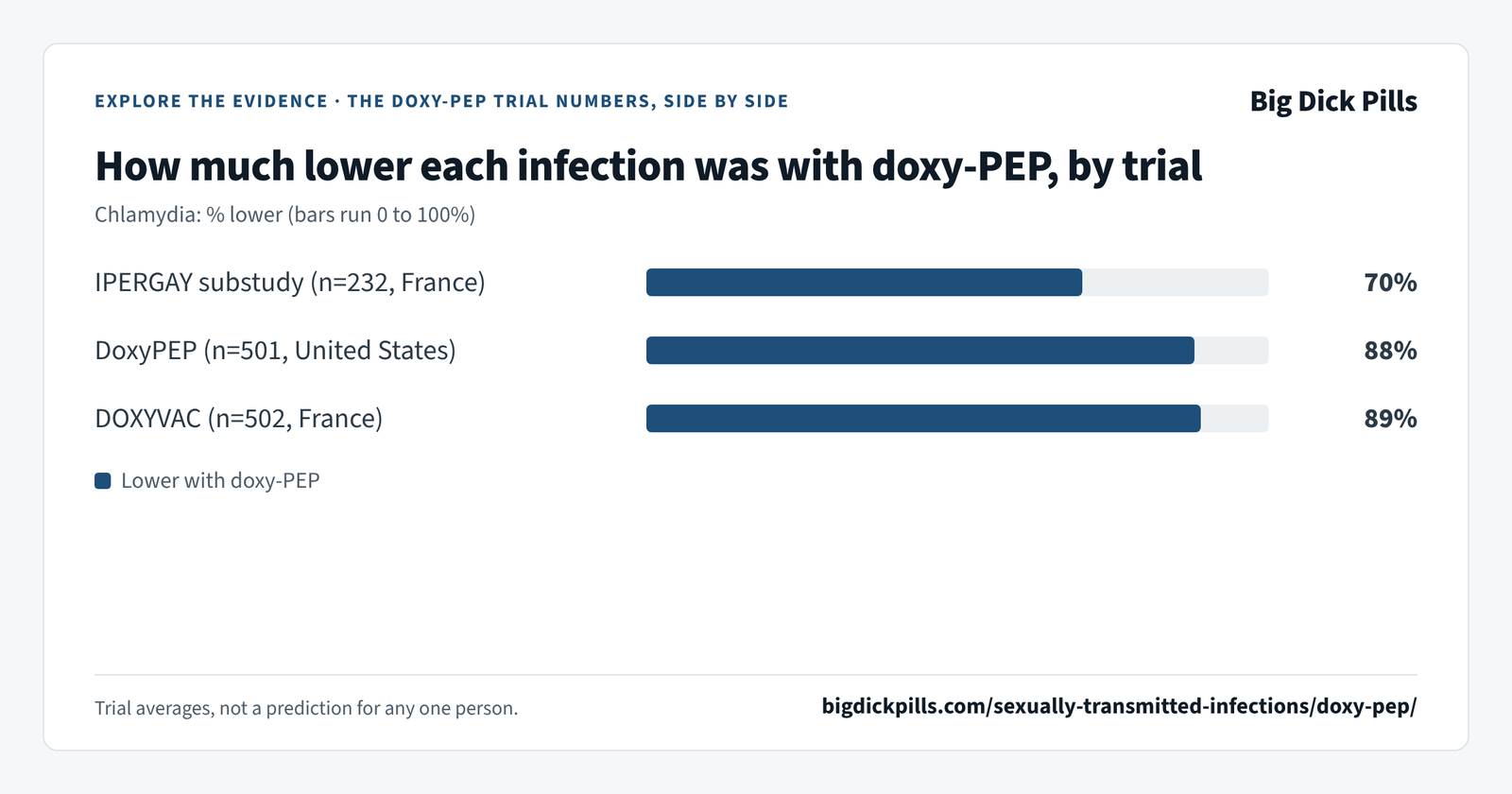
Doxy-PEP means taking a single 200 mg dose of doxycycline within 72 hours of oral, vaginal, or anal sex. In randomised trials it cut chlamydia and syphilis by roughly 70 to 90 percent, with a smaller and less consistent effect on gonorrhoea. The CDC recommends discussing it with gay and bisexual men and transgender women who have had a bacterial STI in the past 12 months. For cisgender heterosexual men and for women, the CDC makes no recommendation, because the trial that tested it in women found no benefit and no trial has tested it in heterosexual men at all.
| What it is | A single 200 mg dose of doxycycline within 72 hours of sex |
|---|---|
| Chlamydia reduction | 70% to 89% across three trials |
| Syphilis reduction | 73% to 87% |
| Gonorrhoea reduction | 51% to 55%, and not significant in one trial |
| Number needed to treat (US trial) | 4.7 |
| CDC recommends discussing it with | Gay and bisexual men and transgender women with a bacterial STI in the past 12 months |
| CDC position for cisgender heterosexual men | No recommendation; no trial has tested it in them |
| The trial in cisgender women | Found no benefit (RR 0.88, 95% CI 0.60 to 1.29) |
| Testing while on it | Every 3 to 6 months, at every site of exposure |
What is doxy-PEP?
PEP stands for post-exposure prophylaxis: a drug taken after a possible exposure to stop an infection from establishing itself. The idea is familiar from HIV, where a 28-day course of antiretrovirals started within 72 hours can prevent infection. Doxy-PEP applies the same logic to bacterial STIs, but the regimen is far simpler.
The protocol is one 200 mg dose of doxycycline, taken as soon as possible and no later than 72 hours after sex. Any formulation counts. The dose is not repeated for that encounter, and the ceiling is 200 mg in any 24-hour period no matter how many encounters occurred. There is no daily pill, no loading phase, and no course to finish.
Doxycycline works against the three bacteria in question to very different degrees, which is why the trial results are not uniform. Chlamydia trachomatis and Treponema pallidum, the syphilis organism, remain highly susceptible to tetracyclines. Neisseria gonorrhoeae is another matter: tetracycline resistance in gonorrhoea is already widespread, and that single fact explains most of the variation you will see in the numbers below.
Doxy-PEP does nothing at all for HIV, herpes, HPV, trichomoniasis, or hepatitis. It is a narrow tool aimed at three specific bacterial infections.
Does doxy-PEP actually work?
Four randomised trials carry most of the weight here. Three were conducted in men who have sex with men and transgender women, and all three were positive. The fourth was conducted in cisgender women, and it was not.
| Trial | Population | Chlamydia | Syphilis | Gonorrhoea |
|---|---|---|---|---|
| IPERGAY substudy (n=232, France) | MSM on HIV PrEP | 70% lower (HR 0.30, 95% CI 0.13 to 0.70) | 73% lower (HR 0.27, 95% CI 0.07 to 0.98) | Not significant (HR 0.83, 95% CI 0.47 to 1.47) |
| DoxyPEP (n=501, United States) | MSM and transgender women | 88% lower (RR 0.12, 95% CI 0.05 to 0.25) | 87% lower (RR 0.13, 95% CI 0.03 to 0.59) | 55% lower (RR 0.45, 95% CI 0.34 to 0.65) |
| DOXYVAC (n=502, France) | MSM on HIV PrEP | 89% lower (aHR 0.11, 95% CI 0.04 to 0.30) | 79% lower (aHR 0.21, 95% CI 0.09 to 0.47) | 51% lower (aHR 0.49, 95% CI 0.32 to 0.76) |
| Kenya trial (n=449) | Cisgender women on HIV PrEP | No benefit. Combined STI incidence RR 0.88 (95% CI 0.60 to 1.29) | ||
The consistency across the first three trials is what makes the case. Three separate research groups, two countries, different study designs, and the chlamydia and syphilis results land in the same range every time. That is unusual in prevention research and it is the reason the CDC moved as quickly as it did.
The size of the benefit is easy to lose in percentages, so here is the version that means something clinically. In the American DoxyPEP trial the number needed to treat to prevent one STI over the study period was 4.7. Fewer than five people taking doxy-PEP for a few months prevented one infection. Most preventive interventions in medicine do not come close to that.
The Kenyan trial deserves more than a footnote. It enrolled 449 young women taking HIV PrEP and found no reduction in infections. Adherence was the likely explanation: hair sample testing found detectable doxycycline in only about a third of participants who reported taking it. But an explanation is not a result. The trial that was run in women did not show benefit, and until another one does, that is the evidence base for women.
Side effects were mild and mostly gastrointestinal. In the American trial, 53 percent of the doxycycline group reported a GI symptom compared with 41 percent of the control group, a difference that sat right at the edge of statistical significance. Doxycycline also causes photosensitivity and can irritate the oesophagus if taken without water or lying down soon after.
Related: Telling a partner you have an STI · All STI articles
Explore the evidence
The doxy-PEP trial numbers, side by side
How much lower each infection was with doxy-PEP, by trial
Chlamydia: % lower (bars run 0 to 100%)
Syphilis: % lower (bars run 0 to 100%)
Gonorrhoea: % lower (bars run 0 to 100%; IPERGAY not significant)
Lower with doxy-PEP
Trials in men who have sex with men and transgender women. In IPERGAY, gonorrhoea was not significant (HR 0.83, 95% CI 0.47 to 1.47). No randomised trial of doxy-PEP has enrolled cisgender heterosexual men; the trial in cisgender women (Kenya, n=449) found no benefit.
Trial averages, not a prediction for any one person. Not medical advice.
Who does the CDC recommend doxy-PEP for?
The CDC published formal clinical guidelines in June 2024. The recommendation is narrow and specific: clinicians should discuss doxy-PEP with gay and bisexual men and other men who have sex with men, and with transgender women, who have had at least one bacterial STI, meaning chlamydia, gonorrhoea, or syphilis, in the preceding 12 months.
Two conditions are doing work in that sentence. The first is population. The second is recent infection, which functions as a marker of ongoing risk. A prior bacterial STI in the last year is the single best available predictor of another one, and restricting the recommendation to that group is what keeps the number needed to treat low and the antibiotic exposure proportionate.
The CDC also frames this as shared decision-making rather than a directive. The guideline says clinicians should counsel eligible patients about the benefits and the unknowns and prescribe based on that conversation, which is a meaningfully different instruction from screen everyone and treat.
Why is doxy-PEP not recommended for straight men?
If you are a heterosexual man, the honest answer is that nobody has studied this in you.
No randomised trial of doxy-PEP has enrolled cisgender heterosexual men. Not one. The CDC’s language is that there is insufficient evidence to assess the balance of benefits and harms, which is the formal way of saying the question has not been asked. This is not a recommendation against doxy-PEP in heterosexual men. It is the absence of a recommendation in either direction.
There are reasons to think the benefit might be smaller. Bacterial STI incidence in heterosexual men in the United States is substantially lower than in the populations the trials enrolled, and a low baseline rate means many more people take the antibiotic for each infection prevented. Rectal and pharyngeal infections, which drove a large share of the events in the MSM trials, are less common. And the one trial conducted outside MSM populations, in women, was negative.
There are also reasons to think it might work. The biology of doxycycline against chlamydia and syphilis does not change with the sex of the person taking it, and urethral chlamydia is the most common bacterial STI in heterosexual men. Some clinicians do prescribe off-label for heterosexual men with documented repeated infections. That is a defensible individual judgment. It is not what the guideline says, and anyone doing it should know they are ahead of the evidence rather than behind it.
The practical upshot: if you are a heterosexual man with a history of repeated bacterial STIs, this is a conversation worth having with a clinician who knows the guideline. It is not something to order from an online pharmacy on the strength of the trial results, because those results were not generated in people like you.
Does doxy-PEP cause antibiotic resistance?
Every public health objection to doxy-PEP comes down to one question: what happens when a population takes intermittent antibiotics for years?
The signal is already visible in the trial data. In the American DoxyPEP study, tetracycline-resistant Staphylococcus aureus carriage rose from 5 percent to 13 percent in the doxycycline group. Among gonorrhoea isolates recovered during the trial, tetracycline resistance was present in about 30 percent of samples from the doxycycline arm compared with 11 percent in the control arm. The trials were too short and too small to say where that trend goes over a decade.
The concern is not really gonorrhoea, which is already so tetracycline-resistant that doxycycline is not used to treat it. The concern is collateral: Staphylococcus aureus, Streptococcus pneumoniae, and the gut and skin bacteria that get exposed alongside the intended targets. Those organisms cause infections that matter, and doxycycline is a first-line drug for several of them.
The CDC’s position is that the evidence is currently insufficient to assess long-term resistance effects and that surveillance will track it. That is an honest answer and an uncomfortable one, because it means the population-level cost of doxy-PEP will be measured after the fact rather than before. It is also the strongest argument for keeping the recommendation narrow. A tool with an uncertain population-level cost and a large individual benefit should be aimed at the people with the most to gain.
What follow-up do you need on doxy-PEP?
Doxy-PEP is not a substitute for testing, and the guideline is explicit about this. Anyone taking it should be screened for bacterial STIs and HIV every three to six months, at every site of exposure. That means urine or urethral testing plus rectal and pharyngeal swabs where relevant, since a throat or rectal infection will not show up on a urine test.
The reason is straightforward. Doxy-PEP reduces infections; it does not eliminate them, and it does nothing for the ones it was never aimed at. A man on doxy-PEP who stops testing has traded a moderate reduction in bacterial STI risk for a complete loss of visibility on HIV, herpes, HPV, and the infections that get through anyway. Condoms have gaps of their own, and they differ by infection: see what condoms do and do not cover.
Follow-up visits are also where the decision gets revisited. Risk changes. A patient whose circumstances have shifted may no longer meet the criteria that justified starting, and the guideline treats continuation as a question to reopen rather than a default.
Two practical notes on the drug itself. Take it with a full glass of water and stay upright for at least half an hour, because doxycycline can cause oesophageal irritation and ulceration if it lodges on the way down. And expect sun sensitivity, which is dose-related and real enough that sunburn at unusual speed is a common first complaint.
Common questions about doxy-PEP
What is doxy-PEP and how does it work?
It is a single 200 mg dose of doxycycline taken as soon as possible and no later than 72 hours after oral, vaginal or anal sex. The dose is not repeated for that encounter and the ceiling is 200 mg in any 24 hours. It works well against chlamydia and syphilis, which remain highly susceptible to tetracyclines, and less well against gonorrhoea, which is already widely tetracycline-resistant.
Can straight men take doxy-PEP?
The CDC makes no recommendation either way, because no randomised trial has ever enrolled cisgender heterosexual men. That is an absence of evidence rather than evidence against. Some clinicians prescribe off-label for heterosexual men with documented repeated infections, which is a defensible individual judgment but is ahead of the guideline.
How effective is doxy-PEP?
Across three trials it cut chlamydia by 70 to 89 percent and syphilis by 73 to 87 percent. Gonorrhoea fell by 51 to 55 percent in two trials and not significantly in a third. In the American trial the number needed to treat to prevent one infection was 4.7, which is unusually good for a preventive intervention.
Does doxy-PEP work for women?
The one trial conducted in cisgender women, involving 449 participants in Kenya, found no reduction in infections. Adherence was the likely explanation, with detectable doxycycline in only about a third of those who reported taking it, but an explanation is not a result. The CDC makes no recommendation for women.
What are the risks of doxy-PEP?
Side effects are mostly gastrointestinal, reported by 53 percent against 41 percent on placebo, plus photosensitivity and a risk of oesophageal irritation if taken without water. The larger question is resistance: in the American trial, tetracycline-resistant Staphylococcus aureus carriage rose from 5 to 13 percent, and the CDC says the long-term impact is not yet assessable.
Sources
- Bachmann LH, Barbee LA, Chan P, et al. CDC Clinical Guidelines on the Use of Doxycycline Postexposure Prophylaxis for Bacterial Sexually Transmitted Infection Prevention, United States, 2024. MMWR Recommendations and Reports. 2024;73(2):1-8. CDC MMWR
- Centers for Disease Control and Prevention. Doxy PEP for Bacterial STI Prevention. Clinical guidance for health care providers. CDC
- Luetkemeyer AF, Donnell D, Dombrowski JC, et al. Postexposure Doxycycline to Prevent Bacterial Sexually Transmitted Infections. New England Journal of Medicine. 2023;388(14):1296-1306. Full text
- Molina JM, Charreau I, Chidiac C, et al. Post-exposure prophylaxis with doxycycline to prevent sexually transmitted infections in men who have sex with men: an open-label randomised substudy of the ANRS IPERGAY trial. The Lancet Infectious Diseases. 2018;18(3):308-317. PubMed
- Molina JM, Bercot B, Assoumou L, et al. Doxycycline prophylaxis and meningococcal group B vaccine to prevent bacterial sexually transmitted infections in France (ANRS 174 DOXYVAC): a multicentre, open-label, randomised trial with a 2×2 factorial design. The Lancet Infectious Diseases. 2024;24(10):1093-1104. PubMed
- Stewart J, Oware K, Donnell D, et al. Doxycycline Prophylaxis to Prevent Sexually Transmitted Infections in Women. New England Journal of Medicine. 2023;389(25):2331-2340. PubMed
This article is for information only and is not medical advice. Doxycycline is a prescription medicine and doxy-PEP is a clinical decision made with a prescriber who knows your history. Talk to a qualified health professional about your own situation.
Cite this page: Big Dick Pills, “Doxy-PEP: It Works, and the CDC Does Not Recommend It for Most Men”, bigdickpills.com/sexually-transmitted-infections/doxy-pep/ (updated ).
Source links on this site are checked every month; last check . How sources are checked.