










 By
By 
“Condoms protect against STIs” is true enough to be worth saying and vague enough to be misleading. The protection is excellent against some infections and only partial against others, and the split follows a simple rule about how each one is transmitted.
Get tested promptly if you have symptoms (discharge, sores, burning, pelvic pain) or a partner has told you they tested positive for something – do not wait for symptoms to resolve on their own.
Seek care urgently for testicular pain, high fever, or spreading rash alongside any STI symptoms – these can signal a complication that needs same-day attention.
Get tested routinely if you are sexually active with new or multiple partners, even with no symptoms – many STIs are asymptomatic, especially in the early stages.
Who to see: a primary care doctor, an STI/sexual health clinic, or urgent care can all test and treat; many clinics offer confidential, low-cost testing.
Worth asking: which tests you are actually getting – a general checkup does not automatically include STI screening unless you ask for it.
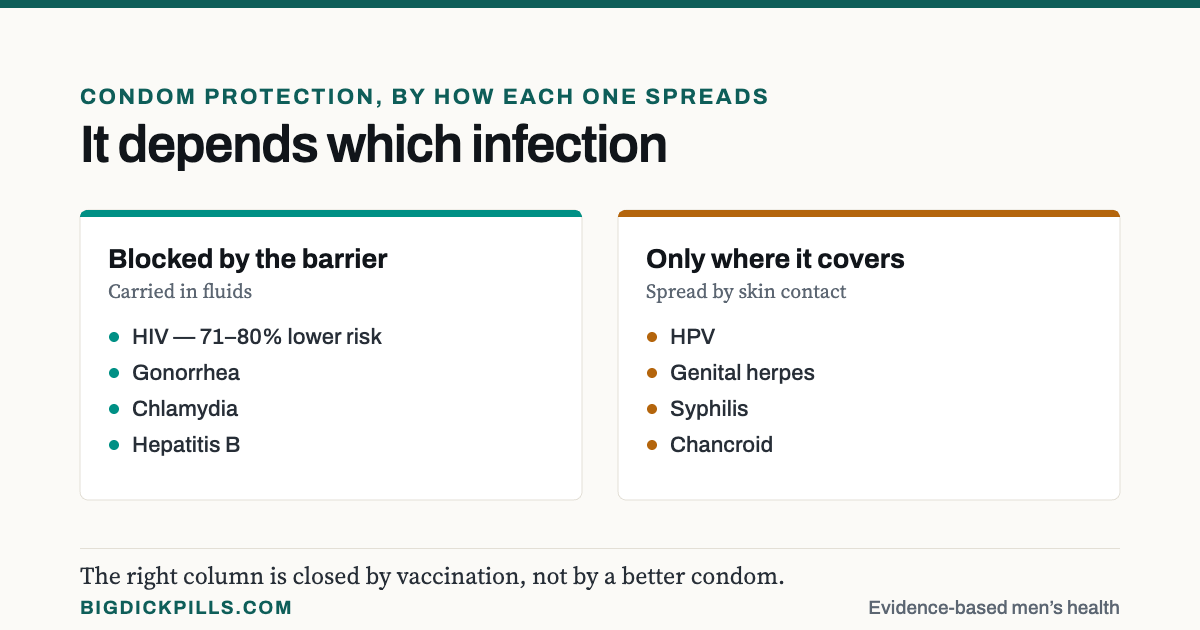
Condoms work by blocking fluids, so they work best against infections carried in fluids: consistent use is associated with a 71–80% reduction in HIV transmission in heterosexual couples of mixed status, and 70–91% in studies of men who have sex with men, plus reduced risk of chlamydia, gonorrhea, hepatitis B and trichomoniasis. Against infections spread by skin contact (HPV, herpes, syphilis, chancroid) they only protect the area they cover. That gap is closed by vaccination, not by better condoms.
| HIV, heterosexual mixed-status couples | 71% to 80% lower risk with consistent use |
|---|---|
| HIV, men who have sex with men | 70% to 91% lower risk |
| Gonorrhoea, chlamydia, hepatitis B, trichomoniasis | Risk reduced |
| HPV, herpes, syphilis, chancroid | Only protect the area they cover |
| The rule | Condoms block fluids, so they work best against fluid-borne infections |
| What closes the skin-contact gap | Vaccination, not better condoms |
| Main reason condoms fail | Inconsistent use, not breakage |
Why do condoms work better against some STIs?
A condom is a barrier over one part of the anatomy. That single fact predicts the whole pattern of what it does and does not prevent.
If the infection travels in semen, pre-ejaculate, vaginal fluid or blood, a barrier over the penis blocks the route. Protection is high.
If the infection travels by contact between skin and mucous membrane, a barrier only protects the skin it covers. The base of the penis, the scrotum, the groin, the perineum and the surrounding area are all uncovered, and if there is infectious skin there or on your partner, a condom does not come between it and you.
The CDC states this directly: condoms prevent HPV, genital herpes, syphilis and chancroid only when the infected area or site of potential exposure is covered.
Which STIs do condoms protect against?
| Infection | Protection with consistent, correct use |
|---|---|
| HIV | 71–80% lower risk in heterosexual mixed-status couples; 70–91% in studies of men who have sex with men |
| Gonorrhea | Risk reduced |
| Chlamydia | Risk reduced |
| Hepatitis B | Risk reduced |
| Trichomoniasis | Risk reduced |
Two honest observations about the HIV figures. They are large and they are not 100%. The residual risk is real, which is why pre-exposure prophylaxis exists as a separate and additive tool for people at ongoing risk. And they describe consistent use, meaning every time, not most times. The gap between those two is where most transmission happens.
Related: All STI articles
Which STIs do condoms not fully prevent?
HPV is extremely common and transmits through skin contact across the whole genital area. Condoms reduce transmission but cannot eliminate it. Most infections clear on their own; the ones that do not are the ones that cause cancers: cervical in women, and in men oropharyngeal, anal and penile.
Herpes transmits from skin and mucous membranes, including from areas a condom does not cover, and including when the infected person has no visible sore and no symptoms. Condoms reduce risk meaningfully; they do not remove it.
Syphilis transmits by contact with a chancre (the primary sore). If the sore is on the shaft, a condom covers it. If it is at the base, on the scrotum, in the groin, in the mouth or inside the rectum, it does not. Chancres are typically painless and often go unnoticed by the person who has one.
The practical upshot is not that condoms are pointless against these. It is that “we used a condom” is not a complete answer to a question about syphilis or herpes exposure, and a man who believes it is will skip a test he should have had.
Why do condoms fail?
The image most people carry is of a condom breaking. The CDC puts breakage during intercourse and withdrawal at roughly two per hundred in the United States, not nothing, but not the main story.
The main story is that failure typically results from inconsistent or incorrect use rather than from the condom breaking. Not using one for part of the encounter. Putting it on late. Reusing. Storage that degrades latex. Oil-based lubricants, which destroy latex: a genuinely common and entirely avoidable error.
That reframes the useful advice. The marginal gain is not in buying a stronger brand. It is in using one every time, from the start, with a water- or silicone-based lubricant.
What covers what condoms miss?
For the skin-contact infections that condoms only partly address, the CDC’s answer is vaccination, which it describes as among the most effective methods for preventing transmission.
HPV vaccine. Routinely given in adolescence and available to adults up to age 45 after a discussion with a clinician. For men it prevents genital warts and the HPV-driven cancers, and the oropharyngeal cancer burden in men is substantial and rising. It works prophylactically. It does not clear an infection you already have, which is the argument for getting it earlier rather than later.
Hepatitis B vaccine. Standard childhood immunisation now, but many adults were never vaccinated. Hepatitis B is sexually transmissible and the vaccine is highly effective.
Hepatitis A vaccine is also recommended for some groups, including men who have sex with men.
Vaccination is the only intervention in this whole area that removes risk rather than reducing it, and two of the three are free or low cost in most settings.
Where does doxy-PEP fit?
Doxycycline post-exposure prophylaxis, a dose of doxycycline taken after condomless sex, is a genuinely new tool and worth understanding precisely, because it is easy to over-read.
In the trial evidence the CDC cites, it reduced incident chlamydia by 70% and syphilis by 73%, with no effect on gonorrhea.
Three qualifications. It is an antibiotic taken repeatedly, and the CDC notes that no long-term data exist on its impact on antimicrobial resistance, which is not a hypothetical concern in a field where resistant gonorrhea is already a serious problem. It does nothing for HIV, herpes or HPV. And it is currently recommended for specific populations rather than as general advice, which makes it a conversation with a clinician rather than something to source independently.
It is a real addition to the toolkit. It is not a replacement for any of the above, and it covers two of the infections a condom is weakest against, which is an interesting complement rather than a substitute.
If your question underneath all this is whether you should be tested and how often, the CDC’s schedule is here, and it matters that most of these infections produce no symptoms at all.
Common questions about condoms and STIs
Do condoms prevent all STIs?
No, and the pattern is predictable. Condoms block fluids, so they work best against infections carried in fluids: consistent use is associated with 71 to 80 percent lower HIV risk in heterosexual mixed-status couples and 70 to 91 percent in studies of men who have sex with men. Against skin-contact infections such as HPV, herpes and syphilis, they protect only the area they cover.
Can you get herpes or HPV while using a condom?
Yes. Both are transmitted by skin-to-skin contact, and both can be present on skin a condom does not cover. Condoms reduce the risk meaningfully but cannot eliminate it, which is a different situation from HIV or gonorrhoea where the barrier addresses the actual route of transmission.
Why do condoms fail?
Far more often through inconsistent use than through breakage. The gap between typical-use and perfect-use effectiveness is almost entirely about occasions when a condom was not used, used late, or came off. Breakage rates with correct use and adequate lubrication are low.
What protects against HPV if condoms cannot?
Vaccination. This is the gap condoms structurally cannot close, and the HPV vaccine is what closes it. In the United States, HPV-attributable oropharyngeal cancer in men now exceeds HPV-attributable cervical cancer in women, and there is no approved HPV screening test for men.
Does doxy-PEP replace condoms?
No. Doxy-PEP reduces bacterial infections, chiefly chlamydia and syphilis, and does nothing at all for HIV, herpes, HPV, trichomoniasis or hepatitis. It is a narrow tool aimed at three bacterial infections, and the CDC recommends it only for specific populations rather than as a general substitute for barrier protection.
Sources
This article is for information only and is not medical advice. It cannot account for your individual circumstances. Talk to a doctor about your own situation, particularly before starting or stopping any prescription medication.
Cite this page: Big Dick Pills, “Do Condoms Protect Against STIs? It Depends Which One”, bigdickpills.com/sexually-transmitted-infections/do-condoms-protect-against-sti/ (updated ).
Source links on this site are checked every month; last check . How sources are checked.