
 By
By 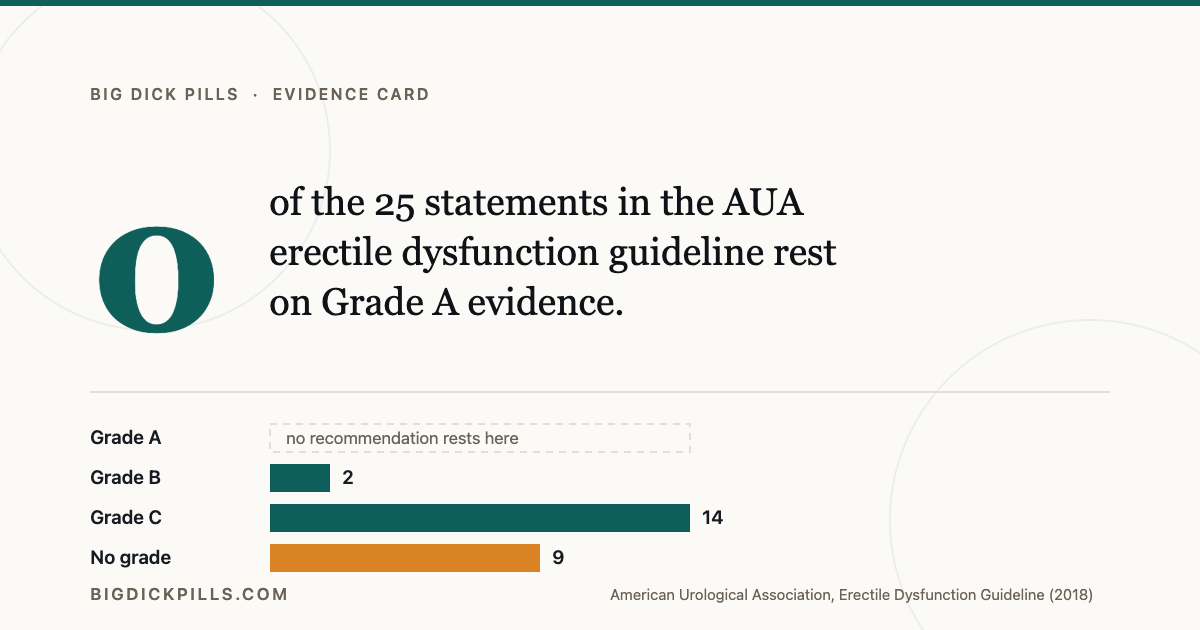
This page exists because we could not find one. If you want to know what the evidence behind a given erectile dysfunction treatment actually is — not whether a clinic says it works, but what the profession’s own guideline grades it — you have to read a 2018 document written for urologists and track each statement down individually. So we coded all 25 of its statements and put them on one page.
The American Urological Association’s erectile dysfunction guideline contains 25 numbered statements. Not one of them rests on Grade A evidence. Two rest on Grade B, fourteen on Grade C, and nine carry no evidence grade at all — they are the panel’s judgement rather than a body of trials. The best-supported thing in the treatment of ED is telling a man that oral PDE5 inhibitors exist.
| Statements in the guideline | 25 |
|---|---|
| Resting on Grade A evidence | Zero |
| Resting on Grade B | 2 — both about oral PDE5 inhibitors |
| Resting on Grade C | 14 |
| Carrying no evidence grade | 9 — six Clinical Principles, three Expert Opinion |
| Designated investigational or experimental | 3 — shockwave, stem cell, platelet-rich plasma |
| Guideline year | 2018, American Urological Association |
How strong is the evidence, really?
Guideline panels grade the evidence behind each statement from A (strong, consistent, from good trials) down to C (low certainty, from few or flawed studies). Some statements get no grade at all, because no body of evidence underlies them — they are labelled Clinical Principle or Expert Opinion.
Sorted that way, the ladder has an empty top rung.
This is not a scandal, and it is not an argument that ED treatment does not work. Grading systems are deliberately conservative, and erectile dysfunction is genuinely hard to study: the main outcome is self-reported, the placebo response is large, and blinding a vacuum pump is not straightforward. But it is the context that every confident sentence about ED treatment is written against, and almost nobody states it.
Every treatment, and what the guideline grades it
All 25 statements, grouped by strength. Wording is our plain-language summary; the grade is the guideline’s own.
| Treatment or action | What the guideline says | Grade |
|---|---|---|
| Oral PDE5 inhibitors sildenafil, tadalafil, vardenafil, avanafil |
Should be discussed with every man with ED, unless contraindicated | Strong · B |
| PDE5i dose titration | Dose should be titrated for optimal effect | Strong · B |
| PDE5i usage instructions | Instructions should be given to maximise benefit | Strong · C |
| Penile prosthesis | Should be discussed as a treatment option | Strong · C |
| Vacuum erection device | Should be discussed as a treatment option | Moderate · C |
| Intracavernosal injections | Should be discussed as a treatment option | Moderate · C |
| Morning total testosterone | Should be measured in men with ED | Moderate · C |
| Lifestyle change diet, physical activity |
Improves overall health and may improve erectile function | Moderate · C |
| PDE5i plus testosterone | May be more effective together in men with testosterone deficiency | Moderate · C |
| Mental health referral | Should be considered to aid adherence and reduce anxiety | Moderate · C |
| Early PDE5i after prostate cancer treatment | Men should be told it may not improve spontaneous function | Moderate · C |
| Penile venous surgery | Not recommended | Moderate · C |
| Intraurethral alprostadil | Should be discussed as a treatment option | Conditional · C |
| Penile arterial reconstruction | May be considered in selected young men with focal arterial blockage | Conditional · C |
| Low-intensity shockwave therapy LI-ESWT, acoustic wave, GAINSWave |
Should be considered investigational | Conditional · C |
| Intracavernosal stem cell therapy | Should be considered investigational | Conditional · C |
| Platelet-rich plasma PRP, the “P-Shot” |
Should be considered experimental | Expert Opinion |
| History, examination, selective labs | Should be done in every man presenting with ED | Clinical Principle |
| ED as a cardiovascular warning | Men should be counselled that ED is a risk marker for heart disease | Clinical Principle |
| In-office test before intraurethral alprostadil | Should be performed | Clinical Principle |
| In-office test before injections | Should be performed | Clinical Principle |
| Counselling before prosthesis surgery | Post-operative expectations should be discussed | Clinical Principle |
| Prosthesis surgery during infection | Should not be performed | Clinical Principle |
| Validated questionnaires | Recommended to assess severity and track treatment | Expert Opinion |
| Specialised testing | May be necessary in some men to guide treatment | Expert Opinion |
Where the internet and the guideline disagree
Three of the treatments above carry an explicit warning label: the guideline calls them investigational or experimental. They are also three of the most heavily marketed treatments in men’s health.
In September 2026 we audited 90 consumer-facing pages and coded 137 separate claims about these three therapies against the guideline. Where a page took a position, this is how often it presented the therapy as effective or established without telling the reader about the designation.
| Therapy | Guideline designation | Claims coded | Omitted the designation |
|---|---|---|---|
| Low-intensity shockwave | Investigational · Conditional, Grade C | 55 | 51% |
| Platelet-rich plasma (P-Shot) | Experimental · Expert Opinion | 49 | 55% |
| Stem cell / exosome injection | Investigational · Conditional, Grade C | 33 | 39% |
The pattern is what you would predict from incentives, and we would be overstating it if we left it there. Several private clinics in the sample disclosed the status plainly, one citing the guideline by name and year. At least one major academic medical centre’s main ED page listed shockwave therapy among its treatment options with no caveat anywhere. Incentive predicts the tendency. It does not decide the individual page.
How to read a recommendation grade
Two separate things are being graded, and conflating them is the single most common error in health writing.
| Label | What it actually means |
|---|---|
| Strong / Moderate / Conditional | How confident the panel is that the benefits outweigh the harms. A recommendation strength. |
| Grade A / B / C | How good the underlying evidence is. An evidence level. |
| Clinical Principle | Widely agreed practice with no graded evidence behind it. Usually uncontroversial — take a history, do an exam. |
| Expert Opinion | The panel’s consensus judgement. The lowest tier in the system. |
A statement can be a Strong Recommendation on Grade C evidence — that is exactly what penile prosthesis is. It means the panel is confident about the trade-off even though the trial base is thin. The reverse is rarer but possible. So “strongly recommended” is not a claim about evidence quality, and “Grade C” is not a claim that something does not work. It means we know less than we would like.
Common questions about the evidence card
What is the best-evidenced treatment for erectile dysfunction?
Oral PDE5 inhibitors — sildenafil, tadalafil, vardenafil and avanafil. Two statements in the AUA guideline rest on Grade B evidence and both concern them: that men should be informed about them, and that the dose should be titrated for optimal effect. Nothing in the guideline rests on Grade A evidence.
Does the AUA guideline have any Grade A recommendations?
No. Of the 25 numbered statements, zero carry Evidence Level Grade A. Two are Grade B, fourteen are Grade C, and nine carry no evidence grade at all, being either Clinical Principles or Expert Opinion.
Which ED treatments does the guideline call investigational?
Three. Low-intensity extracorporeal shockwave therapy and intracavernosal stem cell therapy are both “considered investigational” as Conditional Recommendations on Grade C evidence. Platelet-rich plasma, marketed as the P-Shot, is “considered experimental” on the basis of Expert Opinion, the lowest tier in the guideline.
Is a Grade C recommendation worth following?
Often, yes. Grade C describes the quality of the underlying evidence, not whether the treatment works. Penile prosthesis implantation is a Strong Recommendation on Grade C evidence, meaning the panel is confident the benefits outweigh the harms even though the trial base is limited. Recommendation strength and evidence level are two different measurements.
Can I reuse this chart or table?
Yes. The coding, the charts and the underlying dataset are free to reuse with attribution. A print version and the full per-claim dataset are linked on this page. If you republish a figure we would appreciate a link back so readers can check the method.
Take this with you
The per-claim coding table (CSV)137 coded claims across 90 pages, with the provenance header. Reproduces every figure on this page.
Embed the chart
<figure>
  <img src="https://bigdickpills.com/wp-content/uploads/2026/09/bdp-ed-evidence-card-share.png"
       alt="Of the 25 numbered statements in the AUA erectile dysfunction guideline, zero rest on Grade A evidence."
       width="1200" height="630">
  <figcaption>Source: <a href="https://bigdickpills.com/erectile-dysfunction/ed-evidence-card/">The ED Treatment Evidence Card</a>,
  Big Dick Pills. CC BY 4.0.</figcaption>
</figure>
How to cite
Preston, W. The ED Treatment Evidence Card: every AUA recommendation and the evidence grade behind it. Big Dick Pills, 13 September 2026. https://bigdickpills.com/erectile-dysfunction/ed-evidence-card/
Sources
- Burnett AL, Nehra A, Breau RH, et al. Erectile Dysfunction: AUA Guideline. American Urological Association, 2018. AUA
- Half of ED treatment pages leave out that the treatment is investigational. Big Dick Pills, 12 September 2026 — the disclosure figures on this page. Method and dataset
- Ergun O, Kim K, Kim MH, et al. Low-intensity shockwave therapy for erectile dysfunction. Cochrane Database of Systematic Reviews, 14 July 2025. Cochrane
This card summarises a clinical guideline for general readers. It is not medical advice and cannot account for your circumstances. Treatment decisions belong with you and your doctor. Guideline wording is summarised in plain language; the grades are quoted as published.