
 By
By 
Most articles on this subject open with “lift heavy weights.” The meta-analysis that tested exactly that found no effect on resting testosterone at all. What does work is less exciting and considerably more powerful.
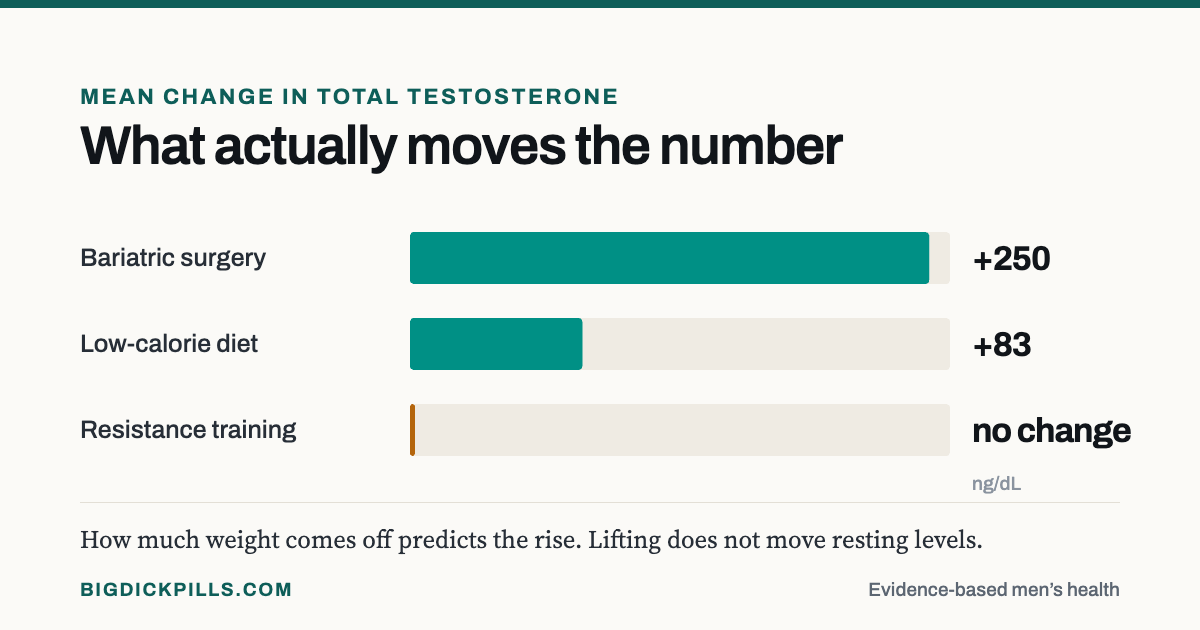
Losing weight is by far the largest lever, and the amount you lose predicts the size of the rise: a low-calorie diet raised total testosterone by around 83 ng/dL on average, and bariatric surgery by around 250 ng/dL. Sleep is the second: a week of under five hours a night cut daytime testosterone by 10 to 15% in healthy young men. Resistance training, despite its reputation, did not significantly change resting testosterone in a meta-analysis of 22 studies.
| Low-calorie diet | +2.87 nmol/L, about 83 ng/dL |
|---|---|
| Bariatric surgery | +8.73 nmol/L, about 250 ng/dL |
| Sleep restriction, under 5 hours for a week | Daytime testosterone fell 10% to 15% in healthy young men |
| Resistance training | No significant change in resting testosterone across 22 studies |
| The largest single lever | Body weight; the amount lost predicts the size of the rise |
| What no supplement achieved | Anything comparable to the weight loss figures |
Does losing weight raise testosterone?
Fat tissue converts testosterone into oestradiol, and that conversion suppresses the hormonal signal telling the testes to produce more. It is a self-reinforcing loop, and it is the reason obesity is the single most common cause of a genuinely low reading in an otherwise healthy man.
It is also reversible. A meta-analysis of 24 trials examined what happens to testosterone when men lose weight:
| Intervention | Mean rise in total testosterone | Roughly |
|---|---|---|
| Low-calorie diet | 2.87 nmol/L | about 83 ng/dL |
| Bariatric surgery | 8.73 nmol/L | about 250 ng/dL |
The crucial finding was not which method was used but how much weight came off. The degree of body weight loss was the best single determinant of how much testosterone rose. Surgery outperformed dieting because it produced more weight loss, not because of anything surgical.
Put that 83 ng/dL in context. If two morning tests put you at 260 ng/dL (under the diagnostic threshold, and carrying significant excess weight) a sustained diet could plausibly move you above 300 without a prescription. That is a larger and more reliable effect than any supplement in this category has ever demonstrated.
Improvements were most pronounced in younger men without diabetes who started out more obese. If that describes you, this is the intervention.
How does sleep affect testosterone?
The most quoted study here deserves its reputation, and also deserves its caveats stated.
Ten healthy young men, average age 24, spent three nights sleeping up to ten hours, then eight nights sleeping under five. Daytime testosterone fell by 10 to 15%, with the lowest levels between 2pm and 10pm on the restricted days. The researchers characterised that drop as equivalent to ageing ten to fifteen years.
Two honest qualifications. It was ten men, which is very small. And it tested severe restriction, under five hours a night for over a week, rather than the ordinary bad sleep most people get.
Even so, the direction and speed are striking. This is not a change that takes months to appear. One bad week is enough to measurably move the number, which also means a testosterone test taken during a stretch of poor sleep may not represent your baseline.
Untreated sleep apnoea deserves specific mention. It is common in exactly the men most likely to be worried about testosterone: middle-aged, overweight, tired, and it disrupts sleep architecture profoundly. If you snore heavily and wake unrefreshed, that is worth investigating before anything else on this page.
Does lifting weights raise testosterone?
Here is where the popular advice and the evidence part company.
A meta-analysis of 22 studies looked at whether short-term exercise training changes resting testosterone in older men. The result for resistance training was as close to nothing as a result can be: a standardised difference in means of −0.003, with a p-value of 0.986. Not a small effect. No detectable effect.
Endurance training produced a small but statistically significant increase, as did interval training. The reviewers’ overall conclusion was that short-term exercise training influences basal testosterone inconsistently, with results varying by modality, study design and which hormone fraction was measured, and that results were particularly inconsistent within the resistance training studies, despite similar protocols.
Why does the myth persist? Because heavy resistance exercise does produce a genuine acute testosterone spike — for perhaps an hour afterwards. That is real, and it is transient, and it is not the same as raising the level a blood test would find the next morning.
None of this is an argument against lifting weights. Resistance training builds muscle, improves insulin sensitivity, protects bone and helps you lose fat, and the fat loss will raise your testosterone, by the mechanism in the first section. It just does not do it through the hormonal route that gets advertised.
What lowers testosterone?
Sometimes the useful question is not what raises testosterone but what is currently suppressing it.
Opioids. The most under-recognised cause. Chronic opioid use directly suppresses the hormonal axis, and it can produce profound deficiency. If you are on long-term opioid pain medication, that is very likely the explanation.
Heavy alcohol use. Sustained and substantial drinking suppresses production.
Anabolic steroids, past or present. Exogenous androgens shut down your own production, and recovery after stopping is neither guaranteed nor quick.
Untreated chronic illness. Poorly controlled diabetes, significant chronic disease and severe stress all suppress the axis.
Several of these are more addressable than they look, and none of them are fixed by a supplement.
How much can you realistically raise it naturally?
This depends almost entirely on where you are starting and why.
If you are overweight, sleeping badly, and reading low: you have real room. The weight loss data above, combined with fixing sleep, can plausibly move a genuinely deficient man back into the normal range. This is the scenario where “natural” methods are not a consolation prize; they are the correct treatment.
If you are lean, sleeping well, and reading low: there is not much lifestyle left to optimise, and the honest answer is that you need a proper work-up rather than a protocol. Something is causing it.
If you are reading normal but feel tired and flat: nothing on this page will change the number much, because it is not low. And the trial that specifically tested whether raising testosterone improves vitality found that it did not. The cause is likely to be somewhere else entirely.
Before deciding which of those you are, make sure the number is real: two early-morning tests, not one afternoon one. And if a supplement is tempting, read what the systematic review found first.
Common questions about raising testosterone naturally
What raises testosterone the most naturally?
Losing weight, by a wide margin, and the amount lost predicts the size of the rise. A low-calorie diet raised total testosterone by around 83 ng/dL on average, and bariatric surgery by around 250 ng/dL. No other lifestyle intervention comes close to those figures.
Does lack of sleep lower testosterone?
Substantially and quickly. One week of under five hours a night cut daytime testosterone by 10 to 15 percent in healthy young men. That is a large effect from a single week, and it is the second biggest lever after body weight.
Does lifting weights increase testosterone?
Not resting testosterone, which is the uncomfortable finding. A meta-analysis of 22 studies found no significant change in resting levels from resistance training. Training produces acute post-exercise spikes, but those are transient and are not what a blood test measures. There are excellent reasons to lift; raising baseline testosterone is not reliably one of them.
How much can you raise testosterone naturally?
Realistically, the ceiling is what weight and sleep can deliver, which is meaningful if you are overweight and sleep-deprived, and close to nothing if you are already lean and well rested. A man at a healthy weight with good sleep has already taken the two big levers.
Is natural testosterone boosting worth trying before TRT?
If you are overweight or sleeping badly, yes, because those changes can move the number by more than most people expect and carry no downside. If a genuine deficiency is confirmed on two morning tests and your weight and sleep are already in order, lifestyle change is unlikely to close that gap on its own.
Sources
- Corona G, Rastrelli G, Monami M, et al. Body weight loss reverts obesity-associated hypogonadotropic hypogonadism: a systematic review and meta-analysis. European Journal of Endocrinology, 2013. European Journal of Endocrinology
- Leproult R, Van Cauter E. Effect of 1 week of sleep restriction on testosterone levels in young healthy men. JAMA, 2011. University of Chicago Medicine
- Hayes LD, Elliott BT. Short-term exercise training inconsistently influences basal testosterone in older men: a systematic review and meta-analysis. Frontiers in Physiology, 2018. Frontiers in Physiology
- Mulhall JP, Trost LW, Brannigan RE, et al. Evaluation and Management of Testosterone Deficiency: AUA Guideline, 2018. AUA guideline
This article is for information only and is not medical advice. It cannot account for your individual circumstances. Talk to a doctor about your own situation, particularly before starting or stopping any prescription medication.