
 By
By 
The honest answer to this question is not a list of symptoms. It is that most sexually transmitted infections produce no symptoms at all, in either partner, for as long as they are present, which is exactly why they spread, and why “I feel fine” is not information about your status.
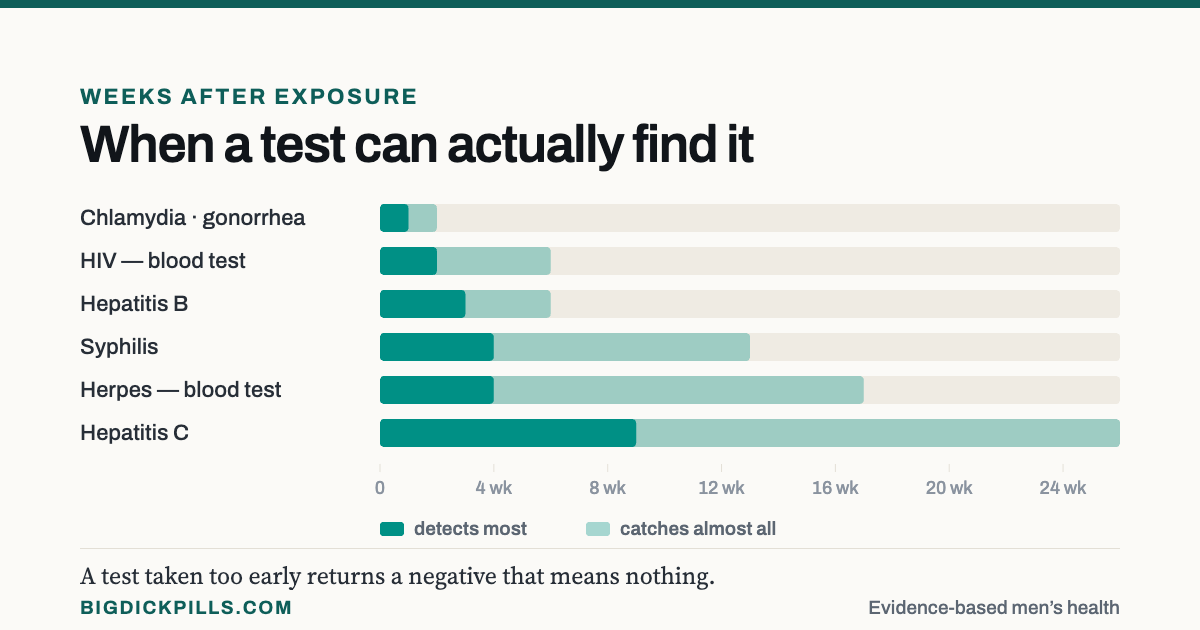
Chlamydia and gonorrhea are usually asymptomatic in women and frequently asymptomatic in men. There is no way to know from how you feel. Testing is the only method, and it has to be timed correctly: chlamydia and gonorrhea are detectable at about a week, syphilis takes around a month, and HIV antigen/antibody testing catches most infections by two weeks and almost all by six. A test taken the morning after an exposure tells you about the exposure before it, not that one.
| Chlamydia | Detects most at 1 week; almost all at 2 weeks |
|---|---|
| Gonorrhoea | Detects most at 1 week; almost all at 2 weeks |
| Syphilis | About 1 month; almost all by 3 months |
| HIV, antigen/antibody blood test | 2 weeks; almost all by 6 weeks |
| HIV, oral swab | 1 month; almost all by 3 months |
| Hepatitis B | 3 to 6 weeks |
| Hepatitis C | 2 months; almost all by 6 months |
| Herpes, blood test | 1 month; almost all by 4 months |
| Can you tell from symptoms? | No. Chlamydia and gonorrhoea are frequently asymptomatic in men |
Can you have an STI with no symptoms?
The US Preventive Services Task Force, reviewing the evidence for screening, states the position plainly: chlamydial and gonococcal infections in women are usually asymptomatic, and men are often asymptomatic, though gonorrhea produces symptoms in men more often than it does in women.
That is the entire reason population screening exists for these infections. If they announced themselves, you would not need a program to find them; people would simply turn up.
It also explains the epidemiology. An infection that causes no symptoms is not treated, and an untreated infection keeps being transmitted. The asymptomatic period is not a quiet phase before the real illness. For a great many people it is the whole course of the infection.
What are the symptoms of an STI in men?
When symptoms do appear, these are the ones worth acting on. None of them is diagnostic on its own, and several have entirely innocent causes.
- Discharge from the penis, or a change in discharge
- Burning or pain when urinating, or needing to go more often
- Sores, ulcers, blisters or warts anywhere in the genital or anal area, or around the mouth
- Pain or swelling in one testicle: this one warrants same-day attention, because testicular torsion is a surgical emergency that can present similarly
- Rash, particularly one involving the palms and soles, which is a classic feature of secondary syphilis
- Anal pain, discharge or bleeding
- Sore throat that does not resolve, after oral sex
Two notes on that list. Sores from syphilis and herpes are frequently painless and can sit somewhere you will not see, which means “I checked and there is nothing” is weak evidence. And symptoms that go away have not necessarily taken the infection with them: the primary sore of syphilis heals on its own while the infection continues.
Why does the timing of the test matter?
Every test has a window period: the interval after exposure during which an infection is present but not yet detectable. Testing inside that window produces a negative result that means nothing.
| Infection | Detects most | Catches almost all |
|---|---|---|
| Chlamydia | 1 week | 2 weeks |
| Gonorrhea | 1 week | 2 weeks |
| Syphilis | about 1 month | 3 months |
| HIV, antigen/antibody blood test | 2 weeks | 6 weeks |
| HIV — oral swab | 1 month | 3 months |
| Hepatitis B | 3–6 weeks | , |
| Hepatitis C | 2 months | 6 months |
| Herpes (blood test) | 1 month | 4 months |
The practical consequence: if you have had a specific exposure you are worried about, the useful test is not the one you take tomorrow. It is the one you take at the right interval, and for the infections with long windows, a repeat later.
If you have symptoms now, that is different. Go now. A swab of an active symptom does not wait on a window period in the same way.
What does an STI test actually cover?
Two things surprise people, and both matter.
A standard panel does not usually include herpes. Blood testing for HSV is not recommended as part of routine screening for people without symptoms, because the results are difficult to interpret and a positive tells you little about where, when or whether you will transmit. If you assumed “the full works” included it, it generally does not.
A urine test only tests your urethra. Chlamydia and gonorrhea infect the throat and rectum too, and those infections are usually symptomless and are missed entirely by a urine sample. If oral or anal sex is part of your life, the swabs need to be taken from those sites specifically. You may have to ask.
More detail on what to request, and how often, is in the CDC’s actual testing schedule.
What happens if an STI goes untreated?
In men, untreated chlamydia and gonorrhea can cause urethritis and epididymitis; serious complications are uncommon.
The larger consequence is usually borne by partners. In women, untreated infection can cause pelvic inflammatory disease and, through it, ectopic pregnancy, infertility and chronic pelvic pain. That asymmetry is worth stating clearly on a men’s health site: an infection that is a minor event for you may not be one for the person you pass it to.
Syphilis is its own case. It progresses in stages over years, the early stages resolve on their own, and the late consequences are serious and neurological. It is also entirely curable with antibiotics at any stage. The damage already done is not reversed, but the infection is stopped.
What should you actually do?
If you have symptoms, get seen now rather than testing at home.
If you have had an exposure and no symptoms, test at the right interval, and ask for throat and rectal swabs if they are relevant to you.
If neither applies and you simply have not been tested in a while, that is what the screening schedule is for, and it exists precisely because feeling fine is compatible with having something.
And if a test comes back positive, the next problem is a conversation rather than a medical one. How to handle telling a partner, including the options that do not require you to do it yourself, is covered separately.
Common questions about STI symptoms
Can you have an STI without symptoms?
Routinely, and this is the central fact. Chlamydia and gonorrhoea are usually asymptomatic in women and frequently asymptomatic in men. There is no way to know from how you feel. Testing is the only method of knowing, which is why screening intervals exist at all.
What are the first signs of an STI in a man?
When symptoms do appear they include discharge from the penis, burning on urination, testicular pain or swelling, sores or ulcers, and rashes. Rectal infections may cause discharge, pain or bleeding. Throat infections almost never cause anything. The absence of all of these tells you very little.
How soon after sex can an STI show up on a test?
Chlamydia and gonorrhoea at about a week. Syphilis at around a month. HIV at two weeks on an antigen/antibody blood test, or a month on an oral swab. Hepatitis C at two months. Testing before the window has passed produces a negative result that means nothing.
Is herpes included in a standard STI test?
Usually not, unless you specifically request it. Routine blood screening for herpes is not recommended in people without symptoms, partly because the test has meaningful limitations. If you want it, ask for it by name and discuss what a positive result would and would not tell you.
What happens if an STI goes untreated?
Untreated chlamydia and gonorrhoea can cause epididymitis and, in partners, pelvic inflammatory disease and infertility. Untreated syphilis progresses through stages and can eventually affect the heart and nervous system. Most of this is preventable with a test and a short course of treatment, which is the entire argument for screening while symptomless.
Sources
- US Preventive Services Task Force. Chlamydia and gonorrhea: screening. USPSTF
- Centers for Disease Control and Prevention. Sexually Transmitted Infections Treatment Guidelines, 2021. CDC MMWR
- University of Oregon Health Center. STI screening timetable (window periods). Screening timetable (PDF)
This article is for information only and is not medical advice. It cannot account for your individual circumstances. Talk to a doctor about your own situation, particularly before starting or stopping any prescription medication.