
 By
By 
Two framing points before the list, because they determine whether anything here will be useful to you.
Sperm take about 74 days to develop. Nothing you change today shows up in a semen analysis for roughly two to three months. Any product or programme promising results in two weeks is describing something that is not biologically possible. Plan on a three-month horizon before re-testing.
Volume and sperm health are different targets. Almost everything on this page is aimed at sperm — count, motility, morphology. Very little of it will change how much fluid you ejaculate, because volume is governed mostly by how recently you last ejaculated, plus age and a short list of medical causes. If your specific concern is volume, the causes article is the more relevant page.
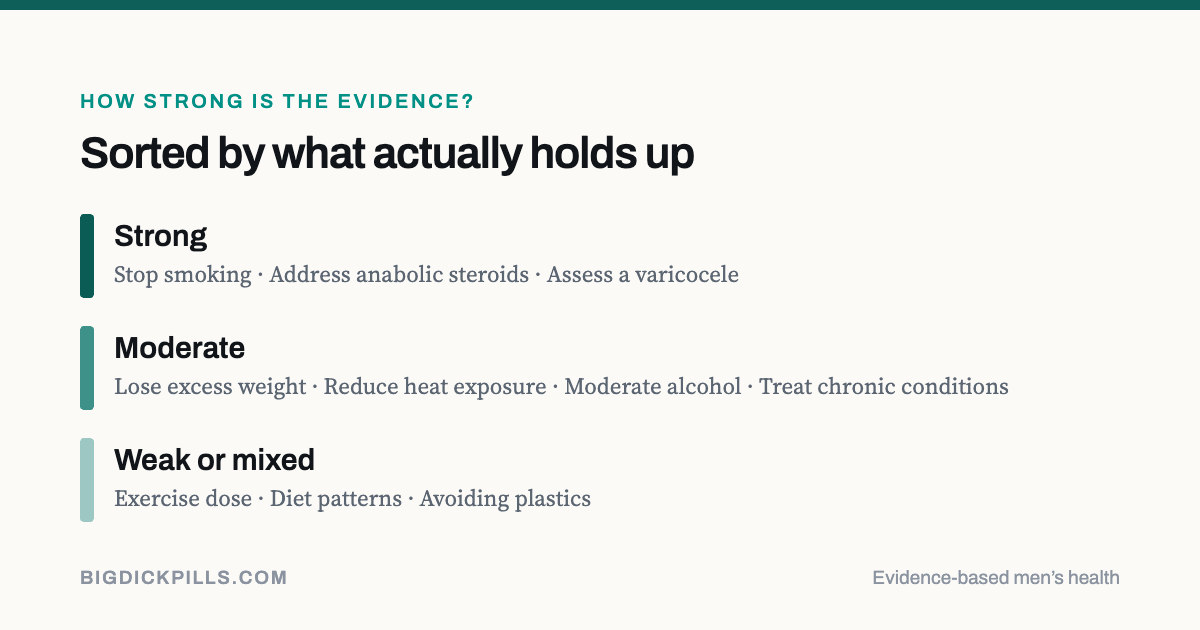
With that said, here is what the evidence supports, ranked roughly by strength.
| Strongest levers | Stopping smoking, reducing alcohol, losing excess weight |
|---|---|
| Time before any change shows | About three months, because of the spermatogenic cycle |
| Heat exposure | Matters only at genuinely extreme doses, and fully reverses |
| Antioxidant supplements | 90 trials, still inconclusive |
| Folic acid and zinc | No benefit in a 2,370-man randomised trial |
| AUA position on supplements | Benefits are of questionable clinical utility |
| The most common correctable medical cause | Varicocele |
What has strong evidence for improving sperm health?
Stop smoking
Smoking is among the most consistently replicated lifestyle associations with reduced sperm concentration, motility and normal morphology. It is also linked to increased sperm DNA fragmentation. The relationship is dose-dependent, and parameters improve after quitting.
If you do one thing on this page, this is the one with the best evidence behind it and the largest benefit beyond fertility.
Deal with anabolic steroids
Exogenous testosterone and anabolic steroids suppress the hormonal signalling that drives sperm production. The effect is profound, often complete suppression, and recovery after stopping takes months and is not reliably complete.
This includes prescribed testosterone replacement therapy. Men are still routinely started on TRT without being told what it does to fertility. If you might want children, that conversation needs to happen before the first prescription, and if you’re already on it and trying to conceive, that’s a conversation with a urologist rather than something to sort out yourself.
Get a varicocele assessed
A varicocele is a dilated set of veins in the scrotum. It is the most common surgically correctable cause of male infertility, and repair improves semen parameters in appropriately selected men. This is a clinical decision, not every varicocele needs fixing, but it is worth knowing whether you have one, and it takes a physical exam to find out.
What has moderate evidence?
Lose excess weight
Obesity is associated with lower sperm concentration and total count, and with altered hormone profiles: higher oestrogen, lower testosterone. The association is consistent. Whether weight loss reverses it is less well established, though the direction of the evidence is favourable and the other health returns are not in doubt.
Reduce heat exposure
Sperm production requires testicular temperature below core body temperature, which is the entire reason the testes sit outside the body. Prolonged, repeated heat (hot tubs, saunas, heated seats, a laptop resting directly on your lap, some occupational exposures) is associated with reduced production. The effect is generally reversible once exposure stops.
The evidence here is better for sustained, repeated exposure than for occasional use. An occasional hot bath is not the issue; a daily sauna habit during a conception attempt might be.
Moderate alcohol
Heavy drinking is associated with reduced semen quality and lower testosterone. Light to moderate drinking has a much less clear relationship, and the studies disagree. “Heavy” is where the signal is; the evidence does not support the idea that a couple of drinks a week is sabotaging you.
Treat underlying conditions
Diabetes, thyroid disease and obstructive sleep apnea all have plausible mechanisms and observed associations with impaired male reproductive function. Treating them is worthwhile on its own terms and may help here too.
What has weak or mixed evidence?
Exercise
Moderate regular activity is associated with better semen parameters in several studies. Extreme endurance training has been associated with the opposite. Most men are nowhere near the volume where the second concern applies. The evidence is observational and the optimal dose is unknown.
Diet patterns
Diets higher in fruit, vegetables, fish and whole grains, and lower in processed meat, are associated with better semen parameters. The evidence is observational, the effect sizes are modest, and diet studies are notoriously confounded: people who eat this way differ in many other ways.
This is worth doing. It is not worth expecting dramatic results from.
Reducing plastics and environmental exposures
There is genuine scientific concern about endocrine-disrupting chemicals, and a real research literature behind it. What does not yet exist is good evidence that individual avoidance measures (switching containers, changing personal care products) produce measurable improvements in an individual man’s semen parameters. The concern is legitimate; the actionable individual advice is not yet well supported.
What does not work?
Supplements. This gets its own article because the marketing is so far ahead of the data, but the summary: the largest trial of the two most-sold ingredients found no benefit and one signal of harm, the Cochrane review of 90 trials rated the evidence very low certainty, and the AUA/ASRM guideline calls the benefits “of questionable clinical utility.” The full breakdown is here.
Drinking more water to increase volume. Severe dehydration can reduce semen volume. Ordinary variation in water intake does not increase it. You cannot hydrate your way to a larger ejaculate.
“Saving up” for a long time. Volume does increase with abstinence, but prolonged abstinence is associated with worse sperm motility and higher DNA fragmentation. For conception, regular ejaculation is generally advised over stockpiling. More fluid is not the same as better sperm.
Anything promising results in weeks. See the 74-day cycle above.
What should you actually do?
If you’re trying to conceive and want to give this a fair attempt:
- Get a baseline semen analysis. Without one you’re guessing at whether there’s a problem and you’ll have no way to tell whether anything you did helped.
- Get a physical exam that includes checking for a varicocele.
- Address the strong-evidence items: smoking, steroids, and any prescribed testosterone.
- Work on the moderate ones: weight, heat, heavy drinking, untreated chronic conditions.
- Wait three months. Not two weeks.
- Re-test, ideally at the same lab with the same abstinence interval, because both affect the numbers.
And if twelve months of trying have passed (six if your partner is over 35) that’s the point to see a specialist rather than continue optimizing alone. Male factor contributes to a substantial share of infertility, and the evaluation is straightforward.
Common questions about improving sperm health naturally
How can I improve my sperm quality naturally?
The levers with the best evidence are unglamorous: stop smoking, reduce alcohol, lose excess weight, and treat any underlying medical cause such as a varicocele. Supplements have been extensively tested and the evidence remains inconclusive, with the AUA describing their benefits as of questionable clinical utility.
How long does it take to improve sperm health?
About three months before anything shows on a test. Sperm production takes roughly two months plus around two weeks of transit, so any change you make this week will only be reflected in a sample taken about three months from now. This is the single most common source of frustration.
Do fertility supplements work?
A randomised trial of 2,370 men found folic acid and zinc produced no benefit, and a review of 90 antioxidant trials remained inconclusive. That is a large amount of testing for a category with so little to show. More is also not better: excessive antioxidant intake can itself be harmful.
Does quitting smoking improve sperm count?
It is among the best-supported changes available, and it acts on several parameters at once. Because of the spermatogenic cycle, the benefit takes about three months to appear, so stopping now and testing in a fortnight will show nothing.
Is it worth trying lifestyle changes before seeing a doctor?
Do both. Lifestyle changes are free and worth making regardless, but they do not identify a varicocele, an obstruction or a hormonal problem, and those are the things that actually change what treatment you need. If you have been trying to conceive for twelve months, both partners should be assessed rather than either making changes alone.
Sources
- American Urological Association / American Society for Reproductive Medicine. Diagnosis and Treatment of Infertility in Men: AUA/ASRM Guideline (2020, amended 2024). Guideline
- de Ligny W, et al. “Antioxidants for male subfertility.” Cochrane Database of Systematic Reviews, 2022. Cochrane
- Schisterman EF, et al. “Effect of Folic Acid and Zinc Supplementation in Men on Semen Quality and Live Birth.” JAMA, 2020. NICHD summary
- Wang C, et al. “Sleep disorders and male reproductive health: a systematic review and meta-analysis.” Frontiers in Physiology, 2022. Full text
- World Health Organization. WHO Laboratory Manual for the Examination and Processing of Human Semen, 6th edition (2021). Lower reference limits (PDF)
This article is for information only and is not medical advice. It cannot account for your individual circumstances. Talk to a doctor about your own situation, particularly before stopping any prescribed medication.