
 By
By 
This is the rare case where the lifestyle advice is not a consolation prize handed out because the real treatment is expensive. In men with severe erectile dysfunction, the measured effect of aerobic exercise lands within range of a prescription drug.
A meta-analysis of 11 randomised trials covering 1,147 men found aerobic exercise improved erectile function scores by 2.8 points on average, and by 4.9 points in men with severe dysfunction, against 4 to 8 points for PDE5 inhibitors and about 2 for testosterone. The dose that produced it was 30 to 60 minutes, three to five times a week, for around six months. Separately, a two-year trial of weight loss in obese men returned 17 of 55 to normal erectile function, against 3 of 55 in the control group.
| Evidence base | 11 randomised trials, 1,147 men |
|---|---|
| Average improvement from aerobic exercise | 2.8 points on the IIEF-EF scale |
| Improvement in men with severe ED | 4.9 points |
| Improvement in moderate ED | 3.3 points |
| Improvement in mild ED | 2.3 points |
| The dose that produced it | 30 to 60 minutes, three to five times a week, for about six months |
| For comparison, PDE5 inhibitors | 4 to 8 points |
| For comparison, testosterone replacement | About 2 points |
| Weight loss trial result | 17 of 55 men returned to normal function, against 3 of 55 controls |
Does exercise actually improve erections?
The best evidence here is a 2023 systematic review and meta-analysis in the Journal of Sexual Medicine. It pooled 11 randomised controlled trials covering 1,147 men: 636 assigned to exercise, 511 to control.
Erectile function was measured on the International Index of Erectile Function erectile function domain, which runs from 6 to 30. Aerobic exercise improved scores by a mean of 2.8 points (95% confidence interval 1.7 to 3.9).
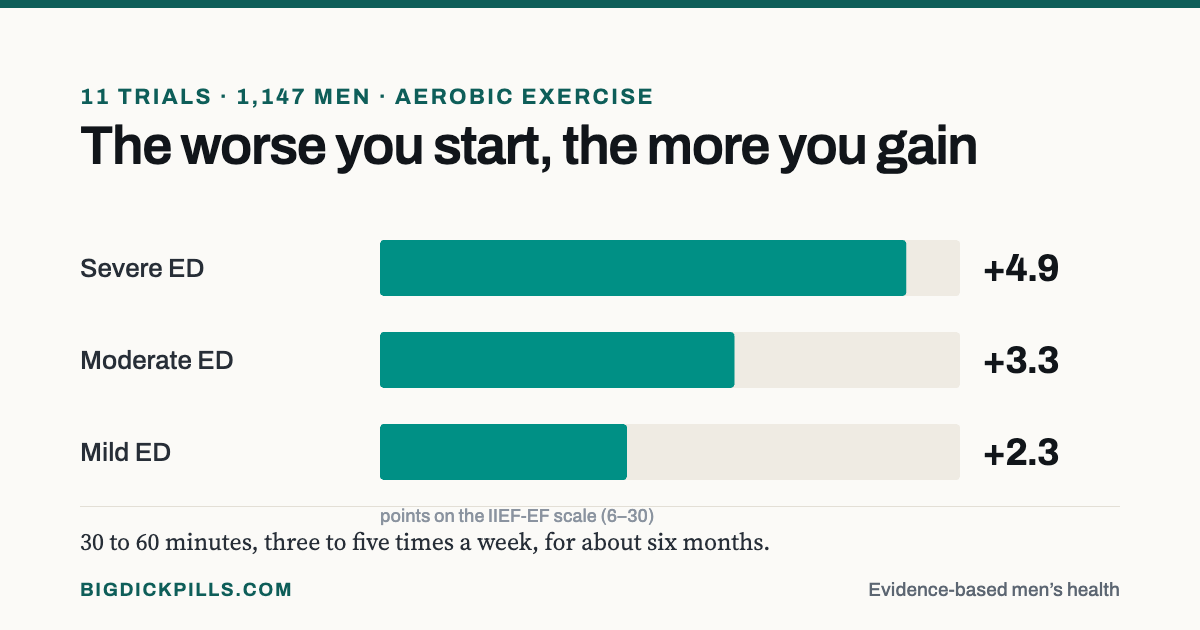
The more interesting result is what happened when the analysis split men by how bad their dysfunction was to begin with:
| Baseline severity | IIEF-EF improvement |
|---|---|
| Severe | 4.9 points |
| Moderate | 3.3 points |
| Mild | 2.3 points |
The difference across those groups was statistically significant. The men with the most to gain gained the most, which is the opposite of how most interventions behave and is a point in this one’s favour.
How much exercise do you need?
Worth stating precisely, because “exercise more” is not a prescription and the trials were specific.
Sessions ran 30 to 60 minutes, at a frequency of three to five times per week. Trial durations ranged from two to twenty-four months, with a median of six. Six of the eleven trials supervised the sessions; five relied on counselling and unsupervised activity.
This is aerobic exercise — the kind that raises your heart rate and keeps it there. Note that this is a different finding from the testosterone literature, where resistance training showed no effect on resting hormone levels. Different mechanism, different outcome: here you are training blood vessels, not hormones.
How does exercise compare with Viagra?
The review’s authors put their result alongside the other treatments on the same scale, which is unusually helpful of them.
| Intervention | IIEF-EF improvement |
|---|---|
| PDE5 inhibitors | 4 to 8 points |
| Shockwave therapy | about 4 points |
| Aerobic exercise, severe ED | 4.9 points |
| Aerobic exercise, all comers | 2.8 points |
| Testosterone replacement | about 2 points |
Read honestly: for a man with mild dysfunction, exercise is worth doing but is not going to match a tablet. For a man with severe dysfunction, the exercise effect is in the same range as shockwave therapy and the lower end of the drug range, and it treats the disease underneath rather than the symptom.
These are not alternatives to choose between. Nothing stops you doing both, and the drug works on the evening while the exercise works on the cause.
Does losing weight fix erectile dysfunction?
The other solid piece of evidence is older and, in its way, more striking.
A randomised controlled trial enrolled 110 obese men aged 35 to 55, all with erectile dysfunction. Fifty-five received detailed support to lose at least 10% of their body weight; fifty-five received general healthy-lifestyle information. It ran for two years.
| Intervention | Control | |
|---|---|---|
| IIEF score at baseline | 13.9 | 13.5 |
| IIEF score at two years | 17.0 | 13.6 |
| Men returning to normal function | 17 of 55 | 3 of 55 |
| BMI | 36.9 → 31.2 | 36.4 → 35.7 |
Roughly one man in three in the intervention group recovered normal erectile function without any treatment aimed at erections. The control group, over the same two years, went nowhere.
Why does exercise help erections at all?
An erection depends on the endothelium, the lining of your blood vessels, producing nitric oxide on demand. Endothelial dysfunction is what breaks that, and it is also the first stage of atherosclerosis.
Aerobic exercise improves endothelial function. So does losing visceral fat, which is metabolically active tissue that drives inflammation and insulin resistance. You are not doing something vague and wholesome to your general wellbeing; you are improving the specific tissue that has to work for an erection to happen.
That is also why these interventions do more than the erections. The same endothelium supplies your heart.
What does smoking do to erections?
Smoking is a direct and dose-related cause of vascular erectile dysfunction, through exactly the same endothelial mechanism. It is listed among the medical causes in the clinical guidance on distinguishing organic from psychogenic ED.
There is not much nuance to offer here. If you smoke and you have erectile dysfunction, you have found a cause, and it is one you can remove.
What can exercise not fix?
Three honest limits.
It is slow. The trials ran a median of six months, and the weight loss trial ran two years. Nothing here works this weekend.
It does not replace finding out what is wrong. Erectile dysfunction is a recognised marker for cardiovascular disease, typically arriving years before heart symptoms. Starting to exercise is an excellent response; it is not a substitute for having your blood pressure, glucose and lipids checked. That argument is laid out in why this is a heart warning first.
It will not fix a non-vascular cause. If the problem is a medication, a hormone deficiency, nerve damage after surgery, or is largely psychological, better endothelial function is not the lever. Which of those you are dealing with is the subject of telling physical from psychological.
Common questions about exercise, diet and erections
Can exercise cure erectile dysfunction?
It can meaningfully improve it, and the worse you start the more you gain. Across 11 randomised trials the average improvement was 2.8 points, rising to 4.9 points in men with severe dysfunction. That is in the same range as some drug treatments. It is not a cure in the sense of restoring a 25-year-old vascular system, and it works alongside treatment rather than replacing it.
How much exercise improves erections?
The dose in the trials was 30 to 60 minutes of aerobic exercise, three to five times a week, sustained for about six months. A separate systematic review put the effective dose at roughly 160 minutes a week of moderate-to-vigorous activity. The common feature is months, not weeks.
How long until exercise improves erectile function?
Around six months in the trials that measured it. This is the single most common reason men abandon the approach: they try for three or four weeks, see nothing, and conclude it does not work. The vascular changes underlying the improvement take months to develop.
Is exercise better than taking Viagra?
No, and framing it as a contest misses the point. PDE5 inhibitors produce 4 to 8 points and work the same day. Exercise produces 2.8 to 4.9 points over six months, and also treats the underlying vascular disease that a tablet leaves untouched. The men who do best generally do both.
Does losing weight help erectile dysfunction?
In a two-year randomised trial of obese men, caloric restriction and increased activity returned 17 of 55 men to normal erectile function against 3 of 55 in the control group. The predictors of improvement were change in BMI, increased physical activity, and reduced inflammatory markers, which suggests the mechanism is vascular rather than simply the number on the scale.
Sources
- Silva AB, Sousa N, Azevedo LF, Martins C. Effect of aerobic exercise on erectile function: systematic review and meta-analysis of randomized controlled trials. Journal of Sexual Medicine, 2023. Journal of Sexual Medicine
- Esposito K, Giugliano F, Di Palo C, et al. Effect of lifestyle changes on erectile dysfunction in obese men: a randomized controlled trial. JAMA, 2004. PubMed
- Burnett AL, Nehra A, Breau RH, et al. Erectile Dysfunction: AUA Guideline, 2018. AUA guideline
- Gandaglia G, Briganti A, Jackson G, et al. Erectile dysfunction and cardiovascular disease. PubMed Central
This article is for information only and is not medical advice. It cannot account for your individual circumstances. Talk to a doctor about your own situation, particularly before starting or stopping any prescription medication.